Two things Jesus did not tell us to do (but we do), and one he did tell us to do (but we don’t)

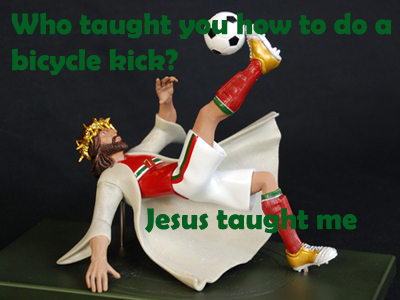
I’m super excited that the Olympics start today.  Soccer is my favorite sport, so while I’m disappointed the US men’s team didn’t qualify, the women’s team looks to make a gold medal run, and I’ll be cheering them on!  In honor of that quest, I thought I’d show you this picture of a Jesus figurine doing a bicycle kick, one of the most acrobatic and impressive ways to shoot a soccer ball.  In particular, notice the caption, which is meant to be humorous.  As fun as it would be to imagine how good Jesus might be at soccer, this picture raises a question.  Obviously Jesus did not teach someone how to do a bicycle kick.  But he did teach a lot of other things, and there is misinformation about what he taught!  We Christians can do a lot of things thinking that Jesus taught us to do them, when in reality he didn’t.

As the title of the post suggests, what comes to your mind when you think about the possible two things that Jesus did not tell us to do, but that we do…a lot?

A few years ago, I read the book Jim & Casper Go To Church, and in the book the question regularly comes up “Did Jesus really tell you to do that?”  The book is the true story of Jim Henderson, an evangelical Christian, and Matt Casper, an atheist, who travel around the United States, dropping in on worship services at twelve churches of varying stripes, shapes and sizes.  Jim and Matt spend time discussing what they experience, and numerous times, in response to what he has seen at a particular worship service, Matt asks Jim “Did Jesus really tell you to do that?”

Most often Matt asks that question in critique of churches that have placed great emphasis on buildings and highly-produced worship experiences.  Matt’s is a penetrating question.  I ask you to think about it because the answer is very easy to come by.  Just take a few hours and read through the four Gospels and you will find the answer.  I would suggest that there are two things in particular that we Christians do a lot of that Jesus did not teach us to do.

What are those two things?  While Jesus spent a lot of time talking about the Kingdom of God, and teaching and leading his disciples, he did not instruct them to build buildings so that they could hold worship services.

First, let’s take a look a the practice of building buildings.  On one particular occasion while the group of them were walking near the temple grounds, the disciples remarked how amazing the temple building was.  Jesus’ response went in a surprising direction.  No doubt the temple grounds were actually an astounding work of ancient architecture.  Beautiful and majestic.

If you look at some of the models recreating what the temple mount probably looked like, even the small-scale models are impressive.  The temple mount was the pride of the city of Jerusalem, the nation and the people of Israel.  But Jesus had other thoughts.  He said to the disciples “it will all be destroyed.”

Jesus was saying “Hey guys, don’t put all your eggs in that basket.  God’s doing a new thing, and it doesn’t involve a building.”  Those early Christians took Jesus’ words to heart.  For the first few hundred years of the church’s existence there is absolutely no record of Christians building buildings.  They met in homes.  Building places of worship was not the mission of God’s Kingdom.

Did Jesus tell us to build buildings?  No.  He did not.  And yet, we have, haven’t we?  Lots of them, all over the world.  Is it wrong for Christians to build meeting places?  No.  Jesus did not prohibit the building of meeting places.

But here’s where it gets murky, and where we need to be exceedingly cautious when we Christians purchase property and put up buildings.  Jesus’ comments about the destruction of the temple suggested to the disciples that they not become enthralled by buildings.  Though God had made a building, the temple, to be a central element of his interaction with the nation of Israel in the past, God was now doing a new thing.  God was relating to people through a new means, and Jesus himself was paving the way for that new relationship with God.  After Jesus’ death and resurrection defeated sin, death and the devil, making it possible for our sins to be forgiven and for us to have a restored relationship with God, the temple was unnecessary.  It was at the temple where sacrifices for sin were made, atonement for the nation.  But through Jesus’ sacrifice, the old system of sacrifice and the temple that housed it became obsolete.  In fact, one of Jesus’ earliest followers, Paul, would go on to write that we, Jesus’ followers, are the temple of God.  Amazingly, wonderfully, God lives in and with those people who give their lives to become his disciples.  We no longer go to a building to meet God, he is always with us.  So when we endeavor to build a building for gathering, we should be very sober-minded about it.  It is all-too-easy for that building to dominate the life and ministry of our church family.

Very much related to building buildings, there is a second practice that Jesus did not tell us to do.  He did not teach his disciples to have worship services.  Again, read through the four Gospels and you won’t find a shred of teaching about having worship services or what they should include.  For as much energy and money and personnel as we Christians put into our Sunday gatherings, you’d think there would be at least a little bit of teaching from Jesus about it.  There is none.

But once again, I ask, just because Jesus doesn’t mention it, does that mean it is wrong to have worship services?  No.  While Jesus’ disciples and the other writers of the New Testament mention nothing about building buildings, they do mention worship gatherings quite a bit.  In fact, we read in Acts that the early church did gather regularly, and perhaps, in order to commemorate Jesus’ resurrection, carved out time for a worship gathering on Sundays, which in their culture would have been the first day of the work week.  It would be like us worshiping each week on Monday nights.  Early in the second century AD, before the church was even 100 years old, there is also clear evidence, through the writings of Justin Martyr, who was discipled by John the Apostle, that Christian worship gatherings had standardized orders.  None of this is wrong.  In fact, like the building of buildings, a regular day of the week for worship, and orders of worship services, can be used for good.  But to answer Casper’s question, Jesus did not teach us to do this.  And if we are honest, we have placed an enormous emphasis on it.

At one particular church worship gathering that featured a large building, smoke machines, video screens, and a highly produced service of worship, Casper was particularly incredulous.  “Really?,” he asked Jim, “Did Jesus ask you guys to do this?”  But we need not focus on a spectacle like that.  The reality is that even tiny churches that cannot afford an expensive production can still invest a lot of time, energy and money into their worship gathering.  I would guess that tiny churches invest probably a very similar percentage of their resources into the Sunday worship service as a megachurch.  I do not know this for a fact.  I simply suspect it is probable.  Consider the salary the staff makes, and how much of their time is directed to Sunday morning.  Consider the infrastructure of buildings, utilities, equipment, and upkeep.  Consider the volunteers and all the hours they put into meeting, planning, lessons, practice.  Add that all together, and let us humbly remember that Jesus did not tell us to do any of it.

What remains, then, is to ask, “What did Jesus tell us to do?”

Join us Sunday, August 7, 2016, at Faith Church to find out.

How to rehab a relationship

Do you have relationships that need rehab?  There is help!  Fellowship!

In the very first account of how the earliest Christians interacted with one another, Acts 2:42-47, we read that they devoted themselves to the fellowship?  What is fellowship?

That word “fellowship” in verse 42 is defined by Louw & Nida as “an association involving close mutual relations and involvement.”

This passage describes how these first Christians practiced fellowship.  They clearly had close mutual relations and involvement.  Their relationships went far beyond just seeing people for an hour or so on a Sunday morning at church.  They didn’t have Sunday morning church.  They had no church building. Instead we read that they were together often, meeting in the temple in Jerusalem (presumably for larger group gatherings), and then sharing meals in homes.  Everyday.

When you read the whole description, they were sharing not just meals, but their whole lives.

Jump ahead a few chapters to Acts 4:32-37, and here we see more information about how the first Christians shared life together.  People would sell off property in order to raise cash to help those in need!  They saw none of their possessions as exclusively theirs, but as capital they liquidate if needed to help the suffering.

From Acts 2 to Acts 4 our best estimates are that only a few months have gone by from the very first day of the church.  That means Jesus was still very, very close in their hearts and minds.  And what are these first Christians doing? They are following his teaching.  We’ve seen how they are interacting with one another.  Why did they do this?  Jesus taught them to! What did he teach them?

In the final hours before he was arrested, put on trial and killed, John 13:34-35 tells us about the last teaching that Jesus gave his disciples: “A new command I give you: love one another as I have loved you.  By this all men will know that you are my disciples, that you love one another.”

Relationships in the church, Jesus taught, should be clearly known by love.  Can it be said of you that you are loving the people in your church?  How do we practice this love?

In Romans 12:9-21 Paul says “weep with those who weep, mourn with those who mourn.”  We need to walk with people through the difficult aspects life.  We need to be there for them to talk, we need to listen, we need to allow them to face sorrow knowing that people who love them are right by their side.

In that same passage Paul also says “rejoice with those who rejoice.”  Loving relationships include celebration. Lots of celebrations happen for married people (bridal and baby showers, etc). But what about celebrating people and events that would be considered unconventional in our culture?  The church needs to celebrate singles as well, when you get jobs, new houses, or achieve accomplishments.  We also need to spectate at your hobbies, your sports, your extracirriculars.  We churches should throw more parties!

We can also look to deepen relationships.  Like the early church, one excellent way to deepen relationships is to have people over to your homes.  Get to know them.   Start with the people in your Sunday School class.  Invite them to your home!  Maybe then move on to the people in your small group.  Who are you doing life with?  Who are you caring for in ways that push your comfort zone a little bit?  Call them, text them, email them, go out for coffee.  Take the initiative to care for them.  Fellowship has to go beyond the structured programs.

Certainly not all people and all personalities aren’t going to be best of friends.  Some personalities connect more easily with others.  For example, Jesus, though he had hundreds of followers, focused on twelve.  Within that 12, he focused on his inner circle of three: Peter, James and John.  And even within that three, there was one who was called his Beloved, his best friend, John.  But Jesus was certainly focusing on others, doing life with them, sharing meals, talking through real life issues, and he did that for more than 1 or 2 hours a week.

Are you doing life together with people like the early church did, like Jesus did?

In this Growth Process sermon series, I said in the last sermon that Jesus doesn’t just want Sunday morning worshipers, he wants people to worship with their entire lives.  That means moving on to Fellowship.

But Fellowship isn’t just hanging out with people on a Sunday morning for 15 minutes, or even going to the church picnic or Family Night.  The kind of Fellowship that Jesus desires for his followers must be marked by “love one another”.

I’m not saying that you have to be best friends with everyone in your church family.  That’s not possible, even for a congregation that is less than 50 people.  But it is possible to get really close to a smaller group.

So have you moved beyond being a Sunday morning worshiper to becoming a fellowshipper?

How does a disciple of Jesus move beyond just Sunday morning fellowship into “love one another” and “life together”?

Examine your life and your relationships.  Pour your life into one other.  Love and reach out to those who are more difficult for your personality to love.  And to those who you are already in relationship with, seek to go deeper, interact more. Pray for and encourage one another on a new level.

Do you have relationships that need rehab?

Do you have any people in your life that you feel are just hard to get along with?  Think about the people in your family.  Any family members rub you the wrong way?  What about school?  Is there a person that you really struggle with?  Maybe that classmate, when you see that they are in your class, you immediately know that class is going to be a drag?  Maybe they are the know-it-all who raises their hand constantly to answer questions.  Or maybe they raise their hand to ask a million questions, and you think to yourself “just let the teacher teach!”  Or maybe it is the teacher that you don’t like.  Their style, their voice, their mannerisms.  Is it your co-worker or your boss?  Many of those same tendencies that bugged us about students and teachers are the same tendencies that irritate us about our co-workers or our boss.  The group projects where one person is lazy.  The boss or teacher that is demanding.  The classmate or coworker that is loud and boisterous and arrogant.

But thank God we never have these issues in the church.

Ha!

You’re laughing…or you should be…why?  Because we DO have the same problems.  As many pastors joke, the church would be great except for the people.  That’s funny because the church is the people, and the pastor is one of the people too.  I am the pastor, and I might be the one you think is difficult!  I hope not, but I know it can be true because of interactions I’ve had with people in the past.  I’ve been at Faith Church nearly 14 years.  In that time I’ve seen many times that it is impossible to please all the people all the time.

But I want you to be clear that I believe about myself something the great English writer G.K. Chesterton is said to have written in a letter to the editor.  A British newspaper asked for people to write letters answering the question “What’s wrong with the world today?”  Lots of people responded with many ideas, but it was Chesterton’s reply that was the most memorable…and the shortest.  What’s wrong with the world today?  Chesterton answered “Dear Sir, I am.  Yours, G. K. Chesterton.”

So we do have issues in our relationships in the church, all churches do, and I would be remiss if I didn’t see myself as part of it.  I also want to be part of the solution.

You may have heard the comment that if you found the perfect church, don’t join it.  The moment you would join it, it would cease to be perfect.  There is no perfect church.  Because you and I are a part of it.

What is all this suggesting?  That relationships in the church can be hard.  We people can rub each other the wrong way, offend one another, hurt each other.  But relationships in the church can also be wonderful.  This coming Sunday we continue our series called Our Growth Process.  We’re at Step 2 – Fellowship, which is all about relationships in the church.

As you get ready for gathering for worship on Sunday, I want to ask you, who are the people in your church family that you have the hardest time with?  Just visualize them.  And pray that God will speak to you about your relationship with them.

Join us on Sunday at Faith Church to learn more!

Why our worship services are not good enough (and God might even hate them)

Worship services could actually be keeping us from worship.  Sound impossible?

Peter Rollins, in his book Insurrection, suggests that it’s actually very possible.  In the Old Testament, God pointed out to the nation of Israel that their worship was not acceptable to him.  They were going through the motions of worship, but they weren’t actually worshiping him.

Consider what God said in Amos 5:21-23:

“I hate, I despise your religious feasts; I cannot stand your assemblies. Even though you bring me burnt offerings and grain offerings, I will not accept them. Though you bring choice fellowship offerings, I will have no regard for them. Away with the noise of your songs! I will not listen to the music of your harps.”

And then there is this in Malachi 1:10:

“Oh, that one of you would shut the temple doors, so that you would not light useless fires on my altar! I am not pleased with you,” says the LORD Almighty, “and I will accept no offering from your hands.”

Clearly there were times when Israel’s worship was detestable to God.  What if our worship is also?

This past Sunday I started a summer sermon series called Our Growth Process, through which we’re looking at how disciples of Jesus can grow to be more like him.  Last week I suggested that the foundation to this Growth Process is to learn to focus on the Kingdom of God.  We have for too long focused on church, on church buildings and systems, whereas Jesus taught about his Kingdom.  People who want to grow as disciples of Jesus focus their lives on Kingdom of God, and how it enters our lives and world, transforming them.  So where do we begin?  With worship.

But what if the way we do worship is focused on the church rather than the Kingdom?  What if worship is actually keeping us from the transformation that God wants to bring in our lives?  Rollins thinks it could be.  But why?  And is he right?

In Romans 12:1-2, one of the earliest followers of Jesus said this:

“Therefore, I urge you, brothers, in view of God’s mercy, to offer your bodies as living sacrifices, holy and pleasing to God—this is your spiritual act of worship. Do not conform any longer to the pattern of this world, but be transformed by the renewing of your mind. Then you will be able to test and approve what God’s will is—his good, pleasing and perfect will.”

Paul says we should offer our bodies as living sacrifices, but sacrifices are usually dead.  A sacrifice could be an animal.  A grain offering.  Money.  All dead stuff.  A sacrifice is also that which is given over to something or someone else.  In this case, Paul says we are the sacrifices.  We are not dead, but alive, and thus when we offer our bodies as living sacrifices we give our lives over to God, such that our lives are used the way he wants. Paul calls this our act of worship.

That might sound like a lot.  In fact, it is a lot.  Giving up of our entire life over to God?  What more could there be!  Is God asking too much?  Paul says it is reasonable for us to give our lives as living sacrifices because of God’s mercy.  The word “therefore” at the beginning of verse 1 points back to chapters 1-11 where Paul goes into detail explaining how far God went to show us mercy.  He gave his own son out of love for us.  Jesus gave his life to us. So therefore it is reasonable that we give our lives back to him.  This is worship.

Too often we look at worship as what we do in a church building for an hour or so on Sunday.  Paul’s teaching in Romans goes way beyond that.  When you give your body as a living sacrifice, you are striving to worship the Lord all day every day.  How in the world do we worship all day every day?  Is Paul suggesting that we need to be singing praise songs nonstop? That we need to listen to sermon podcasts every day?

A few years ago I was at the gym running on the treadmill listening to music on my phone.  A praise song came on, one of my favorites, and right there in gym pounding away on the treadmill, I was praising God, even getting emotional about it.  Is that what Paul meant?  I certainly don’t listen to music every time I run.  In fact, I almost always run without listening to music.  And in my car I prefer to listen to podcasts or books on CD.  So I have to confess that I don’t sing or whistle or even think about worship music all day long.  How about you?  What could it possibly mean to give ourselves as living sacrifices?

When I think about people who get connected to Faith Church, Sunday morning worship is most often where it starts.  We’re very glad for guests on Sunday morning.  We’re happy when people continue to attend worship.  But there is a serious concern if people only worship on Sunday morning.  Being a living sacrifice means that we need to move on to a life of worship.  So attending the Sunday morning worship service, while very important, is not enough to qualify as a genuine disciple of Jesus.

In Matthew 7:21-23 Jesus gives us a sobering warning about this:

“Not everyone who says to me, ‘Lord, Lord,’ will enter the kingdom of heaven, but only he who does the will of my Father who is in heaven. Many will say to me on that day, ‘Lord, Lord, did we not prophesy in your name, and in your name drive out demons and perform many miracles?’ Then I will tell them plainly, ‘I never knew you. Away from me, you evildoers!’”

Jesus is referring to people who looked outwardly like true disciples.  People can come to worship services and look outwardly like true disciples.  But Jesus says that though those people looked good, they clearly did not have what was important!  They did not have what mattered, and he says “away from me.”  What is scary is that those people thought they were good to go. They assumed that Jesus should accept them.  But they were wrong.

Likewise, our worship services are not enough.  If all a Christian does is attend worship services they do not have the kind of relationship with Jesus that he wants.  This is why worship services can be like a security blanket, as Peter Rollins says.  I’m going to rely heavily on what Rollins says in the discussion below.

Rollins asks us to imagine the scenario of a child with his blankie accidentally wandering into a room full of adults who are strangers to him.  But he has his security blanket and feels safe.  The child does not feel fear that should normally be there.  In his mind, he feels okay.  Why?  His blanket is providing an emotional safety net.

Take away the blanket and the child doesn’t gain new information or discover something that was being withheld.  He now feels the fear that naturally rises up within a child when they are in a room full of adults whom they do not know.  The blanket, Rollins says “enables the child to consciously accept a situation without experiencing the psychological horror of it.”

Here’s the twist: the blanket is not the problem.  The blanket is the solution to the problem!  The blanket allows the child to cope in a potentially overwhelming scenario.  So the blanket, the stuffed animal, the pacifier, the thumb-sucking are all helpful.  They are not bad things.

But they can become bad things, can’t they?  What will happen if we allow the child to have them too long?  The child can remain in a state of immaturity, Rollins says, and find it difficult to function in social situations as he grows.

Anything can be a security blanket.  And we adults can have them too.  Do you have one?  Something that is acting as a security blanket keeping you from growing mature.

Worship services can be like a security blanket!  Rollins asks us to imagine a worship leader one Sunday leading a congregation through songs that express doubt, anger or abandonment.  He says that a healthy, mature congregation would embrace the honesty, the doubt, the frustration expressed in the music and thus bring them closer to the reality of the Cross.  But if those songs created an anxiety in the congregation, we realize that regular happy worship is acting as a security blanket, protecting the congregation from experiencing the pain of the Cross.

It is possible then to imagine a church where the worship service is actually a security blanket protecting the worshipers from truly experiencing discipleship to Jesus.  In other words, Rollins says, we can affirm the Crucifixion without having to feel it. We are able to look at the Cross from a distance without ever needing to enter into a direct participation with it.

Much of contemporary church resembles a drug that prevents us from facing up to the suffering and difficulty that is part of life.  In the Great Depression, film worked this way.  Despite the poverty across our nation, theaters were packed, showing films about gangsters, comedies and musicals.  They offered people a way to escape their dire reality for a few hours.

Is worship a security blanket for you?

To investigate this a bit, ask yourself what qualifies as good worship?  When you leave a church worship service, and you think to yourself “worship was great today!”, what was it about that worship service that made it great?

Loud music? Vibrant, hand-clapping?  Or maybe you prefer quiet music? Hymns?  Maybe it was just that you got to sing one or more of your favorite songs?

Perhaps what made it good had nothing to do with the music.  Was it that you got to see your friends?  Maybe someone encouraged you.  It could be that the prayer time was meaningful.

Of course it could be the sermon.  When I hear the words, “Good sermon pastor!”, I ask myself, Why did that person think it was a good sermon?  What is really behind those words?

Could it be that the person was thinking “Pastor, that was a good sermon because you said everything I agree with.”  Or maybe they were think “I’m afraid of the way our country is headed, and you preached conservative values.”  Maybe it was “Your sermon encouraged me.”

In all these situations, though, is not the worshiper just affirming what makes them feel good?  By classifying it as “good worship” has the worshiper not just revealed that their approach to worship is consumeristic, whereby they the worshiper get to pick and choose what constitutes “good worship” and thus remain unaffected by it?

John Wesley once preached a sermon where likened this to being “Almost Christian”.  In an Almost Christian, nothing is missing is terms of our actual beliefs and practice; nothing is missing but participation as disciples of Jesus.   An Almost Christian is like the difference between a critic and a lover.  A critic is one who studies something very deeply.  A critic knows the minute details.  But a lover is different from a critic.  A lover is committed with his or her life.

Rollins says that when we come to worship, we participate in it either like a lover or approach it from a distance like the critic who examines every detail, observing whether or not it is “good worship” while remaining distant from its transformative power.

So our worship can be like a security blanket, keeping us from getting the real thing.  We can sing songs, worship God, hear a sermon, give money, pray, take communion, and we can walk out of here thinking “that was good worship; that is what God desires!”  We can worship on Sunday thinking that one hour of enacting religious rituals is the worship that God wants.  But God wants so much more.  Organized gathered worship in this room can leave us thinking that we have done our duty.

But true disciples of Jesus will not want worship to be a security blanket that keeps us from deeply experiencing the life transformation that God wants to work in our lives. Instead disciples of Jesus will want worship services to invite Kingdom transformation in our lives and help us to worship God as Paul said in Romans 12:1-2, with our lives, to offer our bodies as living sacrifices.

So here are some suggestions for how to move beyond a Sunday morning only kind of worship:

Keep God close.  Make prayer a habit.  Practice the presence of God.  On Sunday morning part of our goal of singing songs and praying and hearing God’s word is to have an encounter with the presence of God.  But do we walk out the doors of the church and forget about the presence of God?  If so, then make it your goal to practice the presence of God 24-7.  But how?

Habits.  In worship we learn habits that we can continue throughout the rest of the week.  The habits of daily prayer, daily reading, daily worship.

As Paul says in 1 Corinthians 6:19-20, “your body is the temple of the Holy Spirit.”  God does not live in a temple like he did in the Old Testament.  You are his temple.  He is with you!  You can experience his presence everywhere you go!  And you should!  Develop a practice of the presence of God.

Second, see all you do as an act of worship.  In 1 Corinthians 10:31 Paul says that “whatever you do, do it all to the glory of God.” Even when you eat or drink. Even work. Even laundry. Cultivate a habit of work as worship, of play as worship, school as worship.  Think about the most boring, mundane, disagreeable task as worship.  Think about the incessant flow of emails, text messages and phone calls.  Think about how grumpy that can make you.  Think about all the diapers you change, all the fights you break up, all the weeds you pull in your garden.  All of that can be done as an act of worship.

One lady at Faith Church said, “I would like to do one thing that doesn’t get undone that has to redone.”  The dishes.  The grass.  Cleaning the windows.  They all need to be done.  And you do them today and they will need to be done again tomorrow.  If you do laundry two days each week, that’s over 100 times per year.  Thousands of times in your life.  Ever feel frustrated by the seeming endlessness and hopelessness of these tasks?

Can you transform that frustrating attitude into worship?  Yes, you can!  Those small repetitive tasks are vitally important. To transform them into acts of worship starts by confessing a poor attitude, and the purposefully inviting God to change your mindset.  This transformation may require the help, the accountability of friends.  It could involved getting the help of one who has made progress in this area.  How did they change their mindset about the dishes?  About email at work?  About the mundane tasks that have been disagreeable for them?

In conclusion, I don’t want anyone to think that worship is primarily what happens in a so-called sanctuary or church meeting room on Sunday mornings or whenever or wherever your congregation gathers for worship.  What happens there is only good and acceptable to God to the degree that through this worship our lives are transformed, so that we worship him with our whole lives.  That’s what being a disciple of Jesus is about.  You cannot be a disciple of Jesus if all you do is worship him in a worship service.

I urge you then to examine your life.  What we do for an hour or so on Sundays is to be preparing us to worship through the rest of the week.  What about you?  Are you more than a Sunday morning worshiper?

Could a church worship service be a bad thing?

Did you have a security blanket as a kid?  Maybe it was a special stuffed animal or a pacifier.  Or did you suck your thumb?

I had a blanket as a child.  My own kids had a variety of security items, which got progressively bizarre.  Child #1 carried around a blanket, which we had snugly wrapped him in as an infant.  Child #2 had a stuffed lamb named Lamby (whose ear got wrapped over this particular child’s nose, held in place with the forefinger while sucking the thumb).  Child #3 also had a special stuffed pet, an elephant named Ellie.  But this child did not suck on his thumb.  Instead he sucked on the trunk of the elephant, which got very disgusting.  Not to mention that said child would regularly walk around and play with a stuffed elephant hanging out of his mouth.  Child #4 reverted quite a bit, as she just had a pacifier.

Did you know that adults have security items?  Ours tend to be a bit more socially acceptable, but if left unchecked they can become rather bizarre as well, and sometimes destructive.  Security items keep us from experiencing some part of life, usually the painful parts.  A bottle of alcohol can protect us from experiencing the stress of finances.  Netflix can help us escape from the pain of parenting or work.  Or there might be an addiction that we use to cope with the horrible memories of our past awful experience.  Do you have a security item?

Is it possible that a church worship service might be a security item?  Peter Rollins, in his book Insurrection, suggests that worship services could actually be keeping us from worship.  Sound impossible?

This past Sunday I started a summer sermon series called Our Growth Process, which will look at how Faith Church understands biblical teaching about how disciples of Jesus can grow to be more like him.  Last week I suggested that the foundation to this sermon is to learn to focus on the Kingdom of God.  We have for too long focused on church, on church buildings and systems, whereas Jesus taught about his Kingdom.  People who want to grow as disciples of Jesus focus their lives on Kingdom of God, and how it enters our lives and world, transforming them.  So where do we begin?  With worship.

But what if the way we do worship is focused on the church rather than the Kingdom?  What if worship is actually keeping us from the transformation that God wants to bring in our lives?  Rollins thinks it could be.  But why?  And is he right?  I encourage you to read the book, but I also invite you to join us at Faith Church tomorrow as we are going to look at what Rollins has to say.

How the church has gotten in the way of God’s Kingdom…and what to do about it.

The subtitle of author Reggie McNeal’s book Kingdom Come, is compelling: “why we must give up our obsession with fixing the church—and what we should do instead”.  That grabbed me!  In the book, he tells the story of when he was at a conference for pastors and said this:

 “We’ve been working at fixing the church for the past 500 years…how’s that going for us?”

500 years ago a German Catholic Priest named Martin Luther nailed a piece of paper to the door of his church in the town of Wittenburg, and in so doing he started quite a ruckus.

Some people get confused because there was another Martin Luther who was very famous.  Martin Luther King, Jr.  I’m not talking about MLK.  I’m talking about the guy MLK was named for.  THE Martin Luther.  THE Martin Luther was going through a major change in his view of the church.  He had been a Roman Catholic his whole life, and he was a priest for many of those years.  A very devout priest.  But he was disheartened by things he saw in his church.  So he got to the point where he wanted to do something about it.

He wrote out his concerns, all 95 of them, which are famously known as his Theses, and he tacked them to the door of his church for all to see.  That was before Facebook.

Luther took a lot of heat for this.  In fact, he nearly lost his life because he refused to recant.  He held firm to his concerns and eventually started a whole new movement.  Luther was protesting against the church.  He wanted to reform it.  You put those two words together, “protest and reform”, and you get the title that we have given to Luther’s movement: the Protestant Reformation.

That was nearly 500 years ago.  Just like Luther, we have been trying to change the church ever since.  McNeal asks a good question:  How is that going for us?

In the short years that I have been involved in church, starting in late 80s and early 90s, as McNeal points out, we’ve seen a personal evangelism movement, a church growth movement, the worship wars, a church health craze, the megachurch movement, the emergent church, and plenty of theological debates.  How is that going for us?

A guy who studies the church, Ed Stetzer, has recently published studies that have extensively examined religion in America.  Guess what?  Do you think all those attempts at fixing the church have helped?  Nope.  The mainline church is declining particularly fast.  Thankfully the Evangelical branch of Protestantism is not declining nearly as much, but we, too, are seeing small declines.

You know what McNeal says?  “Why not just do what the church should be doing?—partnering with God in his redemptive mission in the world—and let the overflow of that effort bring about the renewal we’re looking for?”

Basically he is saying that we need to tell our story differently!  Or as a friend at church so often tells me, we need better PR!  Think about it:  What story have we told?

Faith Church tells our community a story.  There’s the story that we think we’re telling, and there’s the story that the community is hearing.  They might be two different things.

I recently talked about why we’re removing the word “Evangelical” from our church sign.  Better PR.  The word “evangelical” no longer means what we want it to mean.  We know that it means “Good News” and in Jesus there is very good news.  But people in our community might not know that.  Instead they think “evangelical” is about a political group, and in the last 25-50 years or so that political group does not have good news.

We might be thinking that we are clearly and compellingly telling the story of the Good News, but is it possible that our community has heard what we’re saying and at least some of them are not thinking that we are speaking about Good News?

What we need to do is go to Jesus and the story that he told.  What story did he tell?  In the the four Biblical accounts of Jesus’ life (aka the Gospels: Matthew, Mark, Luke and John), the word “church” is used three times, all in Matthew and each time referring not to a church building, but instead referring to a gathering of people.

Guess how many times Jesus used the word “Kingdom”?  Over 100 times.  It was his core message.  You do not have to look far in the Gospels to find it.  I recently preached a sermon series through the Gospel of Luke. In chapter 1, verse 33, before Jesus is even born we read a reference to his Kingdom.  The angel Gabriel, when he came to Mary to tell her that she would be the mother of the Messiah, said that her baby have a kingdom that would never end!

When Jesus started his ministry, which we read about in Luke 4:42-44, one of the first things he teaches is  “I must preach the Good News of the Kingdom of God.”

  • No less than 38 times in the book of Luke alone is there a mention of the Kingdom of God.
  • In Mark, it is mentioned 15 times.
  • In Matthew where it is predominantly called the “kingdom of heaven” it is referred to 50 times.
  • John mentions it 4 times.

So, for Jesus, the Kingdom of God is an extremely important concept.  Has our community heard from us that the Kingdom of God is an extremely important concept?

Or have they heard about church?  If you look at Lancaster County, and you evaluate the message of church vs. kingdom, what do you see?  You have to put yourself in the position of a historian who is looking at our society hundreds or even thousands of years of later.

I got to experience a bit of that perspective recently in Cambodia.  We were there because of my wife, Michelle’s, work with Imagine Goods.  It was also our 20th anniversary, so we took two days to visit the ancient temples near Siem Reap.  After a six-hour bus ride from Phnom Penh to Siem Reap, we realized that we were in tourist central because of the ancient temples.

Angkor WatThey are considered to be one of the 7 Wonders of the World.  Called Angkor Wat after the name of one of the largest and best preserved temples, there are actually many temples in the surrounding, large area.  Scientists are still making discoveries about the ancient civilization that built the temples.  Recently they have fitted airplanes with laser scanners and they have flown hundreds of hours scanning the jungle around the temples.   The results of these scans have been staggering.

Angkor Wat laser scanThey have uncovered foundations of cities that jungle had long since hidden.  The scientists estimate that in its heyday, the kingdom around Angkor Wat had a million people.  It was larger than London at the time!

So hundreds of years later these scientists are learning new information about this Cambodian kingdom.  Why did the ancient Cambodians do what they did?  Obviously building temples was really important to them.  I have seen pictures of Angkor Wat many times, as Michelle and teams from Faith Church had explored there.  But seeing the temples in person brought them to life for me.   I got to climb the steps and stones, and walk down the long temple hallways staring astounded at the detailed carvings depicting the wars and glory and power of the king.

What will people 500 or 1000 years in the future say about us?  One thing is for sure, they will say that we were very aggressive about building church buildings.  And they will look at our Scriptures, the New Testament, and there is a probability (I think a high probability) that they will be very confused.  Why?  Because our Scriptures say nothing about building church buildings.

While Jesus, who we believe in, trust in and seek to follow as his disciples, taught a lot about his Kingdom, Christianity in the 1900s and now into the 2000s has continued a trend which has been going on for a long time, the building of church structures of all shapes and sizes.

This should cause us to step back and think: why do we build buildings when Jesus said that we should build his Kingdom!

It goes deeper than just buildings.  There is more.  When you think of your church, think of what you put emphasis on.  There might be staff that you pay.  There might be systems of leadership and ministry.  Quite honestly, our church has many similarities to an organization.  There are many times I feel much more like a CEO than a pastor.  Jesus didn’t tell us to build an organization with buildings.  He put all the focus on his Kingdom.

I’ll never forget a seminary class I took about churches and transitions.  We had numerous guest speakers come to the class, and one was a pastor who talked with us about the amazing growth of his church.  They started small and ended having to buy a large property with all the bells and whistles of large churches that have become so familiar to us.  Did that ever get my attention!  I’ll be honest with you: I thought “That’s what I want Faith Church to become!  I want Faith Church to become the biggest church in our denomination! I want to be able to walk into EC National Conference each May knowing in my head, not having to say a word to anyone, that Faith Church, where I am the pastor, is the biggest church out of everyone in that room.”

Do you think I was giving much credit to God and his Kingdom?  Of course I said I was all about God and his Kingdom, but looking back on it, I wanted to build the church, MY church, OUR church.  I had an unhealthy perspective on church.

One of the most helpful books I read about this was Pagan Christianity by Frank Viola.  He shows through loads of research that pretty much everything that we are used to when we think of church systems comes not from biblical teaching but from Christians through the ages trying to keep up with the spiritual Joneses.  Most times they were trying to keep up with pagan culture.  The pagans, for example, had a big religious celebration at Winter Solstice.  So the Christians decided to keep up with them by having a competing celebration.  You know what that competing celebration is?  Christmas!

Do you think Jesus was actually born on December 25th?  Highly unlikely.  We have no idea what day Jesus was actually born.  What we do know is this: Did Jesus tell us to make a big deal out of celebrating his birthday?  Nope.  Is it okay to celebrate his birthday on December 25th every year?  Sure is, but we need to remember that Christmas is a churchy thing, not necessarily a Kingdom thing.

It goes deeper than church buildings and Christmas. We would do well to examine everything that is normally considered to be church.  A sanctuary with pews.  Sunday School.  Youth Ministry.  An order of worship, and a worship service that lasts about an hour or so.  If we seek to find the origins of those structures and systems in the New Testament, Viola shows us our search will come up empty.  That means a church can still be a church without those structures.  Again, hear me.  I am not saying that church, and all the trappings of church that we are used to, are bad.

I better be careful because another element that is normally considered a pretty big part of church is the pastor.  That’s me.  But the way we employ pastors and our typical pastor’s job descriptions are not in the Bible. Yes, the Bible talks about pastors and paying them.  And the Bible has a couple places where it talks about what pastors should do.  Guess what, though?  What the Bible says about pastors and what they should do is very different than what pastors have done, and what people assume pastors should do.

For example, in Ephesians 4:12 Paul says that pastors should train people up to the do the work of ministry.  But for decades the pastor was seen as the person the church paid to do the work of ministry.  Consider the vending machine.  You put your money in the slot, make a selection, and out pops your soda, candy bar or bag of chips.  Same with pastors.  You put your money in the offering, and your pastor gives you a visit, a funeral, a prayer.  In other words, the normal conception has been that the pastor is the one who is paid to minister to the people, whereas Paul says the pastor is train up the people to do the ministry.

I want to be clear at this juncture:  There is a major difference between church and kingdom.

It is okay to have church, to have church buildings, to have Sunday School and pastors, but ONLY so long as they serve to promote the Kingdom.

Remember when Jesus taught us to pray the Lord’s Prayer?  Here are the first few sentences:

Our Father which art in heaven, hallowed be your name.

Your Kingdom Come, your will be done, on earth as it is in heaven.

Notice what is missing?  No mention of church.  Jesus did not teach us to pray “Your church come” .  Here’s why: the church was never permanent.  The church was always meant to build the Kingdom.  The church serves the Kingdom, not the other way around.  The kingdom is forever, the church is not.

The kingdom, as Jesus taught us to pray, is about God’s will being done on earth as it is in heaven.  That’s what it means for his Kingdom to come.  Normally when we think of God’s Kingdom, we think of heaven, and we think of heaven as a place we go to.  When we die, we are no longer on earth, we have left the earth, and we go to heaven.

But notice how Jesus taught us to pray something completely different!  Have we been praying that prayer all our lives and missed it?  “Your Kingdom come, your will be done, on earth as it is in heaven.”

God wants his Kingdom to reign and rule right here and right now!  He wants his will to be done on earth.  His will is already being done perfectly in heaven.  So just as the will of God is being followed perfectly in heaven, God wants his will to be followed more and more here on earth. That is what Jesus taught us to pray, because that was his mission and he wanted it to be our mission.

To expand on what that mission was all about, he said to his disciples that they should make disciples, who will make disciples, who will make disciples.  He did not suggest that his disciples should group up those new disciples, build buildings to meet for worship and try to make those churches famous.  He told them to make disciples so that more and more people would allow God to reign and rule over their lives, so more and more people would experience God’s Kingdom and have not only the hope of eternal life, but also the experience of what he called abundant life here on earth.

When we allow God’s Kingdom to come into our lives, we experience life transformation.  One of Jesus’ first followers, a guy named Paul, experienced this life transformation.  He changed dramatically from being a vicious man, arresting and jailing and killing Christians, to being perhaps the most powerful Christian missionary ever.

Paul talked about something he called the Fruit of the Spirit: love, joy, peace, patience, kindness, gentleness, faithfulness, self-control.  What happens when you allow God’s Kingdom to rule over you is that you are transformed first and foremost.  Disciples of Jesus experience transformation.  Your inner life is transformed, Paul says, because you are the temple of the Holy Spirit.  You don’t go to a temple.  Now God lives in you.  Faith Church has a building where we go.  We gather at worship services to worship God and hear from him.  We plan our worship services around that idea that people can experience God in worship.

But those buildings are not God’s houses.  I know it is popular to call church buildings  “God’s House.” It is not true. Those buildings are not God’s houses.  The rooms where we meet for worship are not some special rooms.  We have an Ethiopian Orthodox church that rents worship space from us.  The Ethiopian worshipers take off their shoes when they enter the sanctuary.  I am not well-versed in their theological reasons for taking of this practice.  Maybe they view the sanctuary as holy ground, like Moses took off his sandals when he approached the burning bush where God was.  Or maybe they are just symbolizing that event and a heart of worship. Our sanctuary is not like the ground around the burning bush.  I have no qualms with the Ethiopian church practice, but if they believe that the sanctuary is holy ground, I disagree.

We call it the sanctuary as if it was special.  As if God lives here.  He doesn’t.  If we are true disciples of Jesus, God lives in us.  That means we ourselves should be experiencing that transformation God wants to work in us, and the Fruit of the Spirit should be flowing from us.  As we are changed, we experience God’s abundant life in us.

If you are an impatient person, God’s Kingdom coming more and more in your life means that you grow more patient.

If you are a person with a dirty mind or a dirty mouth, God’s Kingdom coming more and more in you means that your mind and mouth become more clean.

If you are a complainer, you grow more content.

If you are a rough, you grow more gentle.

If you are pessimistic, you grow more joyful.

God’s Kingdom coming into your life means that you are transformed.  But it doesn’t stop there. God’s Kingdom comes into society and society is transformed.  Remember how Jesus, very early in his ministry in Luke 4, returned to his hometown and preached in the synagogue there?  He told the people that day what his mission was all about:

“The Spirit of the Lord is on me, because he has anointed me to preach good news to the poor.  He has sent me to proclaim freedom for the prisoners and recovery of sight for the blind, to release the oppressed, to proclaim the year of the Lord’s favor.”

He was reading from Isaiah the OT prophet, and Jesus said that this prophecy was fulfilled in him.  It describes the rule and reign of God’s Kingdom transforming society.

The poor, the prisoners, the sick, the oppressed, all experience God’s Kingdom.  I saw this maybe as clearly as I have ever seen it in Cambodia.  Through the efforts of Imagine Goods’ partner organization there, Agape, a whole town is being transformed.  Where once the town was a center for human trafficking, it is now a place of hope and a future.  Where once women and children were slaves, now there are safe living places, a school, a church, and great jobs which have pulled families out of poverty, out of slavery, and the criminals have left.  God’s Kingdom is on full display though.  It is beautiful.

That’s why I’m thankful that Faith Church is such a strong supporter of the CV Ministerium and CVCCS.  Those two local organizations are not about a church building.   Instead they are promoting the Kingdom of God.  They spread the Good News of Jesus’ death and resurrection and our hope in him, and they seek to promote God’s Kingdom so that it will transform society.

A few months ago I created a possible future scenario of Old Philly Pike, the road our church property is located on, needing to be widened and our church sanctuary having to be torn down?  Some of you thought I was telling a true story!  But even if it was true, you know what?  That would be okay.

Our mission is not to maintain a building.  Our mission is not to make Faith Church’s name great.  Our mission is not to be a large church that everyone thinks “Wow. That church is going places.”

No, our mission is to promote the Kingdom.  And that is what this new sermon series is all about:  Our Growth Process.  To be disciples of Jesus who make disciples for Jesus, so his name and his Kingdom are the focus!  Because he is the one, and he alone, that transforms people’s lives and through transformed people he transforms society.

And so we pray:

Our Father which art in heaven, hallowed be your name.

Your Kingdom come, your will be done, on earth as it is in heaven.

Give us this day our daily bread,

And forgive us our sins, as we forgive those who sinned against us.

Lead us not into temptation

But deliver us from evil

For yours is the Kingdom and the power and the glory forever. Amen.
Why we’re getting rid of the word “evangelical” from our church sign

Evangelicals are in the news!  Donald Trump recently met with Evangelical leaders.  I have seen so many articles about Evangelicals and politics these past few weeks.  Some signaling the demise of evangelicalism.  Some talking about the decline of evangelical influence.

What in the world is an Evangelical, anyway?

2016-07 Church Sign - Pokemon GoWe are Faith Evangelical Congregational Church.  We normally call ourselves just “Faith Church” because the words “Evangelical Congregational” are long.  It’s much easier to say “Faith Church.”

So we are Evangelical.  But what does that mean?  Why are we Evangelical?

If we go by what we hear in the world out there, we can wonder “Is being Evangelical a good thing or a bad thing?”  Obviously we at Faith Church wouldn’t use the word unless we thought it was a good thing, a biblical thing, a word that would be helpful to the mission of God’s Kingdom.

So the first way to answer these questions is to go back to our historical denominational connection.  Our denomination’s name is “The Evangelical Congregational Church.”

Right around the year 1800 a man named Jacob Albright from Ephrata PA started preaching about Jesus to the German-speaking people, mostly farmers, here in Lancaster County.  God used him mightily and he launched a number of house churches based on the Methodist model because he was discipled and licensed to preach by the Methodist Church.  This group of house churches took the name Evangelical Association (EA).  Albright passed away when the EA was still young, but he and the first leaders laid a foundation for expansion, and expand it did.  Across the country and to many places around the world.

But sadly, the Evangelical Association had growing pains, a big split, then a merger, and eventually, a bunch of the churches trying to be faithful to Albright’s original vision created a new denomination called the Evangelical Congregational Church (EC) in 1922.

Most of our EC churches are in Eastern PA, but we have some in Western PA, Ohio, Illinois and a spattering of other places.  Our headquarters in based in Myerstown, Lebanon County, where we have the denominational offices, then across the street the seminary, and across the street the other way, the retirement community.  Drive up Route 501 through Myerstown and you’ll drive right by all these places.

In the late 1960s one the oldest and largest Evangelical Congregational churches at the time, Grace EC Church in the city of Lancaster, on the corner of South Shippen and Locust streets, had a bunch of people driving into town from the East Lampeter area.  So their pastor David Heil had a vision to start a new church plant out this way, and that’s how Faith Church got started in 1968.  We will celebrate our 50th anniversary in 2018.  It was, therefore, the Evangelical Congregational Church that started us.  We are and have always been a part of the EC Church.

That is the first reason why we have the word “Evangelical” in our name and on our sign.

But is that important?  In 1968 it was really important because the name “Evangelical” meant something important, and most people in the community knew what it meant and they understood it to be a good thing.

What did they actually understand?  What does it mean to be evangelical?  Why don’t we just call ourselves Christians?  To answer that, we need to go way back before 1968 to learn what the word “evangelical” means.

The word “evangelical” is a word straight out of the Bible.  It is actually an English transliteration of one of the Greek words that was used to write the New Testament.  The word evangelical is the Greek word euangelion.  See how similar they look?

In Greek euangelion is the Good News, and in particular it carries the idea of proclaiming the good news.  It was not specifically a word about Jesus or the Bible.  It was used, for example, to describe the birth of the new Roman Caesar, the emperor.  “Good News!  A new leader has been born.”  The Caesars, the emperors, wanted their people to believe that they were God in the flesh, they wanted people to worship them and they wanted people to proclaim them as savior.  The emporer wanted the people to use the word euangelion about them.  Good News! Caesar is born, Caesar is God, and Caesar is Lord.

When the New Testament writers started using this concept about Jesus, they were making a big statement:  there is other good news, there is another savior, there is another Lord.

So the focus of euangelion, or to use the English, evangelism, was to proclaim the Good news about Jesus!

When you read the English word “Gospel” which is found in the New Testament writings quite often, you are reading the Greek word “euangelion”.  For example Paul says in Romans 1:16:

I am not ashamed of the gospel of Christ: for it is the power of God unto salvation to every one that believes.

That focus is very important to remember! There is Good News!  Evangelism pointed to a very good thing. Evangelism was the act of proclaiming the good news about Jesus.  When you think of evangelicals, then, we are people who speak about Good News.

So why is there an Evangelical church?  Shouldn’t there just be a Christian church? Aren’t all Christians supposed to proclaiming this Good News?

Well, a few centuries ago, a number of Christians felt that the mission of proclaiming the Good News of Jesus as the Savior had been lost in the institutional approach Christians had been using for church.  So some Christians and churches started to promote the idea that we Christians need to get back to the wonderful task of proclaiming good news.  Because of their focus on proclaiming the Good News, they became known as the Evangelicals.

That was Jacob Albright’s focus.  Remember that he wanted to preach the Good News to the German-speaking farmers in this area?  They were all church people. But the churches they attended focused more on the institution of the church rather than on the Good News.  Albright himself had always gone to church but he had never heard the Good News.  After hearing the Good News from a traveling evangelist himself, and after deciding to follow Jesus, Albright had a passion that his fellow German-speaking Lancastrians would know the good news of Jesus too.  Albright became a traveling evangelist, literally riding on horseback from town to town, from house church to house church, and many people heard the Good News.

Thus the Evangelical movement started.  It featured revival meetings, camp meetings, and so on.  As the years went by, house churches got organized, and as house churches grew they built church buildings and started denominations.  Albright wasn’t the only one.  There are many evangelical denominations: Evangelical Lutherans, Evangelical Free, and many more that don’t have the word “Evangelical” in their name.

There are some beliefs that we have that are uniquely evangelical, ones that we feel are quite important and good.  That takes us into understanding more about the uniqueness of the evangelical movement.

The National Association of Evangelicals, on their website, says that evangelicals usually hold to these four things:

  1. Conversion & Discipleship: the belief that lives need to be transformed through a “born-again” experience and a lifelong process of following Jesus
  2. Outreach: the expression and demonstration of the gospel in missionary and social reform efforts
  3. The Bible: a high regard for and obedience to the Bible as the ultimate authority
  4. Cross & Resurrection: a stress on the sacrifice of Jesus Christ on the cross, and his victory over sin and death, making possible the redemption of humanity

This explains what Evangelicals believe the Bible teaches about God’s Good News for humanity.  So why would we want to change our sign?  It’s sounding like the word “evangelical” is a very good thing.

Here’s the problem.  In 1968 when Grace Evangelical Congregational Church planted a new daughter church in East Lampeter, the surrounding culture thought of Evangelicals in a good light.  Fast-forward 50 years. When people in our society now think of the word “evangelical” what comes to their mind?

One way to learn is to search for the word “evangelical” on Google.  The results are very interesting.

Based on that history I just told you, if you google “Evangelical”, there should be something about Good News, wouldn’t you think?  There should be something about how God loves the world so much.  There might be our favorite evangelical Bible verse, John 3:16: For God so loved the World! That is awesome Good News.

But when we Google “Opinions of Evangelicals”, there is a surprising result.  Take a look right now.  See for yourselves.  What are some of the results?

Any images of Good News?  No.

Instead we get images of politicians.  And furthermore when you talk with people what the term “evangelical” means to them, you get a wide range of mostly negative responses.  Evangelicalism has become mixed up with politics.  Evangelicals are considered to be a voting bloc, and people have the impression that evangelicals are Republicans who are against so many issues, rather than for the Good News.

One evangelical scholar recently said this: “Due to the secular media’s ongoing misguided and misleading effort to define “evangelical” as a political posture, people are naturally confused when they discover that I am a lifelong, “card carrying” evangelical.  The National Association of Evangelicals adamantly rejects any identification of “evangelical” with a particular political ideology or even posture. Historically and theologically that is correct—even if most people in the United States who identify themselves to pollsters as “evangelical” also identify as conservative Republicans.”

When people think of the word “evangelical” they are not excited about Good News.

One Faith Church family tells the story about the first time they came to Faith Church.  My wife Michelle had invited them to the final night of VBS when we had a community Fun Fair.  That year Turkey Hill sponsored the Fun Fair and placed one of their huge Turkey Hill cows our church property’s front lawn, blocking the view of the church sign.  The family had a great time, and Michelle invited them to return to church that Sunday morning.  So on Sunday they pulled up, the cow was gone, and they saw the words “Faith EVANGELICAL Congregational Church” on the sign.  The impression they had of the word “Evangelical” was so negative that they almost turned right around in the parking lot and left.  But to keep a promise, they decided to stay.  And in the past eight years they have found Faith Church to be very different evangelicals indeed!

Think about that with me for a minute.  How many people see the word “Evangelical” on our church sign, get the wrong impression and just turn around and leave?  How many people in the community driving by every day see that word on our sign and assume that we are just like the evangelicals they have heard about in the news?  I don’t blame them.  The news is full of stories of evangelicals behaving badly.

I suspect it is very possible that people don’t think of Good News when they read our sign.  They don’t look at our sign and think “that must be a church focusing on good news”. How could they?  Many in our community have never been told about the connection between the word “evangelical” and the Good News.

That word “evangelical” on our sign, then, can become a blockade to the Good News! While we remain committed to proclaiming that there is Good News in Jesus, because the impression of the word “evangelical” has become so confused in our society in the past 50 years, having the word on our sign has made it more difficult for us to proclaim Good News to those in our community who so desperately need to hear Good News!

By keeping the word “evangelical” on our sign we are making it much harder for ourselves.  Unnecessarily harder!

We are not on the mission of getting people to like the word “evangelical”.  We want people to become disciples of Jesus! 

So our Leadership Team has talked about this, and we decided to remove the tagline from our sign.

But hear this, we’re not changing our name.  We’re just not including the tag line on the sign so that the word “Evangelical” is not a deterrent.  We are not changing the name of our church, we are not changing our affiliation with our denomination, and we are absolutely not changing our commitment to the Good News.  Our desire to remove the word “Evangelical” from the sign is actually based in our commitment to sharing the Good News.  We don’t want to place unnecessary deterrents blockading our ability to proclaim the Good News. By removing the word “evangelical” from our sign, we are strengthening our ability to share the Good News.

It is a reminder for all of us to consider how evangelical we are.  Are Good News people?  Or are we political evangelicals?

What does it look like to be people of Good news?

What will it look like for you to be a Good News person?

Do the people in your life know that you are a disciple of Jesus who is living and proclaiming Good News?

Telling your story is more important than you think

Hey Christian, you are witnesses of these things!

Last week on the sermon intro blog post, I suggested that one bit of Christian lingo, the word “witness,” might not mean what you think it means.

So what does “witness” mean?  Jesus says in Luke 24:36-53, that his disciples are all witnesses.

They watched his life unfold before their very eyes.  A witness is one who sees something.  In a court of law a witness tells the judge and jury what they saw.  Those disciples saw Jesus.  They witnessed his words, his works and his way.

In the same you, too, are witnesses of Jesus’ words, works and way.

In this teaching series through the book of Luke, you have had the opportunity to observe Jesus very closely.  What have you seen?

In your life, you have been able to see how God has been at work over the years.  What have you seen?

You are witnesses of these things.  Tell the story!  A witness tells the story of what they have seen.

Nike has an advertising campaign that could just as easily apply to disciples of Jesus.  I love to tell the stories of athletes and their amazing accomplishments.  I don’t know, but they get me fired up.  I witness their performance and it amazes me and I want to talk about it.  Mostly because I have played those sports many times and I know how hard it is to do what they do.

But we disciples of Jesus are witnesses of something much greater, a performance much more significant and amazing.  We are witnesses of Jesus.  His words, works and way.  We are witnesses of his life, death and resurrection, not with our eyes, but through the transformation that he has worked in our lives.  We have a story to tell!

Be ready, Jesus tells us.  At all times.  To be the best, caring, loving, gracious, fun, encouraging, helpful, friend you can be, because that too tells a story in an of itself.

And know that your story doesn’t have to be a lightning bolt or thunderclap of adventure.  Your story doesn’t have to be perfect.  Actually, it shouldn’t be perfect because none of us is perfect.  Our story includes the foibles of life.  And our story features God’s love and grace in midst of them.

Be ready.  When Jesus says that we are witnesses, we are!  We have seen him at work in our lives, and thus we tell the story of what we have seen him do.  You don’t have to memorize 10 Bible verses and some really specific sales pitch to try to get people to follow Jesus.  Instead, you are witnesses.  You tell the story of God at work in your life.  You tell the story of Jesus, his words, works and way.

How are you telling your story?

Hey Christian, “witness” might not mean what you think it means

We Christians use a lot of lingo.  This lingo is insider talk, words and phrases that most of us understand if we have been in churches for a number of years, but newcomers or anyone else might find this lingo confusing.  Some have even dubbed it “Christianese”.

Not sure what I’m talking about?  A friend recently directed me to this video that will introduce you to Christianese.

As you can see in the video, there are loads of Christian words and phrases that are classified as Christianese.  One was not mentioned in the video, and I would like to talk about it because Jesus talks about it in our final section of our series studying through Luke: Luke 24:36-53.  Read it and see if you can figure out which word is the lingo word.  Or just sneak a peek at the title of this post…

“Witness” is one of those Christian lingo words. In the Lancaster County town of Quarryville, for years there was a Christian Music Festival called Witness.  So perhaps when those of you from Lancaster think of the word “witness” the sounds and images of that concert are what comes to mind.  But there is a much more widespread way that Christians talk about “witness” and the act of “witnessing”.

When a Christian says the phrase “we are witnessing,” because of the way I was raised and because of my college and mission experiences, what comes to mind is people going out to share the Gospel with strangers.  Usually when you witness you have Bible tracts that you hand out.  You have memorized verses and what is called “the plan of salvation” so that you can encounter strangers on the street, or in the mall, or out and about, maybe on a college campus, wherever people are, and you can ask them if you can talk with them about Jesus.  And you hope that you can get into a conversation and share that plan of salvation with them, or at least hand them a tract that they can read later.  Most people don’t want to be bothered, and you come to expect that, but you hope to talk to at least a few.  This is what I was raised to call “witnessing.”  Is that the witnessing that Jesus is talking about here?  Nope.

There is another way we Christians use the word “witness.” And that is when we say that if you go to watch a particular movie like 50 Shades of Grey, or if you wear an immodest dress, or if you go to a bar, or read a certain book, or you name it, that behavior will ruin your Christian witness.  It is the idea that our witness is our reputation.  If we don’t have a particular kind of reputation, we won’t be credible in our attempt to talk about Jesus.  At the core, I agree.  Christians should practice what we preach.  But too often a Christian “witness” can become a very legalistic rules-based approach to following Jesus.  So is that the witnessing Jesus is talking here?  Nope.

Hey Christian, “witness” doesn’t mean what we have been told it means.  So what does “witness” mean?  Why does Jesus talk about when he gives his final instructions to his disciples?

Join us this coming Sunday, June 12th at Faith Church to learn more!

How to find the good life (is it in North Dakota?)

Do you want to have a good life?  Apparently you can find it in North Dakota.  I wonder what people from North Dakota have to say about that?  I’ve never been, but I often say to my wife, after dealing with some kind of difficulty in our family, finances, or jobs, that maybe we should sell it all and go live off the grid in North Dakota.  Maybe the good life is there.

When we are dealing with the messiness of life, when life seems turned upside-down, we can long for more.  We want the good life.  Are you longing for it?

Jesus’ disciples had just had their lives turned upside-down.  Life seemed like it was in a shambles.  After three amazing years, the best years of their lives, Jesus was arrested, put on trial, beaten and killed.  In a matter of a few short hours, all they worked for, all they gave during those three years, was ruined.  Now they locked themselves in a room in Jerusalem, hiding away, afraid that the religious establishment could arrest them just as easily as they came for Jesus.  Only a few of the women were courageous enough to go place the traditional burial spices on Jesus.

And those women came back with astounding news.  He is risen!

He is risen?  Dead people do not rise again.  So what could this mean?, the disciples wonder.  A stolen body?  What is going on?  He is risen?

Eventually Jesus himself shows up to two of the disciples.  You can read about it in Luke 24.  Then he shows up to Peter too.  All of sudden there is some strong evidence that he really did rise again.

But how would you feel?  Your life has just been wrecked.  You thought for certain you were living the good life.  Following Jesus, things are great.  You are riding a wave of national popularity, recognition and prestige.  You have latched on to a rising star.  Things are good.  But now all is lost, and it feels like life is a mess.  Not only the disciples, but we, too, can feel like that.  Many of us are wondering how to live the good life.  Many of us are wondering what life is all about.

It is great to hear some good news, but really, does lots of good evidence remove all doubt?  NO!  Why?  It is hard to believe in someone and give our lives to follow them when we can’t or don’t see them face to face.  It is also hard to believe in someone and follow their teachings when their teachings don’t always make sense to us.  It is also hard when we see people who say they believe in and follow Jesus and those Christians disappoint us or act in a way that is NOT as Jesus would act.

So, yes, we do still doubt.  That means to follow Jesus there is still FAITH involved.  It’s OK to doubt, to ask questions, to struggle through things with Jesus.  Jesus welcomes that.  It is a part of growing and learning, like our kids who ask “why” and “who” question as they grow and learn.

I’ve been listening to a podcast lately called The Deconstructionists, and it is two Christian guys embracing doubt and faith questions and struggles and trying to make sense of it.  They interview lots of people who are wrestling with doubt as well.  And instead of increasing my doubt, through their podcast I have found that their embrace of difficult questions actually increases my faith!  I would encourage you to listen to The Deconstructionists.

So where does that leave us?

Resurrection Sunday is the most incredible day of the year for disciples of Jesus. But it came at a cost. The only pathway to glory was through suffering. Multiple times on the day of Resurrection we see various people mention how the victory Jesus won came through pain.

We’ve heard it before in our world.  “No pain, no gain.”  People understand the principle that when you go through difficult times, you grow.  When you do the hard work of weight training, you strengthen your muscles.  I remember when I first started working out in the fall of 2009.  I went to the gym and worked out with our LBC student intern at the time, Joe.  He and his friend Matt put me through a beginner’s workout.  But even on a beginner’s level, I was so out of shape I couldn’t do much.  Push-ups, pull-ups, dips, maybe a couple of reps and sets each.  When it came to running, I was a little better.  But that night in bed, guess what happened?  My muscles were on fire.  It hurt so bad.  The soreness.  I got out Icy-Hot or something, and because I was in pain, I put on way too much cream.  It stunk up our bedroom and then we couldn’t sleep.  In time, I stuck with exercise, the pain subsided, and my abilities grew as I strengthened.

For Jesus, it was a bit like that, and yet his pain produced for us something so infinitely better: He went through the sacrifice of the cross so our sins could be forgiven.

A few years ago I was walking through our laundry room to go out to our deck to fire up the grill and make burgers.  Opening the door from the laundry room to the deck, I noticed how dirty the doors were.  Then I saw on the dryer a box of Magic Erasers.  There was one left.  So while I was waiting for the food to cook, I decided to use the Magic Eraser on the door.  You know how grimy doors can get over time.  Those Magic Erasers really cut through the dirt.

Permit me this analogy, but Magic Erasers reminded me of the death of Christ.  Did you ever use one?  You get it a bit wet, and you use it to scrub off the dirty spots.  But what happens to the eraser?  As it removes the stain, the eraser takes a beating.  In essence, it dies.  It disintegrates in your hands.

As Jesus hung on the cross, the Lord placed the guilt of the sin of all humanity on him.  And he took our sin, our stain, to his death.  He gave his body and his blood for us.

Anyone can die.  That’s nothing special.  But only Jesus lived a perfect life and didn’t deserve to die.  None of us can do achieve perfection.  We all sin, and that creates a brokenness between us and God.  The result of that brokenness is that we die and are separated from God.  But God loves us and wants to be in a relationship with us now and for eternity.  That brokenness was not acceptable to Him, so he sent Jesus to fix what was broken.  The stain of sin needed to be cleaned.  And that brings us to his resurrection.  Anyone can die, but onlt Jesus didn’t stay dead!  He defeated sin and death by rising again through the power of God.  That means there is hope in him!

In Luke 24, after Jesus broke the bread when he was talking with two disciples, he immediately disappeared before their eyes.  They finally realized who he was, that he was truly risen, and they returned at once, running I imagine, the 7 miles to Jerusalem.  I know about how fast it takes a person running a steady jog to cover 7 miles.  Around an hour.  Breathing heavy, they burst in on the disciples and declare “It is true!  The Lord has risen!”

Notice how the response has changed.

No longer is it a “He has risen?”  but it is an emphatic “It is true!  The Lord has risen.”

Because he has risen, we now have hope.

Hope that our sins can be forgiven.  Hope of a relationship with him that previously was not possible because of our sins.  Hope of being with him one day in heaven.  Hope of being with him right now, during our days on earth, able to have a foretaste of what it means to live life in his kingdom.  Hope of his resurrection power changing our lives and changing the lives of all those who follow him.

Jesus’ resurrection matters now.  God, through Jesus, is saying to all of us that he wants us to experience his resurrection power. 

It was only just beginning to dawn on those disciples what Jesus’ resurrection meant.  God was doing a new thing.  Through his resurrection he defeated the power of sin, death and the devil.  He was victorious.  His power is greater.  And he wants to change our lives as well.

I can tell you without question that living life as a child of the King is the best possible way to live.   Our world offers us so many alternatives, and they look good.  Many of you have felt firsthand in your own lives that following the way of our society has left you empty, dissatisfied, lonely, and wondering if there is any meaning to life.

Jesus comes to us and says “I hold out to you a gift.  This gift is new life as you believe in and follow me.  Because I am the way, I am the truth, and I am the life.”

This new life is what resurrection is all about.  Do you need to embrace his gift of new life?  Just like Jesus showed us, it isn’t a life of ease that he is promising, but it is the BEST possible, most abundant life.