Why pastors lie at funerals

Funerals are a place where we pastors can be guilty of lying…a lot.

Maybe I’m just speaking for myself.  So this is my confession: how to do I lie at funerals?  I almost always talk about the person who passed away as definitely being in heaven.  As if there is no question about their eternal destiny.

Should I say that the person who passed away is in heaven?  Do I really know this?  No, I don’t.  I am not the judge.  Only God knows for sure.  So why do I say that the person is in heaven?

I know why I say it. Oftentimes the family has beat me to it. After the person draws their last breath, almost immediately family members start saying their loved one is in heaven. So it can be very daunting and even offensive for me to say at that moment, or anytime in the coming days, “Well, I know your loved one just died, but you don’t really know for certain that they’re in heaven. So let’s talk about that.”

I don’t do that. Instead I just go along with it. But should I?  Am I promoting a lie?

For many of them, based on the life the deceased lived, it is almost certain that their loved one was a true disciple of Jesus, and we can say with confidence that they are in heaven.  Some of them when they were living may have been very vocal about their faith in Christ, some were obviously committed disciples of Jesus.  But for others we are not so certain.  We wrestle with how much theological hairsplitting we should get into with a grieving family.

My thought is that in their moment of crisis and tragedy, I’m not going to make things worse by trying to suggest that maybe their loved one is not in heaven. Instead I have a strong desire to comfort them as they mourn.  I want to help them walk through sadness in a healthy way.  So I choose not to quibble with them about whether their loved one is in heaven or hell.

I’d like to believe that my choice to avoid the discussion is not actually lying.  Instead I look at it as withholding the conversation for a different time.  In fact, that different time is usually during the funeral, though indirectly.  I don’t address the family of the deceased, in the middle of the funeral, asking them pointed questions about their loved one’s eternal destiny.  But I do share with the entire audience about what the Bible teaches about eternal matters.  From there the family can decide for themselves if they want to engage a further discussion.  And you know, while it has been rare, a few courageous ones have had that discussion with me.  They usually ask “I loved my relative, but I don’t know if they are in heaven or hell.”

So, what happens when we die?  Is it possible that we can know now what our eternal destiny will be?  It sure would be nice!

This week in our study of Luke, Jesus tells us a parable set in eternity.  Check it out at Luke 16:19-31.  Perhaps this parable will help us? Or maybe not?  If you haven’t clicked on the link and read the parable, let me warn you, Jesus teaches some rather bizarre details about heaven and hell.  Is he serious?

Join us at Faith Church this coming Sunday, as we’ll talk about this further!

How to have a healthy marriage

I couldn’t really be honest and call this post “How to have a healthy marriage” and then tack on the scripture from our series in Luke on the end of the title like I normally do.  The reason is that Jesus doesn’t really teach how to have a healthy marriage.  He basically says that we should not divorce.

He only brings up marriage because he is talking about the OT Law.  So I didn’t think a title about the OT Law would be as interesting.  Sorry to all of you OT Law enthusiasts.

I did, however, preach a good bit about the OT Law. And I also preached about how to have a healthy marriage.  It’s not enough to just say “don’t divorce.”

The organizations I mention at the end of the sermon are:

House On the Rock Family Ministries

The Marriage & Family Centers

Please contact them, as they offer amazing services for couples in need of help.

Law & Marriage…go together like a horse and carriage?

I am finding Luke 16 to be exceedingly confusing.  As if verses 1-15 and the Parable of the Shrewd Steward weren’t difficult enough (I preached on them this past Sunday…you can read about that sermon here and here), this coming Sunday I’m focusing on verses 14-18 which put Law and Marriage together, and I’m not sure they go together very well!  Last week I had a lot of help from Kenneth Bailey’s studies on the parables of Luke.  Bailey’s awesome study makes great sense of the Shrewd Steward.  This week, well, the scholars are not as helpful.

Let me explain.  My first question is about the placement of verses 16-18 in the passage.  I’ve been reading a number of commentaries, and they have many theories about these verses, most of which don’t even try to see a flow of thought.  They see verses 1-15 and 19-31 as two sections primarily about how to use money.  I get that.  Here’s the strange part: they suggest that the verses sandwiched in between, verses 16-18 about Law and Marriage, are somewhat random.  One scholar, Bock (in the IVP Commentary series), has a theory for the unity of the passage, but I found it unconvincing.

I wonder what you think when you read chapter 16!

Here is a bit more explanation about Law and Marriage, the two topics that we’re going to look at on Sunday:

  1. How Christians should use the OT Law
  2. Marriage and Divorce

They seem like an odd couple of themes to place together, but that is exactly what Jesus does.  Why, though?  What is it about marriage that might relate to the OT Law?  What do we need to know about the OT Law that could help us with marriage?

There is no doubt in my mind that we need to talk about both of these subjects.  There is perhaps just as much confusion about how Christians should use the OT Law, as there is about marriage and divorce.  Randall Balmer points out in his book, Thy Kingdom Come, that decades ago the religious right stopped talking about divorce and marriage because so many of their leaders had gotten divorces.  They needed a new issue to galvanize support for their causes, so they picked abortion.  Balmer suggests that they never should have stopped talking about marriage.  I agree.  Most of us are married or will be one day, but many marriages fail or are painful.  People are hungry for help in their marriages.

Thankfully the pursuit of healthy marriage is something that God loves and encourages, and many people, pastors, churches, and organizations are talking about it a lot.  So will we this coming Sunday.

As I write this on Thursday afternoon, I have to admit that I don’t have this passage all figured out.  I’ve got study to do!  There’s a potential for a big snowstorm to cover our area, so we may need to cancel worship.  But even if that happens, I won’t be off the hook!  I’ll either record a podcast on Monday or upload the manuscript of the sermon for you.  For now, I encourage you to prepare yourself for worship.  Read Luke 16, thinking about that question of the OT Law.  Are we bound to follow it?  And think about marriage?  What does it mean to have a healthy one so that divorce is not even in the realm of possibility?

And weather permitting, we’d love to have you join us at Faith Church on Sunday as we’ll talk about this further.

Unraveling Jesus’ most confusing parable (the Shrewd Steward…and how it matters) – Luke 16:1-15

Would Jesus teach his disciples to do something evil?  Specifically, did he say “Use your money to buy friends?”  It seems so, as I mentioned last week.  Yet, we know Jesus, and it’s pretty clear that he wouldn’t teach his disciples to do something so wrong.  So it is surprising when we read this in Luke 16:9: “Use your worldly wealth to gain friends.”  And that comes after he has told a parable that seems to make a hero out of a wasteful, dishonest, sneaky guy, telling his disciples to be like that guy.  What is going on here?  We have to do a little digging.  That means we need to try to discover the background of this story.  We’ll try to unravel what some have called the most confusing and problematic of Jesus’ parables.

Scholar Kenneth Bailey tells us that “the most probable cultural setting for the parable is that of a landed estate with a steward who had authority to carry out the business of the estate. The debtors were most likely renters who had agreed to pay a fixed amount of produce for the yearly rent.  The steward was a salaried official who managed the accounts. The master was a man of noble character respected in the community who cared enough about his own wealth to fire a wasteful steward.”

Now that we know the setting, let’s take a look at the story itself:

The rich landowner has been hearing bad reports about his steward, so he calls him in and tells him this.

The steward is silent. No response. How much does the master know? The steward manger figures silence is best.

Then the master fires the steward on the spot saying: “You cannot be steward any longer. Hand over the books.” What is amazingly missing here is that there is no argument, no backtalk, nothing from the steward. He still remains silent. He knows he is caught. There is nothing to say.

Scholars tell us, though, that while his legal authority as his master’s agent is canceled, at the same time his dismissal is in progress. He still has some time to cook the books because word of his dismissal has not gotten around to the renters.

As he is on his way getting the books, he converses to himself, and he concocts a plan. He knows he is guilty, he knows his master knows he is guilty, but he also realizes something very important that is lost on us culturally. Or maybe not, if you think about it: the steward realizes that his master is NOT throwing him in jail.

That’s huge. He is fired. But the master is not bringing up charges against him, and the steward knows that master could do so if he wanted. The master is gracious though. The master doesn’t even scold the unjust steward! The master is merciful in his firing.

The crowd listening to Jesus that day, says Bailey, would have intuitively picked up on some things that were culturally significant about the master. First, the master expected obedience and he acts in judgment on the disobedient servant. That was normal. Second, and this is what is astounding in the parable, the master is incredibly gracious and merciful to the servant, though the servant was dishonest.

So the steward starts thinking to himself, what should he do? Digging (manual labor) or begging are both socially unacceptable for an educated man in authority like he was, and culturally we would expect him to reject both options out of hand. Surprisingly he actually considers digging, but feels he is not strong enough.

There’s more here, Bailey tells us, than the steward trying to line up his next meal. The people in the crowd that day would have realized that the steward is in a terrible cultural predicament. To be fired for wasting his master’s property would be shameful, it would give him an awful public image in the community.

Here’s where Bailey’s observations get really interesting. He says “The steward’s plan is to risk everything on the quality of mercy he has already experienced from his master. If he fails, the steward will certainly go to jail. If he succeeds, he will be a hero in the community….and the key to his plan is that no one in the community yet knows that he has been fired. They will find out soon enough, so he has to act quickly.”

In verse 5 we see that the word of his firing has not spread because this steward still has authority to summon the debtors to come see him. If they knew the steward had been fired, they would not have come. They would say “You’ve been fired, buddy; I’m not doing business with you anymore. You have no authority.”

But they do come in. And take notice of the word “quickly” in verse 6. The steward wants this process to move along fast. He knows he has only a short amount of time before his master or the renters find out what is going on. He knows that he has already been fired, he has already lost his authority, and what he is doing is wrong. But the renters have no idea.

The steward is really taking pains to lead them on in verse 5 when he asks the renter, “How much do you owe MY master?” Since the steward has been fired, the master is no longer HIS master. The steward is being dishonest to the renters.

Also, because of the cultural significance of community, the relationship between the master and his renters would have been a very close one. If those renters suspected that the steward was doing something illegal, they would never have risked getting in bad blood with the master landowner. So the result is that the renters believed what was going on here was an arrangement that the master was fully aware and approving of.

One more cultural point about this: the bills are not due, that is clear. The reductions are coming out of the blue, before the bills are due. Bailey notes that a steward like this would have been in the fields regularly, seeing the conditions which could have included lack of rain, insects, or hot sun, which would adversely affect production. So he could easily tell the debtors that he talked with the owner and got their bills reduced. He is like a factory foreman that arranges a Christmas bonus for his workers, and gets praised.

Bailey summarizes the cultural situation by saying: “the steward openly asserts that he still has authority. The debtors assume that the reductions are authorized; otherwise they would not cooperate. The steward quietly lets the debtors know that he has arranged for the reductions. With these assumptions all the cultural elements fall easily into place.”

The debtors each get huge reductions. With the bills adjusted, he now delivers the books to his master as requested in verse 2.

Do you know what the master is thinking when he reads these adjusted numbers? Is he angry? It seems he would be. He just lost loads of income on these contracts. How do you think your boss would react if he lost 50% on one contract and 20% on another? But amazingly, this master is not angry.

He is thinking “Well played, steward, well played.”

You know why? Bailey tells us that we need to think about the community. Again, this is why community and the social ramifications are so important to understanding this story.  Imagine the reaction in the community that by this time has already started as the word of what just happened spreads. One renter just got 50% off, and the other 20% off. We’re talking huge amounts. Their personal profits this year are going to be 50% and 20% more. Imagine getting that kind of raise! You would be on the phone to your wife in a flash.

And remember that it was almost certain that the steward led the renters to believe he had authority from the master to dole out these raises. The renters would be applauding this landowner like you would not believe. Their wives would be ecstatic. Their kids would be rejoicing. Christmas was going to be awesome this year. These are peasants who were struggling all the time to make ends meet, and they just got what might have been the best financial news of their lives. The whole community would be in party mode, and they all would be thinking their master’s generosity was wonderful.

Let’s imagine the two main options the master has at this point:

First, he could stop the party and say “This was all an unfortunate mistake,” explain that the steward was actually fired, that he had no authority to make the reductions, and revert the bills back to their full amounts. But you and I know exactly how the community would respond if he did that.

There was an episode of The Office where that very thing happened. The boss, Michael, led the whole office to believe that they were getting $1000 bonuses. The place erupted. People got on the phone. Told their wives. Started planning vacations. Made purchases. Michael was the hero. But it was all a lie. He lets some time go by and tells them he was just teaching Dwight how to give an influential speech, and once they get over their disbelief, their loathing of him runs deep.

In other words, the master would be stupid to choose this option.

Second, he could accept the losses, and receive the praise that is being given to him. He has already shown his generosity in how he treated the wasteful steward, by not jailing him, and so he chooses this option, and says to the steward “you were shrewd.”

Do you see what happened? The steward risked everything on the master’s generous reputation, and his risk paid off!

To the Eastern listener and reader, Bailey tells us, the steward is a hero. This is a David vs. Goliath kind of story. We love that.  What would have been strange to the Eastern listener, to the people in the crowd that day, was that Jesus calls the steward dishonest. In verse 8 he also contrasts the actions of the steward with the people of light, thus equating the steward’s actions with darkness!  We Westerners are surprised at Jesus for putting a dishonest man in the role of hero. But Easterners are surprised at Jesus for calling him dishonest at all!

Bailey says this is very much like one of Jesus’ “How much more” parables. In this case it could be said that his teaching in this parable is “if this dishonest steward solved his problem by relying on the mercy of his master to solve his crisis, how much more will God help you in your crisis when you trust his mercy.”

Before we get too far in the meaning of the parable, though, there is a word in verse 8 we really need to look closely at: shrewd.

We tend to look at shrewd with a negative bent. But this word could be understood more positively, using the word wisdom. So we could understand Jesus as teaching that the steward is praised for his wisdom, Bailey tells us. The steward is sensitive to the hopelessness of his own situation. He is aware of the one source of his salvation, namely, the generosity of his master.  He is praised for his wisdom in knowing where his salvation lay, not for his dishonesty.

This brings us to the second half of verse 8 and the verses following.

In verse 8b Jesus uses shrewd again. If we take the meaning of the parable, that of praising the steward for knowing where his salvation lay, then Jesus is saying that we, the people who he calls the people of the light, should be so shrewd, so wise.  Jesus is saying that we should use our earthly means wisely for eternal purposes. We’ve heard him talk like this before. Store up treasure in heaven.

In verse 10 his comments about being trusted with money, about being dishonest, are reflected in the steward who was dishonest and untrustworthy to start off with, but in the end does something quite wise with his master’s wealth.

So we need to see ourselves as stewards of God’s possessions. Of course Jesus is not condoning wastefulness and dishonesty. Instead he is condoning the wisdom of the steward and the mercy of God.

That causes us to think, then, as we review what Jesus taught in verses 11-13: How am I doing as God’s steward? Am I trustworthy in handling the true riches of God? Which master am I serving? God or Mammon? Mammon is a word that means worldly wealth. Do our lives give evidence that we are serving or pursuing worldly wealth?  Instead, we should see God as the owner of all wealth, and use it to serve his interests.

While Jesus focuses on money throughout this entire section, there is more than just money in view here. Jesus is not just talking about writing a check, putting money in the basket at worship services.

It takes more than just money to make friends.  Our generosity to people can really help, of course. It might open a door. But we also know that we cannot buy friendships. We must give of ourselves. Making friends takes an investment of our lives.

I’ve long admired the lead singer of the rock band U2, Bono, for using his star power for good. He talks about it openly. He knows he has influence and he wants to use it for God’s Kingdom.

We might not have the money and influence of a world-renowned rock star, but we do all have gifts and abilities, money and influence in our families, in our neighborhoods, in or schools. So let us spend our lives using our influence to promote God’s Kingdom, to make disciples. If we do that, just as the renters and their families would have been praising the master for his mercy, more people in our lives will be praising God for his mercy to them.

Photo by Campaign Creators on Unsplash

That time Jesus told us to do evil

Yeah. That time Jesus told us to be evil.
For real.  He did.

Is there a catch?  Though I’ve barely written ten words, you’re probably suspecting that there’s a catch.  There’s no way I would believe that Jesus told us to do evil, would I?

Except that this is what he Jesus said: “I tell you, use worldly wealth to gain friends for yourselves…”.  You can read the whole context if you want at Luke 16:1-15.

What Jesus is doing in this section is normal enough for him.  He is teaching his disciples.  Some Pharisees are there too, Luke tells us.  Though not mentioned specifically, we suspect the large crowds that have been following him in this phase of his ministry are still there too, hoping to catch him healing or say something offensive to the Pharisees.

Go ahead and click on the scripture link above and read the section.  There’s a very interesting parable, and the teaching I mentioned.  Does Jesus really tell people to use their money to make friends?  Yes, but can he mean that?  Is there more to the story?

I did some digging this week and found that scholars are conflicted about this section.  Kenneth Bailey, in his work Poet & Peasant, says that “many commentators affirm that this parable is the most difficult of all the synoptic [material in Matthew, Mark and Luke] parables.”  He goes on to quote C. C. Torrey as writing:

This passage brings before us a new Jesus, one seems inclined to compromise with evil.  He approves a program of canny self-interest, recommending to his disciples a standard of life which is generally recognized as inferior: ‘I say to you, gain friends by means of money.’ This is not the worst of it; he bases the teaching on the story of a shrewd scoundrel who feathered his own nest at the expense of the man who had trusted him; and then [Jesus] appears to say to his disciples, ‘Let this be your model!’

Huh?  What gives?  Is Jesus compromising with evil?  Why is no one talking about this?

Bailey tells us that people have talked about this: “The seeming incongruity of a story that praises a scoundrel has been an embarrassment to the Church at least since Julian the Apostate used the parable to assert the inferiority of the Christian faith and its founder.”

Have you heard of this before?  I hadn’t.

So what should we do?

Join us at Faith Church this coming Sunday morning, and you’ll find out.

How an old painting can change your life – Luke 15

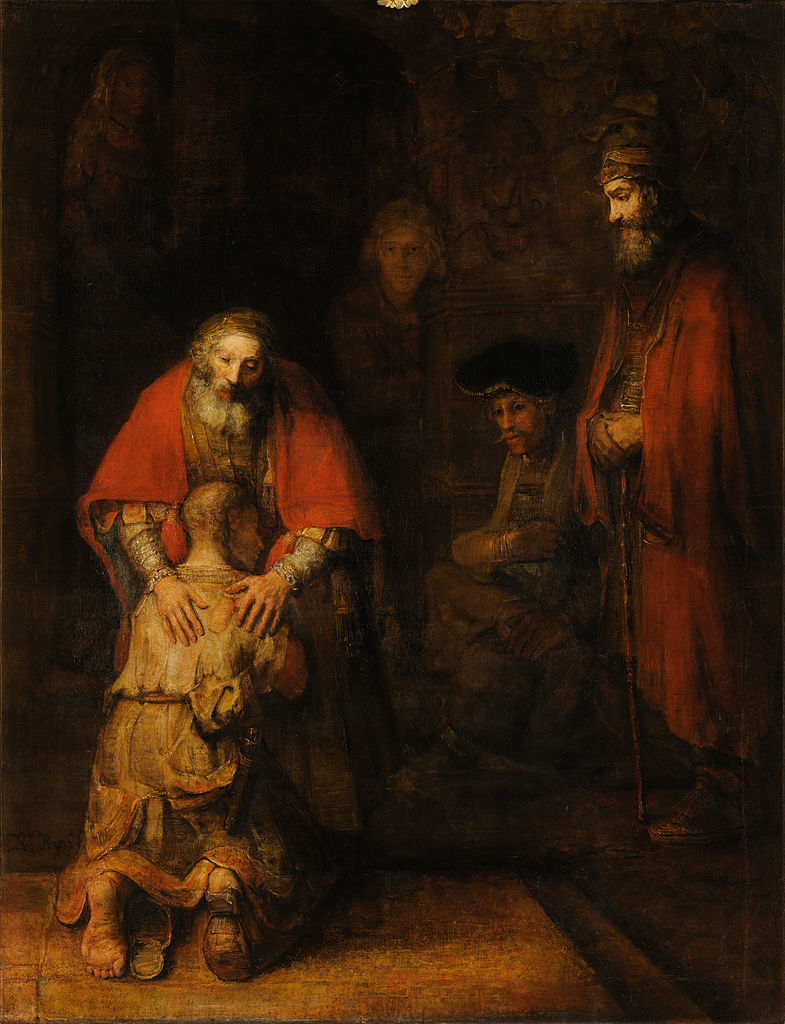
Years ago a guy by the name of Henri Nouwen sat in front of an old painting hanging in a old art museum in Russia.  He stared at the painting, studying it for six straight hours.  It changed his life.  You can read all about it in his powerful book, The Return of the Prodigal Son.  The painting is Rembrandt’s work of the same title, and Nouwen saw it at the Hermitage in St. Petersburg.  At the time Nouwen was feeling very lost.  Though he was a priest who had dedicated his life to the Lord, he felt like something was very wrong inside.  Maybe you feel some of that too.

I find Nouwen’s book to be the best work on spirituality I’ve ever read, and I bought a print of Rembrandt’s painting to hang in my office so I can regularly remember what I learned from Jesus’ parable.

As I mentioned last week, many of us feel lost, whether we are Christian or not.  Just as Nouwen learned through the parable and the painting we can be found by God.

What I write here is a distillation of Nouwen’s writing.  You really should get the book, though, because what he has to say is so encouraging, challenging and hopeful!

First of all, Jesus teaches that We Can Be Lost In A Distant Country.

Before we can be found, we need to realize that we have traveled to a distant country.

In his book Nouwen explains what is going on in the first part of the parable, Luke 15:11-16, where the son asks for his share of the inheritance:

“Kenneth Bailey, in his penetrating explanation of Luke’s story, shows that the son’s manner of leaving is tantamount to wishing his father dead. Bailey writes, ‘For over 15 years I have been asking people from all walks of life, from Morocco to India and from Turkey to Sudan, about the implications of a son’s request for his inheritance while the father is still living. The answer has always been emphatically the same…the conversation runs as follows:

KB: Has anyone ever made such a request in your village?

Villager: Never!

KB: Could anyone make such a request?

Villager: Impossible!

KB: If anyone ever did, what would happen?

Villager: His father would beat him, of course!

KB: Why?

Villager: The request means he wants his father to die.

The son deeply disrespects his family and community by leaving.  Things get worse because he practices reckless living which is living without thinking.  Usually we think of prodigals as people go off the deep end, like the younger son in this story. We have people like this in our lives. People that we point to. People that we compare ourselves to so that we feel pretty good about ourselves and our relatively good behavior. The reality is that we all can travel to distant countries and practice reckless living.  Think you have not done so?  When God is not enough for us we seek acceptance, love, etc. in “distant countries.” Anger, Jealousy, Bitterness, Lust, Greed, and Fantasies show us that we are lost in distant countries.

Still some of us may think, “I’m not like that.” Maybe, then, we are more like the elder son.

In the parable, Jesus teaches us through the elder son that We Can Be Lost At Home.  In Luke 15:25-30 we meet the elder son, who though he stayed home, didn’t practice reckless living, and was faithful, he was just as lost as his younger brother.  How so?  The lostness of the younger son is outward, while the elder son had a lostness that was hidden, inside.

When the elder son moans about slaving for his father, Nouwen points out that “in this complaint, obedience has become a burden and service a slavery.”  The elder son revealed his heart.  He was not joyfully, graciously serving his father because he loved his father.  To him his service to his father felt like slavery. That tells us something about the lostness of his heart, doesn’t it?

Additionally, the older son was confused about the purpose of celebration. How could irresponsibility be celebrated rather than dutifulness? He was so bitter about this that he refused to enter the house.  Jesus purposely gives us that detail.  The older son was no more home than his younger brother; both had left the house.

We can be lost abroad or at home. We need to allow ourselves to be found.  We must be found and live in the Father’s embrace.

In Luke 15:17-24; 31-32 we read about the Father, especially that wonderful moment when he wraps his arms around his lost son.

Why is his embrace so important? Because lostness in the parable is depicted as a state of leaving the father. Something we choose. Deliberate separation.

Being found in his embrace starts by coming to your senses (vs. 17).  The younger son must realize that his life had become pitiful, sinful and rebellious.  Note the big difference between “coming to his senses” and “reckless living/living without thinking.”

In response to the son’s realization, repentance and return, do you see what the Father does?  This shows us how God feels about his lost children!  He celebrates our return and restores us. The ring, robe, and sandals are indications not of slavery but of sonship.  Slaves didn’t wear those symbols, only sons did.  Though we can be lost, God wants to fully restore us!

But the image of God’s love goes even further in the parable.  See how the Father comes to both sons. His love is unconditional and non-comparing.  Though the elder refuses to enter the party, the Father goes out to him, pleading with him to enter.

We don’t know the outcome of the elder son.  But we do know how difficult it is for the prideful, the arrogant, the complainer, the bitter to soften their hearts.  God wants us to know what an amazing loving, caring God he is, though.  He wants to change our hearts, make us new.

And so Nouwen concludes:

“But had I, myself, really ever dared to step into the center, kneel down, and let myself be held by a forgiving God? I so much wanted to keep some control over my spiritual journey, to remain able to predict at least a part of the outcome, that relinquishing the security of the observer for the vulnerability of the returning son seemed close to impossible.”

We need to be found by God and live in his embrace.  We need to remain in that moment where he has wrapped his arms around us saying “You are my son whom I love.  Welcome home.”

So how do live in the Father’s embrace? Nouwen suggests that we make the following our practice:

  1. Unceasing prayer to stay in his embrace.
  2. Thankfulness that his love is unconditional and non-comparing.
  3. Rejoice in celebration with him.

Are you feeling lost?  Let yourself be found in God’s embrace.

Check out this contemporary retelling of the parable, and come home:


How God feels about you when you feel lost

Ravi Zacharias tells a story about two English Navy men on leave for the weekend.  They decide to go to a local pub and enjoy themselves.  As you can imagine, they get wasted.  Eventually they leave the pub walking through the city for hours only to realize they are hopelessly lost. So they ask a passerby, “Excuse me, bloke, could you tell us where we are?”

Unbeknownst to them, they had just addressed their commanding officer who was incensed at their condition and disrespect. He growls back, “Do you know who I am?!?”

So the one sailor looks at the other and says, “I think we’re really in trouble now!”

The second sailor says, “Yeah! We don’t know where we are, and he doesn’t know who he is!”

Like the sailors and their officer, many times in life we don’t know where or who we are! Many of us feel lost, but we would never admit it.

I once had representatives from a cult group come to my house.  We had a nice chat.  They agreed with everything we talked about except the possibility that they might be lost.  Not lost like those sailors.  They knew their location.  But they would not agree that they might be lost spiritually, that their beliefs might be misguided.  I tried to say that the nature of faith is that possibility that we might be wrong.  I have to concede that about my faith.  It wouldn’t be true faith otherwise.  They refused to agree with me.

Do you ever wonder if we believe a lie? Those visitors wouldn’t hear it, and I fear we will not either. We believe those without Christ are lost and can be found in him, accepting him as Savior.

So why do many Christians seem lost? Without hope, love, faith, or peace?

On Sunday we come to another one of Jesus’ famous stories, the parable of the Prodigal Son.  We’re going to be looking at all of Luke 15, of which the Prodigal story is a part, because the whole chapter is actually three stories about lost things.  A sheep, a coin and a son.

The story of the prodigal is about much more than a lost son.  I have found Henri Nouwen’s book The Return of the Prodigal Son to be a wonderful guide for mining the depths of Jesus’ story.  Jesus tells such a simple story, but it’s implications are profound.  I encourage anyone to pick up a copy of Nouwen’s book, as he covers the story so well.

And if you are feeling lost, even in a small way, I encourage you to join us at Faith Church this coming to learn more about how God feels about lost things.

What does it really mean to follow Jesus? Luke 14:25-35

Just as the military recruiter had a wonderful offer for me, to be a chaplain, Jesus has an offer for you: Are you interested in being his disciple?  And just as I had to consider how becoming a military chaplain would affect my family and my church, Jesus says that before becoming his disciple, we need to consider what it will involve.

He tells some parables in Luke 14:25-35 to explain what you need to do. They are pretty simple:

First, in verses 28-30, he says you need to be like the builder who thoroughly plans out his building. You don’t take the building preparation lightly. If you do, and you get halfway into building and you realize you screwed up the plans, and you have to stop…it will be awful. Not only will you have wasted a lot of time and money, but you’ll have a half-building and be the ridicule of the town.

Second, in verses 31-32, you need to be like a king who plans out a battle carefully. Otherwise you might have to seek a treaty rather than get the win.

And why does he tell these stories? He wants to sum up the principle of counting the cost of discipleship. You have a choice to be his disciple or not to be. If you want to be his disciple, then he says in verse 33, like the builder and the king you have to plan it out and know ahead of time that there is only one way to be disciple, and that is to give up everything for him.

There is no half building and half battle. Likewise there is no half disciple.   There is no “I’ll just believe in him so I can go to heaven when I die…and I’ll leave the hard disciple stuff up to others.” Jesus is saying that won’t work. As his brother James would later go on to write in James chapter 2, even the demons believe.   But there is a wrong belief and a right belief. The wrong belief is what the demons have. They know Jesus is the truth, they know he is the savior. But their belief doesn’t lead to a life change. So they have the wrong kind of belief.

We need to have right belief. Belief that leads to discipleship. There is no halfway. Instead we need to go all the way, give up everything, and believe in him and then completely follow him.

That’s why he says in verses 34-35 that halfway believers are like salt that has gone stale. Thrown out.

So again I ask, will you be his disciple?

What will it look like for you to be his disciple?

Start where he wants you to start. Come to him, with everything. Follow him. Give up all for him. There is no other way.

Or maybe there is another way? Thinking back to the military recruiter who had an offer for me, when you join the military, would it be fair to say that you give up your life? And you have to do things the military way? Does the military have a lower tier where you can still be in the military but not have to give up your life? Is it possible to just go to a meeting once per week, read the manual, and still get paid? Of course not.

When you follow Jesus, it’s all or nothing, he is saying. But this is where it can get confusing.

You do not have to become a missionary or a pastor to give up all to follow him. If you are gifted to do those things, of course you should consider them a viable option.  But most should still be an employee at your job, a stay-at-home mom, a student at school, a neighbor, a dad, a grandparent. And in all of those important areas of life, you allow Jesus to have complete control over you.

As we have seen Jesus teach, and as we have seen him confront the legalists, giving Jesus complete control is not about following man-made religious rules. Instead it is saying “Jesus I want to give up all to you, I want to learn what it means to follow you way every minute, every hour, every day of my life.”

Make 2016 the year where you make forward steps in following Jesus.

If you know you are struggling to follow him in some way, then I encourage you to get that out in the open. To not only tell Jesus about it, and not only to ask him to help you follow him better and help you change, but also tell it to someone else.   Get input and help from someone that is farther along in following Jesus, and ask them to disciple you to help you better follow Jesus.

That time a military recruiter called me with an amazing proposal

A couple years ago, I got one of those out-of-the blue calls that sounded legit, but also made me very suspicious.  It was from a military recruiter, the Army Reserves to be precise.

At the time I was 39 years old.  Not quite the age anymore to be considered for military service.  He explained that he was recruiting for the military chaplaincy, and at 39 I had a couple more years before I would be too old to start a career in the military.  He told me I didn’t need to worry…I wouldn’t have to go through basic training!

I would, however, have to go through a chaplaincy training program, but the Army Reserves realizes that its chaplains are usually already in full-time ministry, so they try to fit the training around a pastor’s schedule.

As a chaplain in the reserves, after my training was complete, my responsibilities would be just like any other Reservist, spending one weekend per month on base, and two weeks each summer.  Of course, if my unit got called up to active duty, I would go with them.  The recruiter assured me that many of their chaplains are full-time pastors, and their churches work around their Reserves schedule.

Additionally, and this piqued my interest, I would be qualified for a military pension if I served 20 years, and because I already had my master’s degree, I would start my military career as an officer!

I couldn’t believe it.  I had not sought this out.  I had not had a conversation with the chaplains in my denomination.  It came completely as a surprise.  How did he find out about me?

Maybe he just looked on my denomination’s website?  I don’t know.  And it doesn’t really matter how he found out.  What mattered was that this was a serious offer, and I needed to evaluate it.

I have to admit that there was an inkling of interest deep within me.  I liked the idea of a military pension.  I liked the idea of being an officer is the US Army.  And I’ve heard from my military chaplain colleagues how many wonderful ministry opportunities there are for chaplains.  I like all of that, and it excited me.

So Michelle and I needed to talk about it.  We needed to pray about it.  If I became a military chaplain, it could deeply impact my family.  Would my wife and kids be okay with having me gone so much?  And what if my unit got called up, and I went to serve in a war zone?

I also needed to talk with my church, or at least the group of leaders in my church that could give me honest feedback about this decision.  It was an opportunity that could also deeply impact our church.  My church already graciously and wisely allows me one Sunday off preaching every month.  It doesn’t always happen, but I’m very thankful for it.  This chaplaincy opportunity would go well beyond the once/month off though.  Would the church be okay with me being gone so much?  And what would happen to this full-time ministry that I committed to before the Lord and before the church if my unit did get called up and I would be gone for months?

Simply put, for an opportunity like this, I would have to count the cost.  And I would have to get others to join the evaluation process with me.  It was an amazing opportunity.  Very enticing.  But it came with a cost.

This coming Sunday at Faith Church we will study Luke 14:25-35, a passage about counting the cost.  Check it out before worship on Sunday.  Like that recruiter, God is offering you an amazing opportunity, as we’ll see in this teaching by Jesus, but we need to count the cost.

So we invite you to join us to learn more.

That time Jesus said a chicken would save the world – Luke 13:22-35

In this story, Jesus takes a question from the crowd: “Will only a few be saved?”

How will he answer?

144,000?  Maybe that’s how many will be saved?

Nope, he doesn’t say that.  His answer is a story.  He tells a parable about a man with a house, and the house has a narrow door.  In the story people will try too enter the house, but the owner will shut the door.  Outside the people start banging on the door, frustrated as to why the owner will not let them in.  From the other side of the door he calls to them “I never knew you! Go away.”

Outside you can see the people looking really confused, shrugging to one another with a look on their face that says “What is he talking about?”  They respond back to him saying “But we ate and drank with you, and you taught in our streets!”  It sure sounds like the people outside have convincing evidence for him to think, “You’re right…fine!” then open the door and let them in.  There seems to be a relationship between the people outside and the owner of the house.

Instead the owner shouts back, “I never knew you! Away!”

The Pharisees speak up because they suspected, rightly, that Jesus was telling this story about them.  They tell him to leave that place because they local maniac king Herod was apparently uttering threats against Jesus!

Jesus, undeterred, says “Go tell that fox that I must be about my business.”  Jesus then proceeds to say that a chicken will save the world.

Kind of.

But truly, when you think about it.

He doesn’t use the words: “a chicken will save the world.”  He says that he is like a hen who has desired to gather her chicks.  He is using a simile, a figure of speech, to liken himself to a chicken.  And he does desire to save the world.  That was why he was born.  That was the focus of his preaching, that the Kingdom of God was being made known through him.  That people should follow his way.

And so in an astounding image, Jesus says that he looks at the people (and he specifically mentions the city of Jerusalem here), and desires to draw them in like a hen would lift up her wings and cover her little chicks.

That’s how God feels about us.  He loves us and wants to save us.  Jesus never answers the question if just a few will be saved.  Instead he reminds of how God wants to save us.  He has not only provided a door, albeit a narrow one, for us to walk through in order to be saved.  God also loves us and wants to save us.  We see the heart of God in this passage.  God’s heart is an attitude of grace, love and mercy for us.

There’s a problem though.

In the narrow door story, the people thought they knew Jesus, but they were wrong.

In the hen story, Jesus goes on to tell the people, they were not willing to be gathered under his wings.  Instead people are like a chick who would run away from the loving, care of the mother hen.

We might ask why any chick would do that.  Why would they be unwilling when the care of their mother is so good and safe and warm?  I can’t answer for a chick, but I think you and I can answer that question for humanity.

So what if we rewrite the question: Why would so many people turn away from God?  When God loves us so much, when he gives us grace and mercy, when he sent his Son to give his life for us so that we can walk through that narrow door, why would we not want to be close to him?

There are many reasons why a person would not want to be close to God.

It could be distractions.  Our American society has a lot of entertaining distractions to offer.  If we have food, clothing, and fun (and we have oodles of them here), why do we need God?

It could be disbelief.  Plenty of people simply don’t believe in God.

It could be particular view of God.  Some see God as a tyrant or judgmental.  Who would want to be close to that kind of God?

There could be more reasons.  How do you feel about God?  Do you feel close to him?  Do you feel far?

I don’t know that I can answer the questions and concerns that you have about God.  But the parables Jesus tells us in this passage give us some clues.  First, the narrow door is still open.  Enter through it. Get to know him, to really know him.  Knowing him starts with a question: “What does it mean to really know him?”  Then make this year the year where you seek that answer.  Jesus’ parable suggests clearly that we should not assume that we know him.  Instead have a teachable heart that says “Lord, I want to know you better!”

I came across an article this past week that could point out roadblocks that could prevent you from knowing God better.  It’s called 10 People Nobody Can Help.  Are you one of those 10?

Second, be like the chick that is willing to be gathered under his wings.  Run to him.  Remember that he loves you.  God is not angry at you.  He wants to be close to you.  Jesus’ point is that staying under his wings is the best possible place to be.  Do you believe that being close to Jesus is the best possible place to be?  I will probably not be able to convince you.  Instead I urge you to take him at his word and give him a try.

Want to know how to run to him?

It starts with prayer in the midst of situation “Lord, I trust in you. Take my life. I give myself to you. I want you to help me.  I want to know you more.” And you have to mean it.

Jesus, another time, said “Abide in me, and let my words abide in you.” Get his words in you. Study the Bible.   Even if it is reflecting on one verse per day.   Read a chapter of Proverbs per day. Read a Psalm per day. Then get in touch with someone who can help you study the Bible deeper. Get a study bible and use the notes.

Be committed to his mission of making disciples. Be discipled yourself by someone who is more mature. Ask them to disciple you. I should be able to go to each of you and ask “Who is discipling you?” and you should be able to give me that name. And from the other direction I should be able to ask you “Who are you discipling?” and you should have a name. You can ask the same questions of me!

Abide under his wings through being generous with your money. Abide through giving of your time to serve the Lord…in a ministry in the church, in a community outreach, etc. This is the sacrificial nature of the disciple of Jesus.

As we head into 2016 let’s take a look at Jesus and let’s check our hearts. Are we “riding the coattails” of our family’s Christian values, are we hoping we are being good enough because there are so many others who are worse?

OR are we willing to do the hard work, to make tough choices and to follow God’s best way for our lives? To look at ourselves and see which ways we might be able to make changes to grow to be more and more like our Jesus. He wants to gather us. He loves us. Are we running to him or away from him?”