 The subtitle of author Reggie McNeal’s book Kingdom Come, is compelling: “why we must give up our obsession with fixing the church—and what we should do instead”. That grabbed me! In the book, he tells the story of when he was at a conference for pastors and said this:
“We’ve been working at fixing the church for the past 500 years…how’s that going for us?”
500 years ago a German Catholic Priest named Martin Luther nailed a piece of paper to the door of his church in the town of Wittenburg, and in so doing he started quite a ruckus.
Some people get confused because there was another Martin Luther who was very famous. Martin Luther King, Jr. I’m not talking about MLK. I’m talking about the guy MLK was named for. THE Martin Luther. THE Martin Luther was going through a major change in his view of the church. He had been a Roman Catholic his whole life, and he was a priest for many of those years. A very devout priest. But he was disheartened by things he saw in his church. So he got to the point where he wanted to do something about it.
He wrote out his concerns, all 95 of them, which are famously known as his Theses, and he tacked them to the door of his church for all to see. That was before Facebook.
Luther took a lot of heat for this. In fact, he nearly lost his life because he refused to recant. He held firm to his concerns and eventually started a whole new movement. Luther was protesting against the church. He wanted to reform it. You put those two words together, “protest and reform”, and you get the title that we have given to Luther’s movement: the Protestant Reformation.
That was nearly 500 years ago. Just like Luther, we have been trying to change the church ever since. McNeal asks a good question: How is that going for us?
In the short years that I have been involved in church, starting in late 80s and early 90s, as McNeal points out, we’ve seen a personal evangelism movement, a church growth movement, the worship wars, a church health craze, the megachurch movement, the emergent church, and plenty of theological debates. How is that going for us?
A guy who studies the church, Ed Stetzer, has recently published studies that have extensively examined religion in America. Guess what? Do you think all those attempts at fixing the church have helped? Nope. The mainline church is declining particularly fast. Thankfully the Evangelical branch of Protestantism is not declining nearly as much, but we, too, are seeing small declines.
You know what McNeal says? “Why not just do what the church should be doing?—partnering with God in his redemptive mission in the world—and let the overflow of that effort bring about the renewal we’re looking for?”
Basically he is saying that we need to tell our story differently! Or as a friend at church so often tells me, we need better PR! Think about it: What story have we told?
Faith Church tells our community a story. There’s the story that we think we’re telling, and there’s the story that the community is hearing. They might be two different things.
I recently talked about why we’re removing the word “Evangelical” from our church sign. Better PR. The word “evangelical” no longer means what we want it to mean. We know that it means “Good News” and in Jesus there is very good news. But people in our community might not know that. Instead they think “evangelical” is about a political group, and in the last 25-50 years or so that political group does not have good news.
We might be thinking that we are clearly and compellingly telling the story of the Good News, but is it possible that our community has heard what we’re saying and at least some of them are not thinking that we are speaking about Good News?
What we need to do is go to Jesus and the story that he told. What story did he tell? In the the four Biblical accounts of Jesus’ life (aka the Gospels: Matthew, Mark, Luke and John), the word “church” is used three times, all in Matthew and each time referring not to a church building, but instead referring to a gathering of people.
Guess how many times Jesus used the word “Kingdom”? Over 100 times. It was his core message. You do not have to look far in the Gospels to find it. I recently preached a sermon series through the Gospel of Luke. In chapter 1, verse 33, before Jesus is even born we read a reference to his Kingdom. The angel Gabriel, when he came to Mary to tell her that she would be the mother of the Messiah, said that her baby have a kingdom that would never end!
When Jesus started his ministry, which we read about in Luke 4:42-44, one of the first things he teaches is “I must preach the Good News of the Kingdom of God.”
- No less than 38 times in the book of Luke alone is there a mention of the Kingdom of God.
- In Mark, it is mentioned 15 times.
- In Matthew where it is predominantly called the “kingdom of heaven” it is referred to 50 times.
- John mentions it 4 times.
So, for Jesus, the Kingdom of God is an extremely important concept. Has our community heard from us that the Kingdom of God is an extremely important concept?
Or have they heard about church? If you look at Lancaster County, and you evaluate the message of church vs. kingdom, what do you see? You have to put yourself in the position of a historian who is looking at our society hundreds or even thousands of years of later.
I got to experience a bit of that perspective recently in Cambodia. We were there because of my wife, Michelle’s, work with Imagine Goods. It was also our 20th anniversary, so we took two days to visit the ancient temples near Siem Reap. After a six-hour bus ride from Phnom Penh to Siem Reap, we realized that we were in tourist central because of the ancient temples.
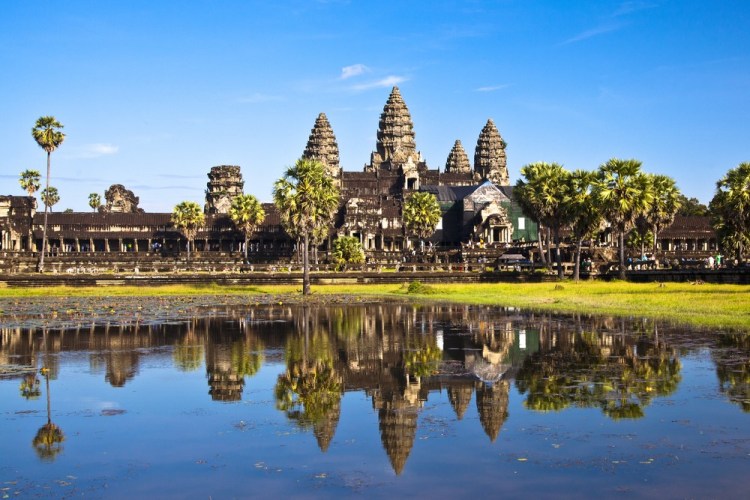 They are considered to be one of the 7 Wonders of the World. Called Angkor Wat after the name of one of the largest and best preserved temples, there are actually many temples in the surrounding, large area. Scientists are still making discoveries about the ancient civilization that built the temples. Recently they have fitted airplanes with laser scanners and they have flown hundreds of hours scanning the jungle around the temples. The results of these scans have been staggering.
 They have uncovered foundations of cities that jungle had long since hidden. The scientists estimate that in its heyday, the kingdom around Angkor Wat had a million people. It was larger than London at the time!
So hundreds of years later these scientists are learning new information about this Cambodian kingdom. Why did the ancient Cambodians do what they did? Obviously building temples was really important to them. I have seen pictures of Angkor Wat many times, as Michelle and teams from Faith Church had explored there. But seeing the temples in person brought them to life for me. I got to climb the steps and stones, and walk down the long temple hallways staring astounded at the detailed carvings depicting the wars and glory and power of the king.
What will people 500 or 1000 years in the future say about us? One thing is for sure, they will say that we were very aggressive about building church buildings. And they will look at our Scriptures, the New Testament, and there is a probability (I think a high probability) that they will be very confused. Why? Because our Scriptures say nothing about building church buildings.
While Jesus, who we believe in, trust in and seek to follow as his disciples, taught a lot about his Kingdom, Christianity in the 1900s and now into the 2000s has continued a trend which has been going on for a long time, the building of church structures of all shapes and sizes.
This should cause us to step back and think: why do we build buildings when Jesus said that we should build his Kingdom!
It goes deeper than just buildings. There is more. When you think of your church, think of what you put emphasis on. There might be staff that you pay. There might be systems of leadership and ministry. Quite honestly, our church has many similarities to an organization. There are many times I feel much more like a CEO than a pastor. Jesus didn’t tell us to build an organization with buildings. He put all the focus on his Kingdom.
I’ll never forget a seminary class I took about churches and transitions. We had numerous guest speakers come to the class, and one was a pastor who talked with us about the amazing growth of his church. They started small and ended having to buy a large property with all the bells and whistles of large churches that have become so familiar to us. Did that ever get my attention! I’ll be honest with you: I thought “That’s what I want Faith Church to become! I want Faith Church to become the biggest church in our denomination! I want to be able to walk into EC National Conference each May knowing in my head, not having to say a word to anyone, that Faith Church, where I am the pastor, is the biggest church out of everyone in that room.”
Do you think I was giving much credit to God and his Kingdom? Of course I said I was all about God and his Kingdom, but looking back on it, I wanted to build the church, MY church, OUR church. I had an unhealthy perspective on church.
One of the most helpful books I read about this was Pagan Christianity by Frank Viola. He shows through loads of research that pretty much everything that we are used to when we think of church systems comes not from biblical teaching but from Christians through the ages trying to keep up with the spiritual Joneses. Most times they were trying to keep up with pagan culture. The pagans, for example, had a big religious celebration at Winter Solstice. So the Christians decided to keep up with them by having a competing celebration. You know what that competing celebration is? Christmas!
Do you think Jesus was actually born on December 25th? Highly unlikely. We have no idea what day Jesus was actually born. What we do know is this: Did Jesus tell us to make a big deal out of celebrating his birthday? Nope. Is it okay to celebrate his birthday on December 25th every year? Sure is, but we need to remember that Christmas is a churchy thing, not necessarily a Kingdom thing.
It goes deeper than church buildings and Christmas. We would do well to examine everything that is normally considered to be church. A sanctuary with pews. Sunday School. Youth Ministry. An order of worship, and a worship service that lasts about an hour or so. If we seek to find the origins of those structures and systems in the New Testament, Viola shows us our search will come up empty. That means a church can still be a church without those structures. Again, hear me. I am not saying that church, and all the trappings of church that we are used to, are bad.
I better be careful because another element that is normally considered a pretty big part of church is the pastor. That’s me. But the way we employ pastors and our typical pastor’s job descriptions are not in the Bible. Yes, the Bible talks about pastors and paying them. And the Bible has a couple places where it talks about what pastors should do. Guess what, though? What the Bible says about pastors and what they should do is very different than what pastors have done, and what people assume pastors should do.
For example, in Ephesians 4:12 Paul says that pastors should train people up to the do the work of ministry. But for decades the pastor was seen as the person the church paid to do the work of ministry. Consider the vending machine. You put your money in the slot, make a selection, and out pops your soda, candy bar or bag of chips. Same with pastors. You put your money in the offering, and your pastor gives you a visit, a funeral, a prayer. In other words, the normal conception has been that the pastor is the one who is paid to minister to the people, whereas Paul says the pastor is train up the people to do the ministry.
I want to be clear at this juncture: There is a major difference between church and kingdom.
It is okay to have church, to have church buildings, to have Sunday School and pastors, but ONLY so long as they serve to promote the Kingdom.
Remember when Jesus taught us to pray the Lord’s Prayer? Here are the first few sentences:
Our Father which art in heaven, hallowed be your name.
Your Kingdom Come, your will be done, on earth as it is in heaven.
Notice what is missing? No mention of church. Jesus did not teach us to pray “Your church come” . Here’s why: the church was never permanent. The church was always meant to build the Kingdom. The church serves the Kingdom, not the other way around. The kingdom is forever, the church is not.
The kingdom, as Jesus taught us to pray, is about God’s will being done on earth as it is in heaven. That’s what it means for his Kingdom to come. Normally when we think of God’s Kingdom, we think of heaven, and we think of heaven as a place we go to. When we die, we are no longer on earth, we have left the earth, and we go to heaven.
But notice how Jesus taught us to pray something completely different! Have we been praying that prayer all our lives and missed it? “Your Kingdom come, your will be done, on earth as it is in heaven.”
God wants his Kingdom to reign and rule right here and right now! He wants his will to be done on earth. His will is already being done perfectly in heaven. So just as the will of God is being followed perfectly in heaven, God wants his will to be followed more and more here on earth. That is what Jesus taught us to pray, because that was his mission and he wanted it to be our mission.
To expand on what that mission was all about, he said to his disciples that they should make disciples, who will make disciples, who will make disciples. He did not suggest that his disciples should group up those new disciples, build buildings to meet for worship and try to make those churches famous. He told them to make disciples so that more and more people would allow God to reign and rule over their lives, so more and more people would experience God’s Kingdom and have not only the hope of eternal life, but also the experience of what he called abundant life here on earth.
When we allow God’s Kingdom to come into our lives, we experience life transformation. One of Jesus’ first followers, a guy named Paul, experienced this life transformation. He changed dramatically from being a vicious man, arresting and jailing and killing Christians, to being perhaps the most powerful Christian missionary ever.
Paul talked about something he called the Fruit of the Spirit: love, joy, peace, patience, kindness, gentleness, faithfulness, self-control. What happens when you allow God’s Kingdom to rule over you is that you are transformed first and foremost. Disciples of Jesus experience transformation. Your inner life is transformed, Paul says, because you are the temple of the Holy Spirit. You don’t go to a temple. Now God lives in you. Faith Church has a building where we go. We gather at worship services to worship God and hear from him. We plan our worship services around that idea that people can experience God in worship.
But those buildings are not God’s houses. I know it is popular to call church buildings “God’s House.” It is not true. Those buildings are not God’s houses. The rooms where we meet for worship are not some special rooms. We have an Ethiopian Orthodox church that rents worship space from us. The Ethiopian worshipers take off their shoes when they enter the sanctuary. I am not well-versed in their theological reasons for taking of this practice. Maybe they view the sanctuary as holy ground, like Moses took off his sandals when he approached the burning bush where God was. Or maybe they are just symbolizing that event and a heart of worship. Our sanctuary is not like the ground around the burning bush. I have no qualms with the Ethiopian church practice, but if they believe that the sanctuary is holy ground, I disagree.
We call it the sanctuary as if it was special. As if God lives here. He doesn’t. If we are true disciples of Jesus, God lives in us. That means we ourselves should be experiencing that transformation God wants to work in us, and the Fruit of the Spirit should be flowing from us. As we are changed, we experience God’s abundant life in us.
If you are an impatient person, God’s Kingdom coming more and more in your life means that you grow more patient.
If you are a person with a dirty mind or a dirty mouth, God’s Kingdom coming more and more in you means that your mind and mouth become more clean.
If you are a complainer, you grow more content.
If you are a rough, you grow more gentle.
If you are pessimistic, you grow more joyful.
God’s Kingdom coming into your life means that you are transformed. But it doesn’t stop there. God’s Kingdom comes into society and society is transformed. Remember how Jesus, very early in his ministry in Luke 4, returned to his hometown and preached in the synagogue there? He told the people that day what his mission was all about:
“The Spirit of the Lord is on me, because he has anointed me to preach good news to the poor. He has sent me to proclaim freedom for the prisoners and recovery of sight for the blind, to release the oppressed, to proclaim the year of the Lord’s favor.”
He was reading from Isaiah the OT prophet, and Jesus said that this prophecy was fulfilled in him. It describes the rule and reign of God’s Kingdom transforming society.
The poor, the prisoners, the sick, the oppressed, all experience God’s Kingdom. I saw this maybe as clearly as I have ever seen it in Cambodia. Through the efforts of Imagine Goods’ partner organization there, Agape, a whole town is being transformed. Where once the town was a center for human trafficking, it is now a place of hope and a future. Where once women and children were slaves, now there are safe living places, a school, a church, and great jobs which have pulled families out of poverty, out of slavery, and the criminals have left. God’s Kingdom is on full display though. It is beautiful.
That’s why I’m thankful that Faith Church is such a strong supporter of the CV Ministerium and CVCCS. Those two local organizations are not about a church building. Instead they are promoting the Kingdom of God. They spread the Good News of Jesus’ death and resurrection and our hope in him, and they seek to promote God’s Kingdom so that it will transform society.
A few months ago I created a possible future scenario of Old Philly Pike, the road our church property is located on, needing to be widened and our church sanctuary having to be torn down? Some of you thought I was telling a true story! But even if it was true, you know what? That would be okay.
Our mission is not to maintain a building. Our mission is not to make Faith Church’s name great. Our mission is not to be a large church that everyone thinks “Wow. That church is going places.”
No, our mission is to promote the Kingdom. And that is what this new sermon series is all about: Our Growth Process. To be disciples of Jesus who make disciples for Jesus, so his name and his Kingdom are the focus! Because he is the one, and he alone, that transforms people’s lives and through transformed people he transforms society.
And so we pray:
Our Father which art in heaven, hallowed be your name.
Your Kingdom come, your will be done, on earth as it is in heaven.
Give us this day our daily bread,
And forgive us our sins, as we forgive those who sinned against us.
Lead us not into temptation
But deliver us from evil
For yours is the Kingdom and the power and the glory forever. Amen.


 Engaging Scripture