The important connection between Noah’s flood…and baptism?

Photo by Li Yang on Unsplash

Do you know how those two concepts might be connected?

Baptism.

Noah’s flood.

What might they have to do with one another?  Water, right?  Anything else come to mind?

All week long we have been studying what some scholars believe is the most confusing passage in the New Testament, 1 Peter 3:18-22.  Please see the previous posts here, here and here.  Today we are looking at verse 20, and there Peter makes a connection between Noah’s flood and baptism.  Why is he bringing this up?  What does it have to do with his larger flow of thought?

If you look at the previous posts this week, you’ll see that Peter has just told us that after his death, Jesus was made alive in spirit-form (perhaps before Easter Sunday when he was raised in body?), and he traveled to a prison that held disobedient spirits (fallen angels?) from the days when Noah was building the ark!

It seems that as Peter is writing this, he does a little word association of his own.  While he had been on a stream of thought that was all about Jesus declaring victory over sin, death and the devil, including proclaiming that victory to spirits from Noah’s day, Peter now sees a connection with Noah’s flood.  He says that in the ark eight people were saved through water.

If you think about the ark story, it seems like Peter should actually be saying that the ark saved the people, and the water was the major source of destruction and death.  Flooding then and now can be devastating.  But Peter is following a theme here, and that theme is victory in Jesus, so he continues by saying that the flood symbolizes baptism!

How could the flood, which was so destructive, be related to baptism which is a symbol of spiritual cleansing, as Peter says in verse 21?  Baptism is not about removing dirt from the body.  That’s what baths or showers are for.  Baptism is a pledge or promise made to God of a good conscience, Peter says.  In other words, Peter is teaching us what baptism is.  It doesn’t save us.  Instead, baptism is a time when we declare that we are committing our lives to be disciples of Jesus.  Again, though, how is that like Noah’s flood?

Well, just as the flood was a cleansing of sin from the earth, baptism is a symbol in which we declare that sin has been cleansed from our lives, through Jesus’ victory over sin in his death and resurrection.  Notice what Peter says is the miracle that actually does the saving?  Baptism?  No.  At the end of verse 21, he says that we are saved by the resurrection!  The resurrection is where the power lies.

Baptism is a symbol, and it cannot save. Only resurrection power can save. As one author I read pointed out, for Peter and other New Testament writers, the symbol of salvation (baptism) and the real power of salvation (resurrection) are so closely linked, they are often used interchangeably.  We do this too, for example, when we talk about church.  I might say, “I am going to church,” and by that you most likely understand me to mean that I am going to attend a worship service or that I am going to drive to my church’s building.  But I do not actually believe that a building is the church.  I believe that the church is comprised exclusively of people.  So why do I say, “I am going to church” when I actually mean “I am going to a worship service at my church’s building”?  Because it is more concise and most everyone knows what I mean.  I think something like that is happening when the New Testament writers almost interchangeably use “baptism” and “salvation”.

I recently had a wonderful experience with someone who had the correct understanding of baptism and was ready to be baptized because he wanted to send a message to his family and friends.

This summer my son’s friends often hung out at our house.  Usually a couple nights each week.  About a month ago, we were sitting in our living room watching the kids play video games.  One of the guys turned to me and said, “I’m actually here tonight to talk with you, Mr. Kime.”  That was a surprise!  We’ve known this young man ever since we moved here 7 years ago, and he and our son played soccer together and have been buddies the whole time.  In the living room that night, he divulged to me in front of all his friends that he wanted to get baptized, that he wanted to start living differently.  It was incredible. So we talked about baptism, what it meant, and he was ready.  He had even picked out a spot on a river nearby.  A few days later on a gorgeous Sunday afternoon, his whole family, girlfriend, my son, and about 3-4 of their other friends all went to the river.  His dad and I got in the water with him.  I had the young man share the story that brought him to this decision, and then I said a few words about baptism, and then we baptized him.  It was really great.  I want to do all baptisms that way!

Baptism is a great starting point for you declare to your family and friends that you have embraced the victory of Jesus in your life, and show your desire to live for him.

And for those of you who are already baptized, remember your baptismal vow, and live it out, just as Peter teaches in verse 21: the pledge of a good conscience toward God.  In Jesus, you have victory, and you can live out that victory.

Tomorrow, as we conclude this passage, Peter’s thoughts about victory in Jesus continue with a vision of heaven.

An attempt to explain the Apostle’s Creed phrase “he descended into hell” and why it matters

Photo by Ian Stauffer on Unsplash

“He descended into hell”?

Jesus did what?

Remember that phrase from the Apostle’s Creed?

As I said in my first post on 1 Peter 3:18-22, could this be the passage from which the Apostle’s Creed bases its phrase, “he descended into hell”?

That’s what I thought when I read 1 Peter 3:18-22.  See for yourself.  Here is the text in question:

18 For Christ also suffered once for sins, the righteous for the unrighteous, to bring you to God. He was put to death in the body but made alive in the Spirit. 19 After being made alive, he went and made proclamation to the imprisoned spirits— 20 to those who were disobedient long ago when God waited patiently in the days of Noah while the ark was being built. In it only a few people, eight in all, were saved through water, 21 and this water symbolizes baptism that now saves you also—not the removal of dirt from the body but the pledge of a clear conscience toward God. It saves you by the resurrection of Jesus Christ, 22 who has gone into heaven and is at God’s right hand—with angels, authorities and powers in submission to him.

What do you think?  Do verses 19-20 (in bold) match up with “he descended into hell”?  Maybe.  Keep reading as we look further into this.

As I mentioned yesterday, the NIV’s translation of “Spirit” at the end of verse 18 is better translated “spirit”, so we should understand Peter as not talking about the Holy Spirit, but about Jesus, resurrected in a new spiritual form.  Peter is not saying that Jesus did not rise again physically.  Peter himself witnessed and touched Jesus’ risen physical body.  Instead Peter is saying that somehow, someway, Jesus, in a resurrected spiritual form preached to other spirits who had disobeyed in Noah’s day, and had been in some sort of prison ever since.

Ever heard that story before?  What spirits disobeyed in Noah’s day? What prison? When did Jesus do this?  What did he preach?

Scholars through the ages have debated this, providing a variety of possible answers to these questions.  I’m not going to survey those possibilities.  Instead, I’m going to take the advice I. H. Marshall gives in his commentary on 1st Peter, which is to focus on the answer I believe best fits the context.

To attempt that, look at verse 20 where Peter starts to answer some questions.  Those spirits who disobeyed long ago when Noah was building the ark?  What is Peter talking about?  Don’t remember that part of the flood story?  If so, you’re not alone.  It rarely gets told, but come to find out, there is actually a part of the flood story about this.  It is all the way back in Genesis chapter 6, and it, too, is a very strange story.  Join me as we go way back in time, a couple thousand years, to Gen. 6:1-6 and see if you can get what Peter is talking about.  Please read the passage before continuing.

How about that?  Nephilim?  Sons of God?  Angels having children with human women?  What?  The interpretation of Genesis 6:1-6 is as difficult and hotly debated as 1 Peter 3:18-22.  What is clear, though, is that there was disobedience in this story.  Whoever these creatures were, and whatever they were doing, it was clearly going against the will of God.

I think, therefore, we can see at least a little bit where Peter is getting the idea of spirits from Noah’s day who were put in prison because they disobeyed.  Maybe they were fallen angels?  We really don’t know.  But they disobeyed, and they were placed in some sort of prison for fallen angels.

And that brings us to Jesus.  Apparently, after he died and rose again in spirit, he went on a preaching mission to this prison.  We think that’s why the Apostles’ Creed says “he descended into hell”.   Assuming we are understanding this right, what message would Jesus be preaching to these spirits?

Some have said that Jesus was preaching the good news of salvation to them, giving them a second chance to follow him.  But the word that Peter uses is not the standard word for “preaching the good news”.  Peter, rather, uses a more generic word that means “to proclaim” or “to declare.”

Again, there are many theories, but if we take the flow of thought that Peter has been working on here, it seems best to understand that Jesus is proclaiming his victory over sin through his death and resurrection.

He was declaring to them that he has won the victory!

This is the good news, that through Jesus, and his death and resurrection, sin which separated us from God is dealt with, and we can be brought to God.  In other words, there is victory in Jesus!  God is doing a new thing through Jesus.  God is making things right.

Interestingly, Peter seems to make a connection in his mind at this point, and at the end of verse 20 and through 21, he keeps going with the Noah thing. More on that tomorrow!

Feeling distant from God? There is good news!

Yesterday I introduced 1 Peter 3:18-22 by asking, can one of the most mysterious passages in the New Testament help people who are feeling defeated in life?  Today we are going to start studying Peter’s teaching in that passage to try to answer that question.

We have to remember that Peter is talking to Christians in the first century Roman Empire who were being persecuted for their faith.  They were different from everyone else in their world.  They were a small, small group who believed in a new religion, a new faith that is only about 30 years old, and thus the larger population thought Christians were in a cult. The Christians faced hardship because of that.  Imagine the feelings of defeat that they might have been feeling.

If you were a Christian you had to deal with being accused of being in a cult, and then the bodily persecution started.  People actually physically punished you.  It got ugly as it so often does, to the point of beatings and death.  Sadly, this still happens all over the world today, one group of people abusing another group of people because of a disagreement about their religion.  When you are being disagreed with, or threatened about something so fundamental to your life as your faith, it can be quite discouraging, and leave you feeling defeated.

Peter knows this, and throughout 1st Peter we have seen him trying to encourage them.  Here in chapter 3, verse 18, he is back at it.

He reminds them that Jesus also suffered.  But he suffered for us, for our sins, for all people.  His wasn’t just a small little suffering.  Jesus, Peter says, was righteous, and he suffered for the sins of the unrighteous.

When he brings up that word “unrighteous” Peter is talking about people who sin.  “Christ died for sins,” Peter specifies.  This is a common biblical phrase that you will find in many places.  What does it mean?  Sin is best understood as anything that goes against the will of God.  Thought or action.  Big or small.

Why would Jesus have to die for sin?  Because God is perfect, Scripture tells us, God cannot be in relationship with those who are imperfect and sinful.  That’s bad news.  This sin problem we have needs to be dealt with.  God did deal with it, through Jesus, who himself was perfect. As Peter indicates, the righteous one died for the unrighteous ones.

Why would Jesus do something so sacrificial?  “To bring you to God,” Peter says.  That’s why Jesus died for us.  God declares that Jesus’ death dealt with this sin problem so that we can be brought to God, to be in relationship with God.  That is good news!  He loves you.  He wants things made right so that he can have a relationship with you! You know how sometimes in relationships things need to be made right before relationships can continue to grow and be healthy and thrive?  Jesus did that.  He made things right so that we could have a growing healthy relationship with him.

But here’s the thing.  If Jesus stayed dead, that wouldn’t be so impressive.  Anyone can die.  There needed to be something else in order to break the power and consequences of sin.  There needed to be something else to make things right.  Jesus’ death and resurrection is the beginning of God making things right in the world.

That’s what Peter talks about in the second half of verse 18: though Jesus was put to death in the body, he was made alive by the Spirit.

He died, but he also rose again, he came back to life.

We call it the resurrection, and we celebrate it on Easter Sunday, the most important miracle of all.  God’s power brought Jesus back to life, and through his resurrection, Jesus showed that he defeated sin, death and the devil.  There is victory in Jesus!

Peter wants to encourage these defeated Christians to remember that Jesus won the victory! That is very good news!

He goes on to describe this further, but first, we need to deal with a little issue there at the end of verse 18.  If you are reading the NIV 1984 edition, look at the phrase “he was put to death in the body, but made alive by the Spirit” that continues into verse 19 with the words “through whom”?  What you’ll notice is a tiny little bold lower-case letter L after “through whom” in verse 19.  That little letter L means that there is a text note.

Look down at the bottom of the page, find the matching letter L, and the note reads, “L 18,19 Or alive in the spirit, through which”.  What that means is that the translators of this version of the Bible believe that there is another legitimate way to translate this phrase.  That other translation provides a bit of a different understanding.

I would like to propose that the text note’s translation is more accurate than the translation in main text.  In fact most other translations, like the New American Standard or the English Standard Version of the Bible, agree with the text note.  So the best translation is that “Jesus was put to death in the body, but was made alive in spirit.” But what does this mean?

What that phrase means is that Peter is almost certainly not talking about the Holy Spirit, capital S, but instead Peter is saying that after Jesus died, he was made alive in spirit, lower-case s.

As we continue in verse 19 Peter says that after he was made-alive-in-spirit form, Jesus then went to preach to spirits in prison from the days of Noah.  Huh?

Now this passage gets really wild. That’s where we’re headed tomorrow.

Can a mysterious Bible passage help those feeling defeated in life?

Photo by Ian Espinsoa on Unsplash

Are there any areas of life where you just feel defeated?  Work?  Parenting?  A relationship?  Finances? Health?

Think about the last few weeks or months.  How has it been?  Do you ever feel like the waters are rising up around you?  Like you are drowning?

Sometimes I think life can be a journey in managing disappointment.  Why is it that the bad times seem so much more powerful than the good?  When a good thing happens, we are joyful, but it can seem like we need 10 good things in a row in order to offset the pain and disappointment of just one bad occurrence.  Know what I mean?

I’ll give you a personal example:  I am about to start studying for my doctorate in our seminary’s new Doctor of Theology program, and specifically in the leadership track.  If I submit a research essay, even if I get an A on the paper, if the professor makes critiques, guess what I will be dwelling on?  The A?  The good comments?  Nope.  I will dwell on the places the professor thinks I could have done better.  Those will fill my mind.  Sometimes I can obsess about the negative to the point where even if I got a good grade, I feel like I failed.  Defeated.

Those feelings are a common life experience for just about all of us.  The pressures of life these days are high.  Maybe it is a bad review at work.  Maybe it is when your kids were disobedient and you feel like it must be your parenting fail.  I get it.  Maybe it was one of those weeks when multiple appliances, or cars, or computers, or stuff breaks all at the same time.  Do you feel defeated today?

How can followers of Jesus deal with feelings of defeat?  I think Peter tries to answer that question in our next section of 1 Peter.  1 Peter 3:18-22.  Before we look at Peter’s thoughts, I want to introduce this section.

Do you remember a few weeks ago when I mentioned the Apostle’s Creed?  That post talked about 1 Peter 3:8 where Peter says, “live in harmony with one another” and goes on to describe the unity that the church should have.  A foundational question is “to achieve unity, how much does a church family need to agree on, and is it okay to disagree?”

So we talked about this phrase “in essentials, unity; in non-essentials, liberty; in all things, charity.”  That phrase serves as a guide to help us think through how much we should agree on, and how to disagree.  It says that we should be unified on the essentials.  What are the essentials, though?  What are those teachings or doctrines or beliefs that we should be unified about?

I suggested that Christians from the very early years of the church rallied around a common creed called The Apostle’s Creed.  In this short statement we find the teaching of the apostles condensed into something that we believe Christians should find as essential.  And this is why many churches say the Creed every week.

In our Faith Church hymnals, The Apostle’s Creed is printed in a section with other creeds.

Right below the Apostles Creed we find the Nicene Creed.  It is also a very ancient creed. The general consensus is that the Apostles Creed is the oldest creed, and as time went by the leaders of the church wanted to clarify some things the creed said Christians believed.

Compare the Nicene Creed with the Apostles Creed, and the Nicene Creed is much longer.  There was a general church conference that took place in the year 325 AD in the city of Nicaea.  Christians leaders and thinkers from all over were invited to that conference, and they debated many different topics, eventually leading to the publication of the Nicene Creed.  The Nicene Creed is not only longer, but also different from the Apostles Creed.

It is one of those changes that I want to point out.  The Nicene eliminates a phrase from the Apostle’s Creed: “he descended into Hades or hell”

Why would the Council at Nicaea want to get rid of that?

Consider what the Apostle’s Creed says: “Jesus was crucified, dead, and buried.”  We understand that.  Very common, well-established in the Gospel accounts.  But why does the Creed say next that he descended into hell?  Does it come from the Bible?

Now we can look at 1 Peter 3:18-22.  Please read that.

Now do you see why the Apostles Creed says “he descended into hell”?   No, yes, maybe.  Well, look at verse 18.

In tomorrow’s post we’re going to look more in-depth at verse 18, but for now I want you to simply see that this is a pretty standard description of Jesus’ death and resurrection.  It takes you back to Good Friday and Easter.  The story we tell every year.  Jesus was arrested, tried on false charges, convicted, beaten, and crucified.  There on the cross he died, they took his body down, and they buried him.

Three days later he miraculously rose again by the power of God, and he lives.  That’s verse 18.  In just a few words, Peter has reviewed the story that is foundational to Christianity. Jesus died for sins and rose again to bring us to God! Amazing!  This is good news!

But look at what he says in verses 19 and 20: he, Jesus, preached to the spirits in prison who disobeyed long ago in the days of Noah?

Do you know what Peter is talking about?

This is considered to be one of the most difficult passages in the entire New Testament.  There are many theories trying to explain Peter’s cryptic, mysterious words.  I thought about doing a survey of the three main theories, but instead I am going to take the advice of one of the scholars I read and focus on what I believe is the best way to understand Peter’s teaching.  I think you’ll find Peter’s words have wonderful encouragement for those who are feeling defeated.

Tomorrow we dive in.

What to do when talking about faith is scary or difficult

Photo by Alexis Brown on Unsplash

Have you ever been made fun of for your faith?  It can feel awful, making you want to crawl into the closest hole and hide.  That feeling of shame is often so powerful that it gets stuck inside us, and we fear talking about our faith ever again.  What should we do about this?

Instead of responding negatively, Peter says in 1 Peter 3:15 we should, “In your hearts set apart Christ as Lord.”  This is crucial.

I was convicted about this idea this week.  I would say I try to set apart Christ as Lord, but it hit me, how often do I talk about Jesus?  We talk about what is important to us. We’re excited about it. I’m in week 11 of 18 training for a marathon, so I have been talking about running a lot lately.  Mostly it is complaining about being tired, hungry and sore all the time.  Here’s what convicted me: I say Jesus is way more important to me than running, yet I rarely talk about him.  How about you?

Peter says in verse 15 that we should always be ready to talk about Jesus.  “Always be ready to give an answer to those who ask you to give a reason for the hope you have.”  When you have set apart Christ as Lord, when you are in close relationship with him, thoughts about Jesus will be filling your heart and mind, and you’ll be ready to talk about the hope you have in him.

Will people ask about this hope, though?  Peter says we should be ready when people ask us to give the reason for the hope we have.

Peter is not just saying we need to wait around and be quiet until people ask that specific question.  He is talking more broadly.  He is talking about being prepared to share the good news of Jesus at any time.  That would apply in many different situations.

Also, I love that Peter talks about the hope we have.  Peter’s is a wonderfully positive model for how we should talk about Jesus.  Think about it: we believe in good news!  “For God so loved the world!”  And because Jesus gave his life on the cross for the sin of the world, and then rose again to new life, God wants all to have that same new life, both now on earth and in heaven, when we choose to believe in him and follow him.  That is hope!

How about you? How did you come to know that hope?  One practical beginning step is simply to tell your story.  Get the details down.  Write them out or type them.  Or maybe you prefer talking.  Meet up with a trusted friend or spouse and share the story with them.  A great way to “always be ready” is to first become familiar with your story of hope in Jesus, and writing it or talking it out with a friend can really help.

Then look for ways and places to share it.  Always be ready.  Of course Peter is not talking about blurting it out in every single conversation or encounter you get into.  But we do need to be ready.  As I said before, in a culture where hardly anyone will ever ask, being ready can mean actively looking for ways that our story of hope will fit into a conversation.  When Jesus is Lord of your life and you have an active, thriving relationship with him, conversation about him will naturally and joyfully flow out on a regular basis.

Are we doing this?

For those of us at Faith Church, our denomination’s name is Evangelical CongregationalEvangelical is a word that has taken on a very political difficult meaning over the years, and that’s why we removed it from our church sign last year.  But historically, evangelical means “to proclaim good news.”  That is a huge part of the mission that God has given to us.  We are people who proclaim the good news about the hope we have in Jesus.  That is what Peter is talking about here.

We Christians are people who believe the good news about Jesus, and then have chosen to follow his way for life.  We have hope of new life!  So again I ask, are we talking about the hope we have?

At at recent meeting, I asked a small group of people from my church what they thought about how people in our church family are doing sharing the hope we have on an individual basis in our community.  The general consensus was that we could do a better job.

Of course, there are roadblocks that deter many of us from telling our stories of hope.  Fear of wanting to say the wrong thing, fear of wanting people to get the wrong impression, fear of ridicule, fear of being unprepared

But Peter says in verse 14, “Do not fear!”

I am convinced in my own life, that I need to be more vocal.  I would say that I am ready to share the words.  But if I am ready and never actually share the words, what does that say about me?  I will admit to fear.

Do you need to be more intentional and proactive in telling the story of the hope you have in Jesus?

Are Christians in America being oppressed?

This week we are studying 1 Peter 3:13-17.  As you turn there, remember that the backdrop of this letter is that the Christians were being persecuted for their faith.

You might remember three months ago when we started this series, I talked about the situation that these Christians found themselves in.  They were being persecuted.  So when Peter says in verse 13, “who is going to harm you?” he knows there is a real possibility that not only had his Christian friends already been persecuted, but more could be on the way.  It was not a widespread persecution like the Nazi Holocaust of the Jews.  It was much smaller.  But the Emperor in Rome, a kinda crazy guy name Nero, did sanction some persecution of Christians.  It is likely that both main leaders of the church, Peter and Paul, were killed by Nero.

Most of the persecution these Christians were facing, though was small, as I said, and in their own towns and cities.  So what Peter is saying here is that if they are eager to do good, it is less likely that they will be persecuted.  That is common sense.

Who is going to harm you if you are eager to do good?  Very few people.  That is a principle that is true today.  If you are a loving, kind person, people may disagree with your decision to follow Christ, but it is unlikely that they will harm you.

But it is not a promise.  Jews during the Nazi Holocaust, even if they were amazingly good, were being rounded up and exterminated.  In many places throughout history, and still today, there is persecution simply because of ethnicity, nationality, gender, politics, religion.  Even if people are good, they can still be persecuted simply because of the color of their skin, or because of their beliefs.

Does this apply to us Christians in America? Are we American Christians persecuted for our faith?

On the books, because the USA has freedom of religion, persecution and discrimination based on religion is illegal.  If persecution would happen, there is legal recourse that we can take. Just because it is illegal, though, doesn’t mean persecution doesn’t happen.

Does persecution for being a Christian happen in the USA?  The simple answer is “I don’t know.”  I don’t have comprehensive knowledge of everything that happens in the USA.  No one does.  So my guess is that persecution, in some form, does happen.  By that I mean that there are probably times when Christians in America are persecuted for their faith.  Possibly even physical, bodily, painful persecution.  But my suspicion is that it is extremely rare, as Christianity is by far the majority religion in every single state, and that persecution is against the law.

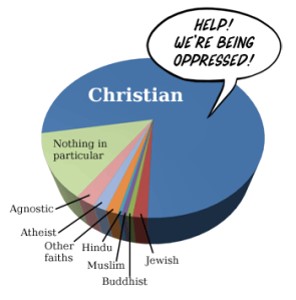
Also I think it is important to note that there is not any systemic, government-sponsored persecution in a physical bodily way against Christians or any other religion.  Sometimes, though, we Christians can act like there is a conspiracy against us, like the picture at the top of this post suggests.  But it is simply not true.  In fact, I would go so far as to say that it is wrong for American Christians to act like or think or declare that we are oppressed in the United States, when there are millions of Christians around the world, living in countries where it is actually illegal to be a Christian, and where they daily face physical bodily persecution.

As you can see on the picture, most persecution against Christians takes place in Africa, Asia and the Middle East.

The newest issue of Persecution magazine came out recently.  I urge you to check it out and learn about what is happening around the world.  Just reading that could make you extremely grateful for the freedom of religion that we have in the USA.  And it could encourage you to pray for Christians around the world who are, right now, being persecuted.

So what persecution do we face in the USA?  We do, from time to time, face ridicule from those who disagree with us. What that means is that we are affected by our Christianity.  As we should be though, right?

We Christians hold to the way of Jesus, and even in free society, there will be people who think believing in God is ridiculous.  They might have all kinds of ways to make fun of us, belittle us, or marginalize us.  We should not be surprised when this happens.  Think about what happened to Jesus.

Photo by Christop Schmid on Unsplash

One author I found said, “We can’t stop people from shooting us down, but we can stop giving them ammunition.  When we respond with anger, bitterness, revenge, we give people ammunition to tear us down.”

Is it persecution when a company takes a stand on an issue and people who disagree with the company’s stand decide to boycott? Should the company say they are being persecuted?  Or should they just say “We took a stand for what we believe is right, and we knew that not everyone would agree, and maybe we’ll lose a lot of income.  But we’re willing to accept those consequences.”

If people treat us illegally, of course we have legal means to pursue getting justice, because in our country there is freedom of religion. But Christians have another way to respond when we are simply insulted or made fun of.

Peter is saying in verses 13-15 that when we are mistreated, we can absorb it, because Jesus is our Lord.  We don’t have to be afraid.  Furthermore we can know that when we are mistreated, Peter shockingly says in verse 14, we are blessed.  Jesus taught that to Peter.  In Matthew 5, Jesus says, “Blessed are you when people insult you, persecute you and falsely say all kinds of evil against you because of me.  Rejoice and be glad, because great is your reward in heaven.”

So instead of responding negatively to criticism or insult, look how Peter says we should respond in verse 15, “In your hearts set apart Christ as Lord.”  This is crucial. And tomorrow we’ll talk about how to set apart Christ as Lord.

A story about what happens after people die

Photo by Ashim d’Silva on Unsplash

What happens after a person dies?  My uncle recently sent me this story, author unknown, that tries to answer that question.

On the outskirts of a small town, there was a big old pecan tree just inside the cemetery fence. One day, two boys filled up a bucketful of nuts and sat down by the tree, out of sight, and began dividing the nuts.

‘One for you, one for me, one for you, one for me,’ said one boy.  Several dropped and rolled down toward the fence.

Another boy came riding along the road on his bicycle. As he passed, he thought he heard voices from inside the cemetery, so he slowed down to investigate. Sure enough, he heard, ‘One for you, one for me, one for you, one for me…’

He just knew what it was. He jumped back on his bike and rode off. Just around the bend he met an old man with a cane, hobbling along.

‘Come here quick,’ said the boy, ‘you won’t believe what I heard! Satan and the Lord are down at the cemetery dividing up the souls!’

The man said, ‘Beat it kid, can’t you see it’s hard for me to walk?’ When the boy insisted though, the man hobbled slowly to the cemetery.

Standing by the fence they heard, ‘One for you, one for me.  One for you, one for me.’

The old man whispered, ‘Boy, you’ve been tellin’ me the truth.  Let’s see if we can see the Lord!

Shaking with fear, they peered through the fence, yet were still unable to see anything. The old man and the boy gripped the wrought iron bars of the fence tighter and tighter as they tried to get a glimpse of the Lord.

At last they heard, ‘One for you, one for me. That’s all.  Now let’s go get those nuts by the fence and we’ll be done.’

They say the old man had the lead for a good half-mile before the kid on the bike passed him.

That boy and the old man had a very interesting view of God and what happens after people die!

While we might take issue with their theology, we can agree with them that something does after to people after they die.  We believe that there is an eternal destiny for all.

Therefore, a significant element of the mission of God’s Kingdom has been that Christians tell the story of hope that we have because of what Jesus has done for us.  We don’t have to look at life beyond the grave with fear because we have hope in Christ.  Additionally, Jesus said that the hope we have in him matters before we die.  We believe that becoming a disciple, a follower of Jesus, gives us hope for eternal life after death, and gives us hope for best possible way to live now.  We believe that God is preparing a place for us in heaven, and he is seeking to transform society now!  Eternal life in heaven, abundant life on earth.  That’s how we summarize this amazing Kingdom of God.

As Peter continues teaching the Christians in the Roman Empire around the year 65 AD, he now teaches them about how to live out this mission of God’s Kingdom among people who might be antagonistic or atheistic, agnostic or apathetic.

So please read 1 Peter 3:13-17.  This week we’re going to see how Peter instructs Christians to talk about this hope they have.

How to be a peacemaker (shocking lessons from an “insane” person!)

Image result for seek peace and pursue it

All week long, we’ve been looking at 1 Peter 3:8-12 where Peter teaches a very difficult thing to do: when people insult you, ask God to bless them.

Is Peter saying you can never defend yourself?  I would submit that Peter would answer, “No. You can defend yourself. But there is a right way and a right wrong to defend yourself.”

First of all, if you are abused, report it and get safe.  We live in a country where there is legal recourse to deal with abuse.  That is a very good thing.  Not all countries throughout history have been like this.  There are certainly Christians living in places around the world even today where they are physically abused, maybe sexually and emotionally too, and they have no recourse.  Imagine how difficult it must be for them to hear Peter’s words.  They might not be able to get safe.  They too, however, can bless those who persecute them.

Thankfully, ours is a country where abuse and persecution are not tolerated.  But I think here in his letter Peter is primarily thinking about how interpersonal relations in a church family can get ugly.  Meanness.  Unkindness. Gossip. In those cases he is not saying, “Do not stick up for yourself.”

He is saying that there is a difference between aggression and assertiveness.  We do not need to attack back.  It will only make things worse if you attack back.

I once heard Ravi Zacharias say: “When you throw mud at others, you not only get your hands dirty, but you lose a lot ground in the process.”  When people are evil to us, or insult us, we are not to get revenge.  Instead, as I said yesterday, if they insult you, eulogize ’em!

Peter supports his argument with a quote from the Old Testament.  Psalm 34:12-16 to be exact. Psalm 34 is a fascinating psalm written by the great poet, warrior, king of Israel David. And it has a wonderful backstory.  The subtitle of Psalm 34 tells us that David wrote this psalm as he was reflecting on a really difficult situation in his life.  At the time he was a fugitive, on the run from his father-in-law King Saul who wanted to kill David.  In 1 Samuel 21 we read that David made the surprising decision, after retrieving Goliath’s sword (the same Philistine Goliath from Gath whom David had killed years earlier), to go to enemy Philistine territory, and of all places the city of Gath.  Can you tell that David was under a lot of pressure and maybe not thinking straight?  He arrives at Gath, and the Philistine leaders there are very suspicious.  In their eyes David was the most well-known Philistine killer.  Not only had he killed their hometown hero Goliath, but in the years following, he had commanded Israelite armies that had killed thousands of other Philistines.  Now he is in their town, hoping for asylum?  David sees their reactions, their doubt, their fear, and he starts thinking “Uh-oh…did I just make a horrible decision coming here?” This would be the Philistines perfect opportunity to get their revenge on David. So what does he do?  He acts insane, to the point of allowing drool to dribble down his beard!  I encourage you to read the account for yourself.  It’s quite a vivid episode in David’s life.  Find out how the Philistines reacted to his insanity ploy!

That is what David was thinking about when he wrote Psalm 34.  The whole psalm is amazing and deserves lots of attention and further study, but Peter only quotes verses 12-16, so that will be my focus here.

I’ll start in Psalm 34 verse 11, “Come, my children, listen to me; I will teach you the fear of the Lord.” I see David in Psalm 34 as older man, wanting to pass on wisdom to his grandkids.  Telling them the story of the time he pretended to be crazy, and then saying these words.  And what does he say?

He starts with: “Whoever of you loves life and desires to see many good days…”

You probably don’t have to look hard to find people who love life and desire to see good days. So for those who want that, what do you have to do?  David has some specific instructions.

He says, “keep your tongue from evil and your lips from speaking lies. Turn from evil and do good; seek peace and pursue it.”

Four things that line right up with Peter’s teaching, and can be summed with: control your mouth!  That means not speaking any evil or lies, no matter what has been done to you.  Then do good.  Turn from evil.  Finally, seek peace. Actually pursue it.

David is not just saying, “be a peaceful person;” he is saying the we should be actively pursuing peace.  Seek it out, make it happen. When you pursue something, you strive for it, and it often takes intense effort.

David, therefore, is not just reactive; he is teaching a proactive seeking of peace.  When our seminary president, Tony Blair, spoke at Faith Church a few years ago, he made a comment I’ll never forget, “mature Christians deflate drama.”  Peace-seekers reduce drama.  And that can be hard work, but it is necessary work in the life of a church, family, workplace, or neighborhood.

This does not mean you agree with people all the time.  It means that you handle things in such a way that drama is reduced.  This goes back to verse 9 and choosing not to react back, or fight back against someone who has been evil to you or insulted you.

Finally look at verse 12, where David personifies the Lord.  God is spirit.  He doesn’t have a body.  It’s hard to know how to depict God.  When I illustrated this part of the sermon, I chose a lion for the slide because there are times in the Bible when God is described as lion.  He’s not a lion.  But look at how David uses human body parts to teach us about the Lord.

Eyes – on the righteous

Ears – attentive to their prayer

Face – against those who do evil

What a comfort!  No matter what is going on in our lives, our God knows, our God hears, and our God defends.  That means we can take hope in the Lord and do good, loving those in the church family, even when people are unkind to us.  He knows, he is on the side of the righteous!

If they insult you, eulogize them!  Guess what I learned this week?  I should love eulogies!  I should be eulogizing all the time!

How to handle difficult people: When they insult you, eulogize ’em!

I learned a shocking thing about eulogies, and in this post I’m going to reveal what I learned.

This week we are studying 1 Peter 3:8-12, and so far we have learned the Top 5 adjectives that Peter says should describe a church family.  Now he gets to some verbs, some actions that members of a church family should practice.

Look at Verse 9 and we see the verb “paying back”, or as the NIV says “repay”.  This can be positive or negative.  You have to look at the context.  A payback can be very positive, right? When you borrow money, you pay it back.  That is good.  Or when someone is kind to you, then you are kind back.  Or you might pay it forward.  You are sitting at the drive through and the person in front of you pays for your meal, so you pay for the meal of the person behind you.  Those are awesome paybacks.

Then there are other not so awesome paybacks.  And that is the verb, the action Peter is talking about.  But he puts a tiny little three letter word in front of it, the word “not”.  Do not repay.  Do not do the negative paybacks. At a recent youth group pool party, I witnessed tons of paybacks.  A person would be standing on the edge of the pool, and another person nearby would push them in!  Guess what would happen five minutes later?  Yeah, paybacks.  I think we got to the point where there paybacks for paybacks for paybacks.

The first things Peter mentions is paying back evil for evil.  Don’t do that, he says.  The second thing he mentions is paying back insult with insult. Don’t do that either.

The word Peter uses for “insult” means “highly insulting and slanderous.”  We are not sure if Peter is referring to the method or the message, or both.  It doesn’t matter.  Don’t do either one.  Don’t speak with an insulting tone, and don’t speak insulting messages.  He is saying “Don’t pay back an insulting comment with an insult of your own.”

This requires huge amounts of self-control and love.  We need it in church families just as much as we need it in any family, any friendship, and workplace, any neighborhood.  Christians show self-control when someone treats us bad.

How about you?  Do you have trouble with self-control?  Has your mouth gotten you in trouble?   The escalation of insulting one another is rampant in our society, and it can happen in the church too.  Drama increases! What should we do when people are mean to us?

As Peter continues in verse 9, he gives us the answer.  Guess what?  He says the answer is eulogy!  See the word “Blessing”? In Greek this is the word from which we get our English word “eulogy.”

I have done a lot of eulogies in funerals.  But Peter doesn’t have a funeral in mind here.  He is saying “Eulogize people when they insult you!”  Now, when you are insulted, you might be inwardly wishing it was that person’s funeral!  But no, Peter is saying, bless them.  Here is the definition of eulogy, the specific word that Peter uses.  This definition blew me away, when I thought about how Peter uses it in the context of a person who has just been insulted!  The definition is “to ask God to bestow divine favor on, with the implication that the verbal act itself constitutes a significant benefit[1]

That is amazing.  When they insult you, eulogize ‘em! And it doesn’t mean you wish them dead!  It means you ask for God to bless them.

What’s more, Peter supports his teaching by saying that we Christians are called to eulogize people who insult us, so that we might inherit a eulogy.

Think about that.  If we bless people who insult us, or who are evil to us, that means that we will inherit a blessing.  Again, remember the definition of this word blessing, eulogy, “to ask God to bestow divine favor on.”  Would you like God to bestow his favor on you?  If so, we are to be the kind of people who ask God to bestow his favor on those who insult us or who are evil to us!

So now whenever someone says something mean to you, just put on a smile and say “I am going to eulogize you right now.”  They’ll give you a weird look.  So maybe don’t do that…they might misunderstand and think that you want them dead, which could make things worse!

Instead, you might just need to not say anything.  You know yourself.  When you are attacked, you might have a really hard time reacting with kindness.  If so, maybe the victory for you is to just respond with a smile, and pray silently in your thoughts that God would shine his favor on them.

You’ll have to evaluate the emotional temperature of the situation.  It may be that the person is so upset that they are not in a place to hear anything, even blessing.

For one of my college soccer games, we were playing another Christian college.  I played defense and my main job that game was to cover one-on-one an offensive guy from the other team.  So we battled a lot throughout the course of the game, and this guy had some attitude.

There we are, players from two Christians schools playing a level of soccer that was maybe the quality of good public high schools.  Not world cup.  Not professional.  Not even close.  And this guy on the other team was fired up, pulling at my jersey, talking nasty to me, and I’m thinking to myself, “You have got to be kidding me.”  Now I will admit that it was not a proper eulogy or blessing, and my attitude definitely had a dose of snarkiness, but at one point I looked at him and said, “Jesus loves you, man.” It was a Christian soccer player attempt at repaying an insult with a blessing.  The funny thing is that it seemed to hit home. 

After the game, he actually came up to me, shook hands and thanked me, saying that it totally convicted him!  I was shocked.  Glad, but shocked.  Embarrassed because my motivations weren’t totally pure, but still amazed that God used that.  When we played that team the next year, that guy came right up to me with a big smile, remembering the previous years’ interaction and he was like a totally different guy.  It was wild.

When they insult you, eulogize ‘em.

[1] Louw, Johannes P., and Eugene Albert Nida. Greek-English lexicon of the New Testament: based on semantic domains 1996 : 441. Print.

The Top 5 adjectives that should describe a church family (do you know them?)

Related image

Get out a pen and paper, or open up a note-taking app.  What are the first five adjectives that come to mind if you were trying to answer the question: “What are the five top adjectives that should describe a church family?”

This week we are studying 1 Peter 3:8-12 where Peter teaches how a church family should interact with one another.  Yesterday we saw the first of five adjectives that Peter says should define a church: harmonious.  A church should be unified.  Today we going to look at the remaining four adjectives, and I think you’ll see that they all very much relate to or support the idea of being harmonious.

The second adjective is Sympathetic.  Sympathy is when you have common feelings or emotions with someone.  Hear the unity in that?

Third is Brotherly Love.  This is the Greek word philadelphia again, just like we saw in 1:22, “love for your brothers.” Same word.  This is vital for unity.  Love is the basis for unity.

Next is Compassionate.  The passion part of this word is not about erotic passion.  The word Peter is using is about painful passion.  We English speakers almost never use the word passion like that, except in one week of the year.  You know which week?  Holy Week.  It is also called Passion Week, and churches do Passion Plays, and what passion are they talking about?  Jesus’ passion, his suffering!  Jesus’ arrest, beating, crucifixion and death are his passion, his pain, his suffering.  And that is what the word compassion is getting at.  It means to “suffer with someone.”  We normally think of compassion as when we see someone hurting and we go, “Awwww…it will be okay,” or some platitude like that.  But true compassion is to enter into the pain with that person.  That is a whole deeper level of kindness and relationship that we can see totally spurs on unity!

Finally, Be Humble.  That one is huge.  Humility, teachability is critical for unity in the church family.  I cannot emphasize this enough.  In a church family, we must simply be humble.  Pride and arrogance will destroy our relationships.  When I did my missionary internship between my junior and senior years in college, I spent three months in Guyana, South America.  There were probably 15-20 different missionaries working together in the same general area.  My host family were really awesome, and they taught me so much about ministry.  One thing they taught me was humility.  One night the wife was telling me about how they had been having significant relationship problems with one of the missionaries.  This other missionary was being extremely difficult about a policy and making false accusations against my host family.  They prayed hard about how to respond, because they knew they had not done what they were accused of.  You know what my missionary host family told me they decided to do?  “It is better to take one for the team and preserve unity, than it is to be right.”  Wow.  That’s humility.

Those are the five adjectives Peter says should describe a church family: harmonious, sympathetic, brotherly love, compassion and humility.  So how many did you get?  And more importantly, are there any that you need to work on?  Who can you talk with in your church family about improving on that characteristic?

But Peter is not done.  He finally gets to some verbs. We’ll start looking at them tomorrow!