How to transform an over-opinionated, judgmental spirit? THE 10th MAN! – Luke 6:37-42

tenthmanLast week I introduced Jesus’ next crazy Upside-Down Kingdom teaching.  Simply put, he gave us two negatives that should be transformed into to two positives. “Do not judge and do not condemn” should change to “forgive and give.” Instead of being negative-minded about people, we need to be generous toward them, forgiving them.

So in place of negative judging and condemning, we should forgive and give. But how? It is so easy to say this stuff. “Oh yeah, I shouldn’t judge and condemn. I should forgive and give.” But in reality, it can be super hard. We judge so much. We have tons of opinions. They often come fast and furious without us even really thinking about it.

So how do we stop judging and condemning? Is it possible? How do we start forgiving and giving when we feel angry and upset?  I think Jesus gives us a clue in two little, somewhat cryptic parables.  Actually many of his parables can seem difficult to understand at first glance!  So let’s take a look.

In Luke 6:39-40 he first refers to the blind leading the blind, which is a common analogy in our culture. Why do we use this phrase? It refers to one person lacking understanding acting like they can help someone else who also lacks understanding. We would call that ridiculous!

The second mini-parable says that a student is not above his teacher.  A student is in lower position than his teacher. A student is unlearned. But he can get there. You have to go through training!  Further, you need to think about who your teacher is, because you will become like them. This was said in a culture of apprenticeship. If you were apprenticed to a person who was bad at farming, you would learn bad farming techniques.

In both mini-parables, it seems to me that Jesus is talking about people who do not have a healthy self-awareness.  If you’re blind, to successfully navigate life, you need to know your limitations.  If you’re a student, to successfully learn, you need to know you’re not as learned as your teacher.

I say that because in verses 41-42 he explains his point very clearly. Examine yourself first! Have you ever been surprised to find out that the very thing you were so hard on someone else about, is something that you struggle with too? I coach my son’s U12 soccer team, and the other day we were working with the boys on taking shots on goal. One particular kind of shot is called a volley where you kick the ball while it is still in the air. It is difficult because it requires good timing and form. If you don’t hit the ball just right, you either send it way over the goal, miss it completely, or flub it like a foul ball in baseball. They were missing everything, so I decided to demonstrate for them. And what do you think happened? I sent it way over the goal, over the fence, and into the high school stadium adjacent to our field.  That meant I had to take a run of shame way around the fence to go get the ball.  A healthy sense of self-awareness for me would be the realization that my soccer skills are really rusty.

Jesus is talking about is the absolutely necessity of having a healthy self-awareness.  This reminds me of my Old Testament professor Dave Dorsey who once said that at 19 he knew a lot more than he did at 60! And what happened in his life during the years since he was 19? He had earned his doctorate, got a teaching position at the seminary, wrote books and went on to be a world-renowned OT authority. How could he possibly have learned less?

He actually didn’t. He gained more knowledge, tons of facts and information, but in the process he also grew an important sense of how much he didn’t know. It was humbling, he said.

So here are some tips that can help us have a healthy self-awareness:

  1. Remember that we are all made in the image of God. All equally loved by God. All just people. Even our heroes. Even the people that we look up to are just people like us.
  2. Always leave the door open to the possibility of seeing things from a different angle.

In the movie World War Z, Brad Pitt’s character is attempting to find the source of the infection that is turning people into zombies.  He travels to Jerusalem because they had built a giant wall around the city to keep the infection out.  He asks the Israeli leader how they had the foresight to build the wall when the rest of the world was unprepared and thus devastated by the apocalypse.  The Israeli leader shares with him what he calls the 10th Man Rule:

We need to apply the 10th Man Rule in our lives.  Allow God’s Spirit to convict you.  Read his word. Have a trusted accountability partner.  Have a healthy self-awareness that includes self-doubt.  All of these things can be our 10th Man.

We need to guard our hearts and minds because we can allow ourselves to get very, very stuck into a way of thinking that is very, very negative about people. There is always much more to people that we could ever imagine.

Have you ever read an email negatively, going down a road of final judgment (condemning as guilty from verse 37)? And then when you sit down and talk with that person, you realize they meant something very different?  We need to apply the 10th man principle!

Use that vital Fruit of the Spirit called Self-control. Before passing judgment, assume that you are not fully understanding them. Strive hard to find the good motivation that could be there. Meet with them face to face to talk it over. Don’t talk with other people about them. Talk with them. And look hard at yourself. Are you actually guilty too?

Let us be a people that are aware of ourselves first!

Are you opinionated?

opinionated_people1256328679-copyOpinions. We have lots of them, don’t we?

Some of us seem to have more opinions than others!

Have you ever thought of that? Why do some people have more opinions than others? And why do some people have strong opinions while others have weak opinions?   Some people seem to have strong opinions about almost everything.   Know anyone like that? I do.

I think the reality is that we all have opinions. We all have feelings about things, but some of us are more vocal about it than others!

Did you ever know someone who is really opinionated, but they had no idea that they were opinionated? Maybe you know someone like that. What I’m getting at is that it can sometimes be very hard to see the truth about ourselves.

How do you see yourself? Are you opinionated? Are you judgmental?

How many judgments have you made today?

None? Or maybe a lot?

As we continue our series through Luke 6, Jesus has been introducing us to his upside-down way of looking at the world. In fact, some people have called it his Upside Down Kingdom. The normal values of our culture do not apply here.

In Jesus’ Upside Down Kingdom, the poor are considered blessed, and the wealthy are considered to be in a horrible situation.

In the Upside Down Kingdom, when you are hungry and mistreated and people hate you, you are blessed. But when you are well-fed and popular you are in a horrible situation.

In the Upside Down Kingdom, you love your enemies. You do not retaliate when mistreated. Instead you give, and you generously.

We saw last week that one of the cardinal rules of the Upside Down Kingdom is that you do to others what you would have them do to you.

Today Jesus teaches us more about how his disciples will live and act in his Upside Down Kingdom.

So we would love for you to be our guest at Faith Church tomorrow.  If you want to prepare, considering reading Luke 6:37-42.

Was Jesus’ teaching too radical? – Luke 6:27-36

UpsideDownKingdom_bannerLove your enemies?  Give the shirt off your back?  Give to everyone who asks?

Last week I introduced the next section in Jesus’ sermon in Luke 6, the section he starts off famously “Love your enemies.”  Jesus really has some challenging things to say here. Because Jesus’ words are so different from the prevailing truth of most cultures around the world, some people have taken to calling Jesus’ approach, The Upside-Down Kingdom.  From the vantage point of our culture, Jesus seems wrong and thus upside-down.

If you’re like me, you can respond to Jesus with of all kinds of “yeah, but…what about this or what about that, Jesus?  Have you thought about how your teaching will work out in real life?” Let me explain.  As I’ve studied for this sermon, I’ve struggled with how to present Jesus’ teaching. There are exceptions to the rule. Would Jesus be okay with allowing for exceptions?

Usually the difficulty lies in those life situations when obeying one teaching leads us to disobey another. Like the idea that if I give all my clothes away, I won’t have any for myself. Do I practice generosity so far that I am guilty of disobeying modesty? If I gave all my clothes away, I would be nude.  Should I do that?  Of course not. Do I practice non-retaliation so far that I allow my kids to be abused? Of course not. We need to use wisdom in applying these principles. And these are great principles. Let us not get confused by the exceptions to the principles so that we just chuck the principles out the window.

Jesus is calling us to be disciples in his upside-down kingdom, and that means we have hearts that love and give, sometimes in a way that seems reckless to the world! So here are some principles to take away:

First, let us give generously and sacrificially, especially to those in need. The biblical principle is that we should give towards equality. In the example of the first followers of Jesus or in passages like 2 Cor 8:14 we see this:

Our desire is not that others might be relieved while you are hard pressed, but that there might be equality. At the present time your plenty will supply what they need, so that in turn their plenty will supply what you need. Then there will be equality, as it is written: “He who gathered much did not have too much, and he who gathered little did not have too little.”

Last week I introduced our evangelical forefather John Wesley’s teaching “Earn all you can, save all you can, give all you can.”

Earn means “work hard and make money.” In fact, make all you can. Use your gifts and abilities to make a lot of money. There is nothing wrong with amassing wealth, as we learned last week, if that wealth doesn’t own us.

Instead, Wesley says, “Earn all you can, save all you can.” Save means “don’t spend the money.” When he said “save,” he didn’t mean you should earn a ton of money and build up a massive savings account so that one day you can have fun in retirement. He specifically meant, “don’t spend your money on yourself.” Of course, we must meet the essential needs of our families, but in so doing live very, very simply. This incredibly hard to do in America because we have been told that we need tons of stuff, food, clothes, gadgets, cars, houses, hobbies and vacations. What we want and what we need has been confused. Wesley taught, however, the biblical principle of simplicity.

And why? So that you give all you can. Make a ton of money, don’t spend it, so you can be generous.

This video of a freezing child really challenged me to be more generous:

In addition to radical generosity, let us practice the principle of radical love.

Let us live lives without tit for tat. You have heard it said “eye for an eye” (OT principle), but Jesus tells us “get hit, turn the cheek!” Jesus himself is our example, washing the disciples’ feet. He is our example, saying “Father forgive them for they know not what they do” while they were nailing him to the cross. We must become people who do not take revenge. Instead, in this upside-down kingdom, when people mistreat us and take advantage of us, we seek to love them. Again, loving them doesn’t mean enabling bad behavior. But we should not be people who hate others, who are looking for revenge, who are hoping for bad to happen to others.

Instead we practice kindness. We practice love. Let us love the difficult people, the enemies. Treat them like you want to be treated. Remember that you are a person who some people have a very hard time with.

Show love to ISIS?

Red heart.A Facebook friend posted an article which included the video below, which is a message to ISIS.  Give it a look and see what you think.

How do you feel about that?

We continue our study of Jesus’ Words, Works and Way in the Gospel of Luke this Sunday, and we come to another one of his classic statements “Love your enemies.”  Continuing a teaching we started last week, Jesus once again turns conventional wisdom on its head.  Love your enemies?  That seems wrong.

Love ISIS?  Really?

What about a passage such as Romans 13:1-7?  Check it out and you’ll find a teaching by one of Jesus’ first followers, a guy named Paul, who was writing to Christians living in the capital city of the Empire, the superpower of the day, Rome.  The Emperor and his Roman armies could be pretty brutal, and not too many years after Paul wrote this, Christians would be on the receiving end of persecution from the Emperor.  For a long time, those Christians were living with the same day-to-day reality that Christians in the Middle East today face with ISIS and other groups targeting them.  Specifically look at what Paul says in Romans 13:4:

“But if you do wrong, be afraid, for he does not bear the sword for nothing. He is God’s servant, an agent of wrath to bring punishment on the wrongdoer.”

Throughout the centuries many governments have used this passage as a basis for what is known as Just War.  Just War theory states that there is a time and place, in order to restrain evil, for one country/group to take military action against another country/group.  There is much debate about what constitutes just war.  I once heard a historian suggest quite seriously, and with scholarly research, that the American Revolution might not have qualified as a just war.  When looking back over history, it seems that sometimes we have done well (defeating Nazi Germany, for example) and other times we have not done so well (Vietnam, possibly?).

What should we Christians do then with “Love your enemies?”  What is an enemy?  Just a foreign nation?  Should we travel in droves to the Middle East and plead with ISIS to stop killing people?  And does “love your enemies” apply, perhaps, in many other ways here at home?  How should we take this teaching from Jesus?

We invite you to join us at Faith Church on Sunday morning as we discuss this further!

Why Jesus says the poor are blessed – Luke 6:17-26

poor

We want to be rich. We do not want to be poor. In Luke 6:17-26, however, Jesus takes that normal desire and turns it on its head.

He says the poor are blessed, while he says “Woe” to the rich.

To understand why in the world he would say that, we need to take a look at those two terms: Blessed and Woe.

Blessed is basically the word “Happy”. Some Bibles actually do translate it that way. And why is the person happy? The definition says that it implies that the person is happy because they are enjoying favorable circumstances. So you would normally use this word to describe the emotional state of someone who is going through a good time. They are happy.

But look at the circumstances that Jesus describes. They are poor, they are hungry, they are weeping, people hate them, exclude them, insult them, and call their name evil.  Nice, right? Good times!

We look at that list and don’t want any part of it. I am not a fan of any of the items on that list.  You?  Who really, truly likes being poor, hungry, weeping, and despised? The prevailing opinion in the world back then and still today is that those are bad, bad places to be!

But Jesus says “Hey poor people. And you hungry ones. And you who are crying and despised…you guys be happy! You are the ones who are in favorable circumstances.”

I wonder if any single person in the crowd that day believed him? I can see them perking up though.  Especially as he goes on to say, “Woe to you wealthy people”.

What does Woe mean? It describes hardship, distress, even horror. Verse 24 could be translated “how disastrous it will be for you who are rich.”

The rich are not enjoying favorable circumstances, Jesus says!  Instead, they are in terrible horror.

Anyone else thinking what I’m thinking? “Jesus, are you serious?” Is he basically saying here that if you’re poor, you’re going to heaven and if you’re rich, you’re going to hell? It could really sound like that, couldn’t it?

In that day and age, the prevailing notion was that poverty meant God was cursing you, and wealth meant God was blessing you.  Health and wealth, to that audience, meant that God was blessing them. Many of us feel the same way!

And Jesus comes along and turns that idea totally upside down.

He goes on to say that if you are well fed now, if you are laughing now, if you are popular now, you are getting your reward now. You are loving life now.

But a day will come when things won’t be so fun.

So does this mean we are supposed to live lives of poverty? If so, we American Christians are pretty much done for.  If the measure is health and wealth, most American Christians have already received their reward.

So what do we do with Jesus’ words? We read this stuff, and we very, very quickly say “Well, he didn’t mean that.” We like Matthew’s spiritualized version better.

Luke’s version confronts us pretty hard, doesn’t it? Maybe we want to take Luke’s version, throw it in the trash, or spiritualize it, and then, whew, we are off the hook.

Think about it, we make delicious, indulgent meals all the time. We laugh a lot. At lip sync concerts.  We are entertainment happy.

Would Jesus say, “Woe!” to us?

As I was studying this I had to ask, “Jesus, why in the world did you say all this stuff?” It is very hard to hear his words from a wealthy American context. If you are a Christian, say, in one of my denomination’s sister EC Churches in Liberia, Africa, where it is super poor, where your country has had nothing but civil war and poverty and Ebola for the last 20 years, you probably hear this passage and jump for joy.

But you and I…what do we with this?

First and foremost, Jesus is not teaching about how to get to heaven. Instead Jesus is speaking very provocatively, which he does often, to get our attention. He was a master of that. Educational theorist Jean Piaget called it disequilibration. What happens to a pond whose waters never move? It gets stagnant. Piaget basically said that happens to our brains. Our brains need to be moved, challenged. To keep a pond from stagnancy, you need to throw rocks in that pond, create wave ripples. Jesus is throwing rocks in the pond of a very stagnant culture.

So remember this rock he once threw into that stagnant pond?: “It is harder for a rich man to enter the Kingdom of God, than it is for a camel to pass through the eye of a needle.” Remember that? Splash!

Is Jesus saying that being wealthy is inherently bad? No, he is just speaking what is so often true, that we can get very dependent on our wealth, we can become addicted to our technology, and we can become distracted by our comforts and entertainment. We can allow this stuff that we love to turn our hearts and minds away from God! That’s why another time a rich man came to Jesus and said “What must I do to be saved?” And you know what Jesus said? “Sell everything you have, give it to the poor, and come follow me.” Splash!  But the guy couldn’t do it. He was too connected to his wealth. He couldn’t let it go. That guy had no idea that following Jesus was better, way better, by far!

Now here’s the question, is it possible for a wealthy person to depend on Jesus and truly follow him? Yes it is. But Jesus is at least saying that it is very, very hard.

But it is possible. Many times on this blog, I’ve mentioned John Wesley’s, phrase about wealth: “Earn all you can, Save all you can, Give all you can.” We’ll talk more about this in the next post. But let me introduce it here. Wesley is saying that we should earn all we can, and for some of you, hard work, using the mind and body God gave you, will result in wealth. That is a good thing! So earn all you can. But also save all you can. By that Wesley meant “don’t spend it on yourself.” Amass wealth, yes. But be careful, it is very, very easy to start spending that wealth on the so-called good life. Wesley says, save it. Don’t spend it. And next week we’ll see why.

So Jesus said these blessings and woes to that crowd that day because he wanted them to understand what is valuable and important in God’s eyes. We are so accustomed to the values of our culture. The crowd that day 2000 years ago in Palestine was likewise accustomed to judging things based on the values of its culture.

In First Century CE Israel, the value was that if you are poor, God was cursing you, and if you are rich, God was blessing you. It was basically a health and wealth Gospel.

Jesus says “No, No, No. The opposite just might be true.”  Splash!

Jesus says that we need to use the values of the Kingdom of God to evaluate our lives.

Will we make our financial decisions based on our culture or based on Christ? We will make our decisions for how we spend our time based on the mission of God’s Kingdom? If we simply spend our money and our time on ourselves, Jesus says, we have gotten our reward here. He is saying that we should be a people who desire God’s rewards!

Where do we draw the line? I don’t want to be legalistic. I am purposefully not going to give you examples of how to spend your money or how not to. There will be many, many possibilities for the choices we should make. Rather I want you to do the hard work of taking the key principle we should adhere to and applying it to your life, and that is this: Go to the Lord and say “Lord, I want to honor you with this decision about how I spend my time, my money, my life.”

I will recommend this: accountability. Will you consider submitting your life to an older, wiser Christian who loves the Lord, who is willing to speak blunt truth, and lay everything in your life open before them?

Jesus is saying that it is not correct to view wealth and health as blessings from the Lord. You might be poor and sick, but if you follow him, there is hope, because one day you will get your reward. Make your life about following him and the mission of his Kingdom!

Instead, be people who give your time, your talent, your treasure sacrificially to God and the mission of his Kingdom.

Does God want you to be rich? (and healthy?)

health and wealthHave you ever heard of the Health and Wealth Gospel? It is a view of faith in Christ that has been around a while that basically says “if you are faithful enough to God, he has to bless you with health and wealth.”

If you believe enough, he will heal you.

If you give enough, he will prosper you.

Basically, if you have enough faith, you’ll have the good life.

You can hear preachers on TV that seem to believe this. But is it true?  God definitely wants us to be faithful to him, and to grow in our faithfulness, but does he promise that he will give us riches and health if we reach a certain level of faith?

The clear response across the many books of the Bible is that we live in a fallen world! We are not going to live forever. There are accidents, diseases, and sinful choices that we make, and that others make, that affect us. The result is that sometimes we will face difficulties in this life. We might lose our job, get sick and have pain.

I’ve officiated enough funerals and done enough hospital visits in my short 7 years as pastor to knwo that when someone we love dies, or when something bad happens to us, we are quick to question “Why did you allow this, God?”

I get it that when we’re in a difficult situation, we are desperate for answers, for explanations, for anything to help us make sense of the pain that we’re experiencing. So we quickly turn it on God.

But think about that with me for a minute. Is the pain in this world God’s fault?

Doofenshmirtz with his Deflate-inator

My kids love the cartoon Phineas and Ferb, and in that show the bad guy, Dr. Doofenshmirtz, creates a new destructive ray gun every episode. He names each gun uniquely, ending with the phrase “-inator”. So there is the “Destruct-inator,” and the “Space Laser-inator” and the “Freeze-inator” and the “Ugly-inator” and about a hundred other “-Inators”. Do we really believe that God has a “Get sick-inator” or a “Accident-inator” or “Marriage break-up-inator” or an “-inator” for all the bad stuff that can happen, and he zaps us with them?

Is the pain in this world God’s fault? When we’re going through a hard time, should we go to God in prayer and ask “Why are you doing this to me, Lord?”

We do that, don’t we? I wonder if we do it because, while most of us don’t believe in a Health & Wealth Gospel, if we are honest with ourselves, we believe it a little bit.

A pastor friend shared the following quote from Jerry Walls that introduced this idea to me:

“Accepting Jesus and following him faithfully does not guarantee or make it significantly more probable that you will flourish physically or financially, or have your best material life now. But having said that, I wonder how many of us who repudiate health and wealth gospel may accept a more subtle, respectable version. In particular, how many of us believe we have been blessed with good health, good jobs, beautiful homes/cars, beautiful bodies, and so on by virtue of thinking God has acted in particular ways to bless us that he has apparently not acted to bless many other persons, including our fellow Christians? How different is this assumption/belief than the version of health and wealth gospel preached by many televangelists?”

That’s a deep question to think about.

Maybe we actually do look at health and wealth as a blessing from God. Maybe we actually do look at sickness and poverty as a curse.

But is it? Is that how God works?

Jesus has what might be a surprising answer for us in our next section of our study through Luke. If you want a sneak peak check out Luke 6:17-26, and if you’re in the Lancaster area and are not involved in church family, we invite you to Faith Church Sunday morning to be our guest!

When the world throws crazy at you, put on headphones – Luke 6:12-16

Today we welcome Phil Bartelt as guest blogger!  Phil is a pastor in the EC Church, who, along with his family, are part of the family of Faith Church.  After taking a couple weeks to fast-forward in Luke to the stories of Holy Week, Phil resumed our teaching series through Luke.   With this post Phil reflects on the sermon and Jesus’ practice of prayer.

In the recent film The Internship one of my favorite actors plays the role of a computer expert working at Google. He’s a rather quirky character, and the biggest of his quirks is that he always wears headphones. headphonesEarly in the film when others try to speak to him he doesn’t answer so they assume he can’t hear them. Later when another character encounters a crisis he’s startled when the computer expert hears him voicing his problem out loud and responds. As the film winds to a close we learn that the computer expert isn’t listening to music or anything else in his headphones. He is simply not comfortable around other people and uses the headphones as a barrier between him and others.

On Sunday we looked at several passages in Luke that demonstrated to us that Jesus lived a life of prayer. The challenge for us as disciples is to figure out how we can follow his example and incorporate prayer into our daily rhythms. We talked about creating or finding a place for prayer, what it looks like to make space (time) for prayer, and how in doing so we are giving a gift to ourselves. We also looked at some different ways to approach prayer like art, journaling, or nature. In the end we saw that the most important thing was for us to find a rhythm of prayer that helped us hone in on God’s perspective as we live in a world that often throws tons of crazy at us.

Shortly after I watched the film, I read an article that stated people were very unlikely to bother you if you were wearing a pair of headphones. So maybe in our era of busy, putting in some ear buds or wearing a pair of headphones might be all it takes for us to carve out a few minutes of separate time with God. Over the next week give that or one of the other options we talked about a try. Or take some time to discuss different prayer options with a friend. No matter what you choose, you can be sure that finding a place and space for prayer in your life will certainly bear fruit.

Open your mind to new life – Luke 24

New-Life-And-OldLast week I asked “Is there only bad news in a broken world?

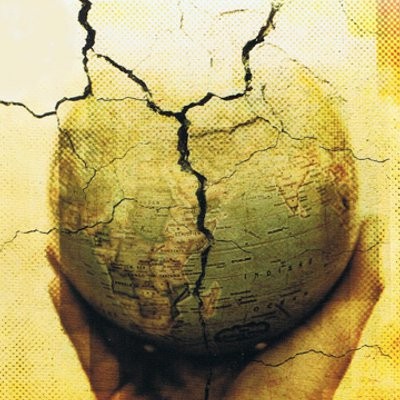
This past Sunday I had some help from the elementary age kids (and some of you older “kids”!) in trying to answer that question.  Becka, our worship leader, drew large a large picture of planet earth, and as I mentioned the bad news out there in the world today, I ripped up the globe into pieces.  It can feel like ours is a shredded world.  I talked about how the disciples following Jesus just had their world ripped to pieces.  Their leader had been arrested, beaten, falsely tried, and killed.  They could easily be next!  So I handed out the ripped pieces of the world, and asked the kids to color them brightly, and I continued with the story.

On the third day those same distraught disciples started hearing very strange news.  Good news.  But so good it was unbelievable.  They heard their Lord was alive!  As the days wears on, their excitement builds as he shows up to meet with a few of them.   Finally, he appears at the place where they were all together.  After getting over their initial shock, he gets down to the business of sorting this all out for them.

You can read about it in Luke 24:44-49. You can see their lights going on, or as Luke says in verse 45, “he opened their minds,” so they could understand that the Scriptures they had heard all their lives going to worship at synagogue now found fulfillment in him. He was the promised Savior, the Messiah. But he was a very different Savior than what they expected. The prevailing idea of the day was of a military Messiah who would remove the Romans from their land.

Jesus wasn’t a king with a sword on a warhorse. Instead, he was the one who would save the world from the penalty of sin. Forgiveness is possible. Repentance is possible. New life is possible. Just as he rose from the dead to new life, so they and you and I can have new life. As he taught them many times, it was not just a promise of eternal life in heaven with him after death. Life after death is good news! It was certainly that. But it was not just that. He also offers to us the possibility of abundant life now.

We Christians often sit back and shake our fingers, saying “What is wrong with the world today?”

The great writer G. K. Chesterton was reading the paper once and came to the editorial section. The editors of the paper asked readers to answer that very question. “What is wrong with the world today?” He knew he needed to respond. So he wrote a letter to the editor. Probably the shortest letter in the history of letters to the editor: “What is wrong with the world?” Chesterton’s response was two words: “I am.”

As long as we just sit back and talk, we are what is wrong with the world. New life means we are changed, and we share that victory with the world.  We are to be the good news in the world. New life in Christ starts by changing our hearts, and then we share that new life in as many ways possible.

As we were talking about this passage a few weeks ago at our sermon roundtable Bible study, one person told the story about a woman who was driving behind him way too close in a big old car. And he got angry. He thought, if she stops, I’m going to give her a piece of my mind. And then he thought “I don’t want to live like that…so angry.” He said that he needs that hope, that awareness of what Jesus has done for me.  When we remember that our sins are forgiven, we can and should repent of our sins and take on the new life of Christ.  Abundant life is a life that turns away from sin.

One of the first followers of Jesus who would come along a bit later, a guy named Paul, said in the letter he wrote to the church in the city of Ephesus that we are not alone in this abundant life.  Instead God wants to help us change.  Take a look:

I pray also that the eyes of your heart may be enlightened in order that you may know the hope to which he has called you, the riches of his glorious inheritance in the saints, and his incomparably great power for us who believe. That power is like the working of his mighty strength, which he exerted in Christ when he raised him from the dead and seated him at his right hand in the heavenly realms, far above all rule and authority, power and dominion, and every title that can be given, not only in the present age but also in the one to come.

Did you hear that? The same power that rose Jesus from the dead to new life is available to us! That is Good News. Jesus’ new life means there is hope for our lives to be made new!

He wants to make the world new. At that point in the sermon, the kids brought their newly colored ripped pieces of the world put the picture of the world back together.

In the same way, when you follow Jesus, know that he wants to make you new, to put your life back together.

Many of you know I really enjoy the band U2.   Their lead singer, Bono, was recently asked about Jesus and new life, and I like what he had to say:

Do you need some good news? The message of Easter is that new life is possible in Jesus. Your sins can be forgiven. Repent of your sin, believe in him, and ask God to give you his resurrection power to make your life new. That is good news. That is news worth searching for. God gave to give us an abundant life – not an easy life, not a cut and dry life – but an abundant life. Life to the fullest. Life lived in community with one another and with an all-loving, gracious, giving God. We have access to a New Life.

Our old history ends with the cross; our new history begins with the resurrection.
Watchman Nee

Is there only bad news and a broken world?

broken worldHearing the bad news coming out of Kenya these past few days has been a sobering reality about our world.  I know that there is tragedy and evil like that pretty much every day of every week, but this one hit home because we have close friends who are missionaries in Kenya, and my son and I are preparing to join a team of 15 from Faith Church going to Kenya this summer.

I’ll admit, probably because of our unprecedented access to every part of the globe, I can get jaded about the bad news.  How many times can you get totally upset over a mass shooting before you start to get numb?  We call it growing a thick skin.

Some people, rightly though, say that we shouldn’t be surprised by the evil and tragedy out there in the world today.  They say that it is a fallen world, and that bad news is part and parcel of a fallen world. I tend to agree, but, man, can that come across callous.

I am paying closer attention to the news in Kenya, and I’m feeling it more emotionally because it is personal.  Thankfully my friends in Kenya live in a different part of the country and are safe.  But so many in Kenya are struggling today, so many are experiencing profound loss with this very bad news.

And that feels completely contradictory to the task I have in this blog post.  My aim is to introduce an Easter sermon.

I would much rather be introducing an Easter sermon after hearing wonderful news about how Christians in the world did something incredible because of the hope they have in Jesus.  Instead today we are hearing about Christians who were killed for being Christians.

I suspect that my consternation over this introduction is at least in part stemming from my vantage point of Christianity as the largest of the world religions.  But the original Easter story happened to a group of people that were the furthest thing a world religion.

Let me explain with a new word I learned this week: Triduum.  Ever heard that before?  It refers to the three days leading up to a feast, in this case Easter.  The Holy Triduum, or the three days leading up to Easter are Maundy Thursday, Good Friday, and Holy Saturday.  As I was preparing for worship this week, it struck me how awful those three days must have been for those first followers of Jesus, and of course for Jesus too.

On Palm Sunday they are marching triumphantly into the city.  The crowds declare him King.  These are bold moves.  You don’t walk through the current king’s front door proclaiming that you are the new king, and you certainly don’t do it without a massive army.  Jesus came not riding on a warhorse, but on a peaceful donkey.

Who knows?  Maybe the Romans were laughing their heads off at that scene.  They probably didn’t feel threatened at all.  If they wanted to, they could have stopped the events of Palm Sunday immediately and ruthlessly.  Physically speaking they had no reason to be threatened by this supposed Jewish King.

Turns out it wasn’t the Romans, but the Jewish leaders who felt threatened.  They had been dogging Jesus for months and now things came to a head.  The joy and victory of Palm Sunday turned to a betrayal and arrest on the first day of the Triduum, Maundy Thursday.  Jesus’ disciple Peter whips out a sword to fight, thinking this is the moment. You gotta love Peter’s passion, making the first strike, cutting off a dude’s ear.  But when Jesus heals the guy, putting the ear back, you have to think that Peter was shell-shocked.

Hours later he denies Jesus three times.  All of Jesus’ 11 remaining inner circle run away, except John.  If Jesus was arrested, they were probably thinking, there could easily be a bounty on their heads too.

Jesus passes the night in a dungeon, and now we’re at day two of the Triduum, Good Friday.  He has been and still is being beaten repeatedly.  He is brought to trial on trumped up charges, and the politicians get involved.  They really don’t know what to do with him as he hasn’t actually done anything wrong, but the pesky Jewish leaders are calling for his death.  So the Roman leader Pilate gives Jesus another beating and sends him to be killed.

And they crucify him.

John alone, of all the disciples, and some of the women, are the only ones at the foot of the cross.  And Jesus dies.  Imagine that.  Three years of ministry.  In the toilet.  One of the Jewish establishment guys who is a secret follower of Jesus takes his body and buries it in a tomb.  He is given an honorable burial, but it sure seems like waste.  Could this one who was supposedly king material just be another in long line of failed upstart Jewish freedom fighters?

That takes us to the final day of the Triduum, Holy Saturday.  A day of waiting, confusion.  He had told them he would rise after three days.  I wonder what those disciples were thinking.  Did they have any idea what “rise after three days meant?”  I also wonder if they were ticked off at Peter.  I wonder if they even knew he had denied Jesus.  Did Peter tell them?  He wasn’t one to keep quiet.  I can hear them arguing, debating wondering what in the world they should do next.  Clearly they decided to stay in the city, maybe just because it was Passover and that’s  what you did.  Maybe they actually weren’t decided on what they should do.  Maybe they were too torn apart to know how to think.

Their world was broken.  The events of those three days had ripped it to shreds.  Our world can feel very broken like that.  Events of the past days leave us confused and frustrated, just like the disciples.

What do we do?

Is there no good news?

The Triduum will eventually finish.  And there will be a new day.  If you’re not part of church, we’d love for you to be our guest at Faith Church on that new day, this Sunday, Easter, as we search for some good news.

How quickly we forget – Luke 19:28-44 – Palm Sunday

As I mentioned last week, for me Palm Sunday feels very strange.

On one hand, there is rejoicing that the King has come. And that is true. The one and only King is there! They were right to party that day, and so should we!

But on the other hand, right in the middle of the party, that king is weeping. And then to make matters even more weird he starts saying some very dark things. Look at Luke 19:43-44. It’s like Stephen King wrote this stuff. Straight out of some horror nightmare. Really, Jesus, you couldn’t wait to bring that part up about children being dashed upon rocks? But guess what? Maybe no surprise here…Jesus’ oracle of destruction is right on the money.

He is right on the money a few days later when the adoring crowds became murderous. Even his own disciples were fickle. Judas betrayed him, Peter denied him, and all but John ran away.

Also, in the not too distant future, about 40 years later in 70 AD, this oracle would be fulfilled when Rome decimated Jerusalem and the temple.

So we have this very bizarre thing going on that day. In the hype of it all, the people are all about proclaiming him king. But all it took was a few days, some confrontation from the establishment, and the people so quickly change their tune.

As much as I feel angry about the night and day change from Palm Sunday to Good Friday, if I am honest with myself, it strikes me as so down to earth, so real. A true picture of how fickle we all can be.

Excited about Jesus and his mission one moment, wimping out the next.

So while we are right to praise the Lord on Palm Sunday because he is the King, we need to hear Jesus’ words with humility. We the faithful can quickly become the fainthearted.

But we don’t want to be fickle! In all of us there is an ongoing battle of motivations where the selfless and the selfish are at war. You know the feeling. We desire to be faithful to Jesus, but we know that we can be weak, fickle and sometimes faithless.

Is there anything this passage can teach us to help us remain faithful? There most certainly is. In fact, there is something right in the middle of the celebration that is so awesome.  Look at verse 37: “…the disciples rejoiced in loud voices because of the miracles they had seen…” They looked back at the past three years and they remembered the overwhelming evidence that Jesus was the King.

What can we learn from their example?

Step 1 – Be people that remember.

Like the disciples, we must be a people who remember what God has done in our lives. When we remember his faithfulness, we are strengthened to make that emotional turn in our lives where we are able to weather the difficulties.  We need to open up space and time in our lives where we actually remember.

But how do we actually do this?

Step 2 – Make a habit of remembering. A daily text, email, list on your mirror. A practice where people remember together the good works of the Lord, for the purpose of maintaining that attitude of trust, allegiance and praise.

Start the day remembering! Before you turn on the phone, the TV, the computer, make it a practice to remember.

Do you need to remember even more frequently than that?

For example, you know your day. You know the areas in life, the times, the groups of people where you are tempted to turn away from the Lord. Could be in the break room at the office when your co-workers start gossiping? Could be in the cafeteria at school when your friends start talking? Maybe a family member that you really struggle with. Maybe a person at church who really struggle with.

Do you need to start a preemptive practice of remembering that Jesus is King of your life?

Let Jesus’ oracle be a caution for us: there is a danger in not remembering. This is the difference between the two crowds. The Palm Sunday crowd is praising God, we are told, in verse 37 because of all the miracles they had seen. The Good Friday crowd must have gotten amnesia or something. They are loud too, but they are condemning. When faced with a difficult situation they forgot not only what happened a few days before when they were ready to crown Jesus king, they also forgot all that he had done in the previous three years.

On Palm Sunday they are not afraid of the powerful religious establishment. On Good Friday, they go right along with the lies and murderous threats of that same establishment.

On Palm Sunday the crowd is more than willing to proclaim a new king in the face of the Roman rulers who did not take kindly to that kind of uprising. On Good Friday, they cower before the Roman rulers.

When faced with the junk and pressures of life, when pain and stress is right in our face, we can forget that we were praising God just yesterday. We can forget the miracles he has done in our lives.

One author, commenting on Jesus’ oracle in verses 43-44 says this: “The reason for the destruction is simple—’you did not know the time of your visitation.’ Messiah has come and Israel has said no. Opportunity for peace has come, but the nation has opted for destruction—a destruction that will not be permanent, as later scripture…makes clear. Still, this soon-to-come destruction will be devastating. …Israel’s house will be desolate. A first-century Auschwitz awaits it. Unlike the twentieth-century version, where repulsive ethnic hatred brought death, the Jewish nation of the first century brought catastrophe on itself. The ancient Jewish historian Josephus blamed the nationalists, the Zealots, for the nation’s demise, but Jesus has a different answer. By rejecting him, Israel has chosen the way of judgment. It has missed the day and the moment.”

The author concludes with a warning we all would do well to heed: “What was true of the Jewish nation can also be true of individuals. To miss Jesus is to miss the time of visitation and face accountability before God.”[1]

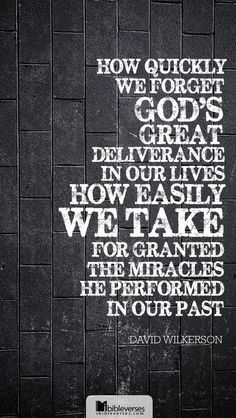
how quickly we forgetSo let’s remember God’s mighty acts today! Do you believe that Jesus is alive and active and at work in your life? When we don’t see that right in front of our eyes, let us not lose heart. Let us be a people who actively remember.   He is actively involved in our lives and in our world.

Let us write them down and talk about them and praise the Lord for them. Let those mighty acts motivate us to praise him as King, because he alone is the one true King.

But let us be humble and teachable, admitting to one another and to the Lord how quickly we forget, lest we, the Palm Sunday crowd, become the Good Friday crowd.

What will you do to make a habit of remembering God’s faithfulness in your life?

I would encourage you to remember the miracles he did in your life in days long past as well as in more recent days.

A charm bracelet of remembrance?

A shelf in your house of remembrance?

Artistic magnets of remembrance on your fridge?

How will you remember?

[1] Darrell L. Bock, Luke, The IVP New Testament Commentary Series (Downers Grove, IL: InterVarsity Press, 1994), Lk 19:28.