In the Gospels Jesus tells the story of a certain servant who owed millions of dollars to a king. When the king requested an accounting of the debt, the servant couldn’t pay. The king ordered the servant, the servant’s wife, children and all his possession to be sold to pay the balance. Horrified, the servant fell on his knees before the king, pleading for time. The king, filled with pity, forgave the entire debt. The man left rejoicing until he bumped into another servant who owed him a few thousand dollars. The first servant violently demanded that this other servant pay him immediately. When the man could not, he had him thrown into prison until the debt was paid in full. Word of this got back to the king who called in the man he had forgiven. How could he have his enormous debt forgiven and then go out and choose not to forgive the small amount this other man owed him? The king, astounded and angry, reinstated the large debt and threw the man in prison until he paid every penny. Jesus’ concludes by remarking, “That’s what my heavenly Father will do to you if you refuse to forgive your brothers and sisters in your heart.” (NLT)
It is a story familiar to us; perhaps too familiar. All of us can share probably numerous personal illustrations of broken relationships, bitterness, and grudges. We wonder when we’ll ever experience the full life that Jesus promised he came to give us. Jesus skillfully used this parable to illustrate that this full life should never include grudges or bitterness toward people for anything they do to us. Symbolically, and certainly in reality, forgiveness frees us. We see in the parable the joy of the first servant, who, if he had not received forgiveness from the king, would have remained locked in a prison, despairing for his lost wife and family and everything he had. Sadly, like us, he returned to that prison as a result of his inability to receive forgiveness and show it to others. I know from firsthand experience that this parable is true-to-life. I am that first servant.
The Crime
In the fall of 1991 just eleven months after passing my driver’s license test, I had been driving with no accidents, no tickets, and basically thought I was the best driver in the nation. I remember how much fun it was trying to push the limits. My parents’ drive to church, for example, took about fifteen to twenty minutes; I did it once in eight. It was a video game to me rather than the responsibility it should have been. Like I said, I hadn’t gotten into any trouble, no tickets for speeding, no accidents because of recklessness, though I had a few close calls. But don’t we all? On Sunday November 3rd, 1991, I went to church with my family and couldn’t wait for it to be done so I could rush home, shovel down dinner, and leave to play football with the guys from church, our Sunday afternoon tradition. After lunch, my brother, Jeff, and I hopped into my parent’s early 1980s AMC Concord station-wagon. Yellow with imitation wood grain paneling on the sides, it is a model hardly seen on the roads now twenty years after its manufacture. We picked up his friend, Chad, my friend, Dave, and sped over to Lancaster Christian School for the game.
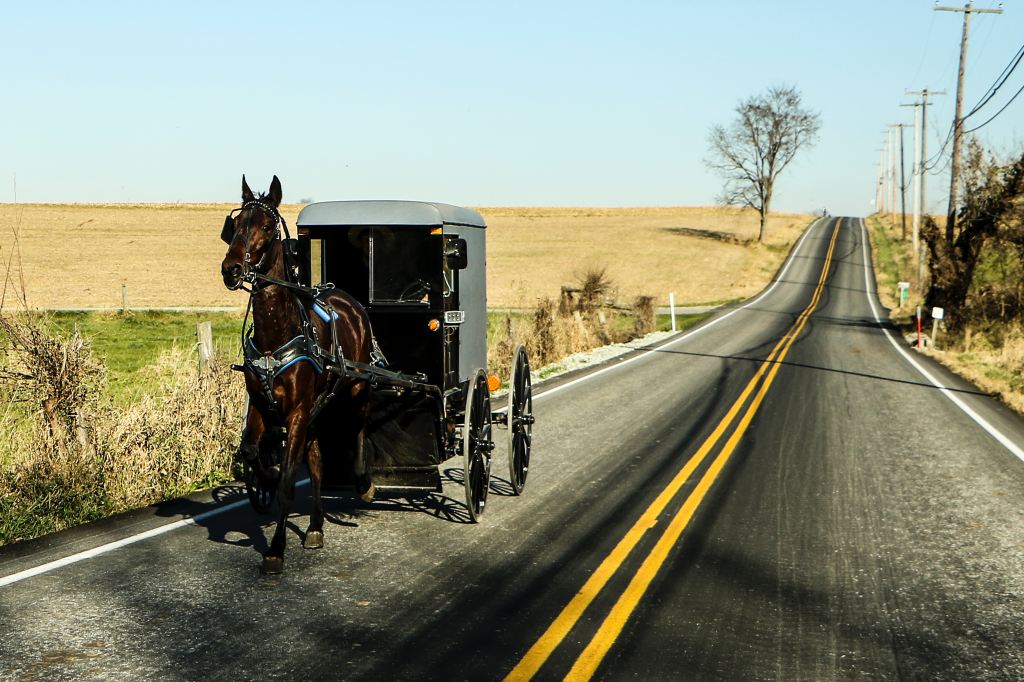
I knew the back way to LCS very well because my brother, sister, and I all attended there through 8th grade. Part of that back way took us south on Kissel Hill Road just to the east of the Lancaster Airport. It was a beautiful fall day, cool, clear, and crisp. I clearly remember driving on the section of Kissel Hill Road between Millport Road and Oregon Road. As I came over the crest of one small hill, I hit the gas and we felt the car lurch into high gear. Sounding like I knew what I was talking about, I made some inane comment about the car “doing good today because it hit third gear at 70 mph.” Dave, who hadn’t yet put on his seatbelt, responded that he’d better do so! Little did he suspect that his caution might have saved his life. As he fumbled with the belt, I saw an Amish buggy about 100 yards in front of us in our lane, heading the same direction as us. I said to everyone in the car something like, “I’m going to blow by these guys.” I thought I was so incredibly cool.
For those of us in Lancaster County, accustomed to the Amish community within our borders, the sight of Amish horse and buggies is commonplace. Lancaster is known world-wide as a hotspot of Amish culture. Thousands of tourists visit each year hoping to catch a glimpse of gray horse and buggies on the roads or of Amish families in their traditional black and blue outfits. Subject to religious persecution in Europe, the Amish journeyed to the New World in search of their own promised land. Their culture and customs have remained, for the most part, exactly as they were centuries ago when they first came to America. The Amish know English, for example, but talk amongst themselves in their Pennsylvania Dutch/German dialect. All Lancastrians can tell you stories about how their culture is changing incrementally, but there is no denying that the Amish have maintained a traditional culture in the midst of a progressive one. The changes and pressures of a farming county that is rapidly blossoming into a wealthy suburban county have, however, over the last few decades, soured many Amish to their Lancaster County soil. As neighborhoods and business parks cover farmland, hundreds of Amish families have migrated to quieter farmlands in such places as Indiana and Mexico.
This small second exodus has done little to change the face of the Amish in Lancaster. Buggies are still regulars on country roads like that one I traveled. By and large, the American culture in Lancaster treats the Amish just as they do their slow-moving buggies, taking them for granted and passing them by. The standard legal practice for passing buggies is to slow down behind them, put your left turn signal on, verify that the left-hand lane is clear ahead, pull over the double-yellow lines into the left-hand land, pass the buggy, put your right-turn signal on, and move back over the double-yellow into the right-hand land. For some this drill is a nuisance: “They slow our progress. Their metal rims wear ruts into our roads, and their horses make a stinking mess everywhere.” This minority view with its accompanying round of Amish jokes can be contrasted, as most Lancastrians will tell you, by the accurate description of the Amish as extremely hard-working, peaceful, and prosperous.
I stomped on the gas again, now doing about 70-75 mph and steered the car into the left lane to pass the buggy. As we raced closer to the buggy, I will never, ever forget seeing the nose of the horse turn out in front of me. Instantly I knew they were trying to turn in front of me. I hadn’t looked for, nor had I seen their turn signal or the small country road they were attempting to turn left onto. Instinct took over as I pounded the brake pedal with my foot. The brakes locked and the car skidded forward, tires screaming. We smashed into the buggy, and I heard the POP of my windshield shattering into tiny pieces of glass. The buggy flew over top of the car and we rumbled to a stop in the field to the left. My hands, gripped tight to the wheel, were streaming with blood, but only from shards of windshield glass that grazed my knuckles. I still have a tiny scar in between two knuckles on my left hand, a constant reminder that basically nothing happened to me.
Dave never quite got his seatbelt buckled. When I hit the brakes, he grabbed the shoulder belt and held on with both hands. The belt locked and swung him around like Tarzan and his left shoulder hit the windshield. Possibly his shoulder, but maybe the buggy, broke the windshield. Other than soreness, though, neither he, Jeff, nor Chad were hurt. Dave’s father, who visited the scene that evening after it was cleared, later told us that the skidmarks from the car quite visibly ran off the road, missing a telephone pole by about 12 inches. It all happened so fast, I do not even remember seeing a telephone pole.
After making sure everyone in my car was okay, I tried to open my door but the collision had jammed it shut. Just then an Amish man came running up to our car yelling frantically, “Does anyone know CPR? Does anyone know CPR?” At 17, I was the oldest in the car. I think Dave had a bit of training, but we were not prepared for what we saw after we got out. We walked down to the crash site, and there the Amish man was holding from behind the crumpled pile of what looked like his mother. She was severely injured, convulsing, and definitely missing teeth. I told Jeff and Chad to run to the nearest homes, which in that area were all farms, to find a phone and call 911. They sprinted across the fields, so riveted on getting to a phone that my brother never even saw the Amish lady. He remembers that the fields were recently plowed, as though he was running sluggishly on a sandy beach. A very frustrating prospect when all you want is to get to a phone as fast as possible. My brother’s race to the phone is the first instance of many in which I realize the extreme pain my sin brought not only to the Amish family, but also to my family. Imagine being a 13 year old, running with all your might to get to a phone to call 911 because your older brother had caused an awful accident? Dave and I stayed and flagged down cars hoping someone might have a mobile phone, which at that time was still a rarity. I tugged at his shirt in desperation saying something like “What do we do?”
Immediate Aftermath
Eventually cars stopped, and a policeman and an EMT/ambulance crew came to scene. That was a huge relief for me. A family friend who was driving by picked Jeff up from the scene and dropped him off at our home. He was the first to inform my parents, and together with my dad returned to pick me up. On their way back to the accident they could see from a distance the car in the field, the buggy unrecognizable. Imagine the dreadful feeling of driving to the scene of devastation that your son caused. How that must have felt for my dad! As my dad and I sat in the back seat of the police cruiser, I don’t remember much except fear and an overwhelming desire to tell the truth, to get what I knew was a weighty burden off my back. The officer gave my dad and me a few moments alone after I had blurted some initial details. We figured he left us to ourselves then so we could go over the details of the story together, possibly to come up with a spin that didn’t make me so culpable for the accident. I knew it was horrible, so I told him exactly what happened, even that I was going at least 70 mph. They were able to confirm that later anyway by the length of the skid marks. I came to find out in the coming weeks that the officer was really impressed with my honesty. At the time I was simply scared to death of any further trouble. Lying was not an option. I didn’t know if I was going to jail, the local juvenile detention center, Barnes Hall, or some other awful place. But the cop let me go home with my dad clearly stating that there would be follow up.
I’ll never forget what my dad said in response to my rather tepid apologies as we drove away, “You’ve been through enough. We’re not going to make it worse for you.” He was right, and I’m very glad for it. It was already bad, about to get worse. When we arrived at our house, less than five minutes away, my mom met me at the door. I must have spent the next half hour just crying on my mom’s shoulder. As the news got out many family and friends showed their love and support by coming over to do nothing and everything at the same time: be there. The friends from church who we were on our way to meet stopped their football game and came over, dirty and disheveled from the game. Gradually a herd of my school and church friends migrated to our house to show support. That in itself was meaningful because I had rarely attempted to mix these two groups of people. I think they even prayed together.
As I was with my friends huddled downstairs in my basement, my parents called me upstairs to my bedroom to tell me that the police officer had just called with a report about the Amish lady who had been taken to the hospital. Due to permanent brain damage, she needed life support to stay alive. Since the Amish don’t believe in life support, she died that night in the hospital. The horrible news began to pile on top of me. The Amish lady, the officer told us, wasn’t the mother of the man. It was his wife. More than that, it was his newlywed bride, and they had been on their honeymoon. They had only been married for 5 days, he was 21 years old, and she was 19. Traditionally, November is the Amish marrying season, and they were on their customary Amish honeymoon travels, visiting a few days in one relative’s home then moving on to another and another and so on. In the midst of that bliss, she was dead, and I had killed her. It was, and still is by far, the worst day of my life. My mother recalls that she held me crying in her arms while my dad and brother sat next to me on the bed, and my 9 year old sister Laura was convinced I was going to jail! Eventually everyone left our house, but God and I talked long into the night.
The next day my parents let me stay home from school, and actually, one of my friend’s parents let him stay home with me. He picked me up and we watched Monty Python videos to get our minds off the disaster. In the middle of Live at the Hollywood Bowl, my parents called. They had found out from my uncle, who had connections in the Amish community, that the viewing was going to be that day, and they told me that I was going. It was extremely frightening news. Yet it signals the depth of my parents’ character. I know my dad later told people that it was the hardest thing they ever had to do. As a parent of a 6 and 5 year old now, I can hardly imagine what I would do if I was in their shoes. How would I handle this horrible thing my son did? How responsible would I feel? And what would my reaction be? Step by step through the process of dealing with my sin, my parents did everything right. In a world where so many want to shift blame, especially when their children mess up, my parents stood by me and guided me through handling this situation in a God-honoring, responsible and truthful manner.
That evening, my parents, my youth pastor (who had only been at our church for 3 months…it still amazes me that he came…another example of godly commitment), and I went to where we thought the viewing was going to be. I felt so nervous there was actually pain ripping across my guts. I didn’t know what these people were like (shows how much this Lancastrian cared about the Amish sub-culture as I grew up around it) or what was going to happen. Would they come pouring out of the porch of the house with shotguns? That was literally the image in my mind. We got the house and it didn’t seem like anyone was home. We had mistakenly been given the location, not of the viewing, but of the husband’s family’s home. Some of his relatives were inside, and my mom remembers his grandmother coming out to meet us, hugging me and expressing her forgiveness. This kind gesture I do not recall, most likely due to the fact that in my mind the worst was yet to come. Amazingly the husband’s father was there and needed a ride to the viewing. So we took him with us, and he led the way. The father, while very reserved, wasn’t mean to us, and even expressed his forgiveness. But can you imagine driving to the viewing of your son’s new wife with the family of the guy who was responsible for her death?
When we finally made it to the viewing, we saw Amish buggies parked all over the farm property, heightening my fear. This was a tragedy in the life of Lancaster’s Amish community, drawing many to support the family and attend the viewing. A loss in what was supposed to be a joyful season made the front page of the local paper. Then the moment came. We got out of the car and walked into the dimly lit house. My mom mentioned that because the father-in-law was with us we didn’t have to go through the painful process of knocking on the door, we were immediately ushered into the house. I had never been in an Amish home and was surprised at how similar it looked to my own. The family, through the grapevine, knew that we were coming and met us in the front room. The parents of the Amish lady who died, Melvin and Barbara Stoltzfus, walked up to me and put their arms around me. Through tears I muttered how sorry I was, and they spoke some of the most incredible words that I think are possible to utter, “We forgive you, we know it was God’s time for her to die.”
Unbelievable. It was totally, absolutely amazing. But they went even further than that! They proceeded to invite my family to come over for dinner! And they wanted us to come soon, within a few weeks’ time! I cannot express the relief that flooded over me.
Then someone led me to a back room where the husband, Aaron Stoltzfus, stood beside the open casket of his wife, Sarah. To my surprise, as I nervously glanced at her, I was looking at a beautiful young woman. Aaron, like her parents, came to me with open arms. I said, “How can I ever repay you?” He simply forgave me. We hugged as the freedom of forgiveness swept over and through me.
As I read and reread the previous few paragraphs, I feel extremely limited in my command of the English language to evoke the feeling of what took place. When I tell the story live, it seems to carry a greater impact. Maybe the audience reads my face. Maybe the emotion can’t help but flow through me. All I know is that the Stoltzfus’ concise words of forgiveness rushed through me with power. Some people have said that Amish are able to forgive like that because their theology leans toward fatalism, meaning that they believe everything is determined, is bound to happen, so there’s no reason to get all bent out of shape about something bad. God is in control. They become somewhat emotionless about all the pain and suffering in life and are much more capable of dealing with it well. I don’t know how true that is for every single Amishman, but I do know that this particular family is very emotional. In a positive way. They are incredibly upbeat and warm people. And I know the accident, Sarah’s death, was very, very hard for them.
My mom, recalling the events said, “I will never forget what Pastor Jim told us the next day. He watched Joel during this entire night. He said he started out as a young teen with an incredible burden of guilt on his shoulder but walked out of that house with a tremendous weight taken him through forgiveness.”
The Sentence
The Stoltzfus’ did have us over for dinner sometime in that next month, an event I recall with wonder. There we were sitting in that same Amish home with Sarah’s family, Aaron, and some from his family too. The table was loaded with delicious food, and never once did they show any kind of resentment. Never once did they attempt to make us feel bad. On the contrary, it was a kind of a get-to-know-you session, an intentional beginning to a meaningful relationship. We exchanged stories comparing and contrasting the Amish sub-culture with mainstream American culture. They were so kind. They had opened their home and hearts to us!
The larger Amish community in Lancaster was also very impressive to me. I still have the pile of at least 50 cards that I received from various Amish people across the County. They were constantly encouraging and pointing me to God.
It was also in this time that I clearly recall a striking visit from my soccer coach. I remember meeting him at the door one evening, probably just a few days after the accident. I will never forget what he said. “Joel, you will be compassionate from now on.” How true. Since that time I have never had trouble forgiving people. Not that I have worked on it and have become talented at it. On the contrary, I think God must have changed my heart, because I don’t have to try to forgive anymore. It flows out as naturally as my heart beats without me having a say in the matter.
In the ensuing months, I did not drive again, handing my keys over to my parents. My trial was set for February 5, 1992. Because of the severity of the accident I was charged with vehicular homicide, a charge that indicates the accidental, but irresponsibly reckless use of a vehicle that caused the loss of life. I’m not sure where it falls on the murder/manslaughter scale, but I do know that if I was one year older, I could have been facing jail time, which is another facet of the whole story that points me to the grace of God. I was 17, a minor, and was therefore dealt with under the juvenile justice system, saved from a much harsher penalty in the adult courts. Soon after the accident, I was assigned a probation officer and a public defender to walk me and my family through the penal process prior to the court date. The standard punishment for juvenile vehicular homicide at the time was a suspension of the offender’s driver’s license for 3 years, 200 hours of community service, payment of all court costs (only about $100), and probation until the community service requirement was completed. To me, with Sarah’s life gone because of my actions, it was an extremely generous sentence.
My trial and punishment served as another instance for the Amish family to demonstrate the freedom of forgiveness. They wrote letters to the judge begging for my pardon, asking that I be acquitted on all counts! Imagine the character it would take to write that letter! Because of the severity of the crime, however, there was no way pardon was possible based on the law. At the trial the only thing my dad asked the judge was if it might be possible for me to get my license back sooner because I would be going to college soon and would need to drive. I hoped that maybe I could have more community service in exchange for a short suspension, but the judge held firm to the standard. A wise decision that was completely rational and acceptable to my thinking. As we walked out of the courtroom, my probation officer met us in the hallway. I will never forget pulling out my wallet and handing my precious driver’s license over to her that day after the court appearance.
From Forgiveness to Friendship
Our relationship with the Stoltzfus’ family has continued ever since (both Aaron and his in-law’s surname is Stoltzfus.) Over the years they have come to our house and we to theirs, about once each year near the anniversary of the accident. Once when they came to our house, I remember playing ping-pong with Aaron. We must have played 10 games and I beat him every time, which was to me an awkward situation. Here I am, I thought, an irresponsible kid who killed his wife, and now I’m playing ping-pong with him. He really seemed to enjoy it and wanted to keep playing. I wondered if I should have let him win, but what would that do? I came to realize that our relationship with Aaron and the rest of the Stoltzfus family, though it began under the most horrible circumstances, had grown into a legitimate, normal relationship. They had forgiven me, and never, ever, went back on that decision. And they backed it up with a real relationship. Consider this: five years after the accident, Michelle and I invited them to our wedding, and they came! For the ceremony and the reception, bearing gifts. Some may read this and think, “How insensitive! You invited them to your wedding? Isn’t that a slap in the face!?!?!” On the surface, it certainly looks like it. It does seem odd to me that we would invite the Stoltzfus’ to share in our celebration when only five years earlier, I had totally shattered theirs. But that viewpoint fails to realize the depth of the relationship. The past had been forgiven, and we were actually friends. People invite their friends to their wedding. I particularly like the idea of trumpeting to the world their brand of forgiveness. To me, having the Stoltzfus’ at my wedding was not to show off the fact that I had friends in the Amish community, it was to display for everyone who knew us the glory of God that results when people obey his commands! To accent this further, when we moved to Jamaica to be missionaries three years later, the Stoltzfus family supported us financially. Forgiveness, they taught me, is not always a one-time event. Perhaps this is one angle of what Jesus intended when he replied to Peter that we ought to forgive someone not just seven times, but seventy times seven. In other words, Jesus said, in order to follow its purpose of freedom, it requires follow-up, the rebuilding of a relationship or, as in my case, the creation of a new one.
God blessed the situation even further as Aaron eventually remarried Sarah’s younger sister, Levina. To me it was as though God allowed the family to be whole again. They now have a beautiful family, full of children.
This past year when we visited Melvin and Barbara (Aaron and Levina live in a house on Aaron’s family’s property in Leola, so we don’t see them as much) on their farm/bakery in Lititz, it was the first we had seen them in a couple years. We missed one year when we lived in Jamaica, and the next year because we had just returned home, so it was good to see them after a 2 or 3 year gap. For the first time in 11 years we talked about the accident frankly, but very kindly. Again, they were never condemning, just admitting how hard it was. How they miss Sarah. I had the chance to express my gratitude and share with them how the freedom of forgiveness they gave me impacted so many people whenever I share the story. I cried then as I am now as I type this.
In this land of liberty, that kind of freedom I received often eludes us. We have so few pictures of what it actually looks like. God glorified himself in my life, however, by blessing me with a wonderful picture of how people can handle terrible crimes against themselves. My uncle, Jim Ohlson, when commenting on an early manuscript of my story added, “What I have seen in you is that the forgiveness of the Amish gave you the confidence to live life to the full.” Jesus said “I have come that they might have life, and life to the full!” That full life is only possible by through the freedom of forgiveness received.



 In the morning, my family has a routine. Our two kids still at home, one middle schooler, one elementary, get ready for school while we are watching the local news. Then at 7am we switch over to CBS for their morning show. A few days ago, we were surprised to hear that CBS fired one of their anchors, Charlie Rose, because of sexual misconduct.

 A few years ago I had one of those eye exams where they put the drops in your eyes to dilate them. I wear contacts, so first my doctor (I go to the optometrist at Costco) had me remove my contacts. He put the drops in, and then my eyes slowly started dilating. If you’ve experienced this, you know how weird it is. Light becomes so bright, as your eyes let more and more in. My doctor said that I had to wait 10 minutes for the drops to take full effect, so I could just walk around the store. You know what my thought was? “Cool! Samples!” Costco usually has a bunch of food sampling stations, so I thought I’d check them out, get a snack.
 How can we remain faithful to God when life is good? How do we remain faithful in the Promised Land? When we are in the wilderness, we feel like we are going to die, and we need God to rescue us, we know that there is nothing we can do, and God has to intervene. At those moments we are desperate and we know that we cannot save ourselves. And when we make it through the wilderness with God’s help, we are quick to give God the credit, and we thank and praise him because he stepped in and provided.
 Engaging Scripture