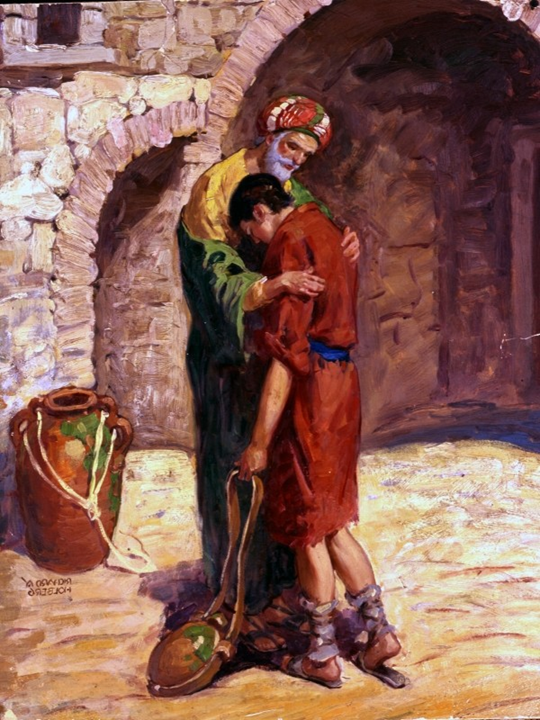
How Jesus redefines “love” and “truth” – 2nd John, Part 2

In the previous post I introduced the ancient biblical letter of 2nd John by looking at some ways that people express themselves when they are in love. Behind it all is the question, “What is love?” Though it is such a commonly used word and concept, is it possible that we might not understand it? I think most people generally understand it, but what we need to investigate, as we read this letter, is how the writer, John, used the word “love.”

What is John talking about in verse 1 when he says, “Whom I love in the truth?”  The “truth” is his way of talking about the family of Christian faith.  As we’ll see, in both short letters of 2nd and 3rd John, John regularly mentions truth.  He continues talking about it in 2nd John verse 1 when he refers to those “who know the truth” and in verse 2 when he says the truth lives in us.  So before we answer the question, “What is love?” it seems we need to answer, “What is truth?”

Truth is an important concept that I will address more fully next week when we study 3rd John, but as we consider how John starts his letter in verses 1 and 2, because he mentions truth three times in the first two verses (get ready, because he’ll mention in verse 3 and 4 and well!), it is vital that we say a few words about truth.  John is not talking about a concept or idea of truth, so much as he is talking about the fact that Jesus is the embodiment of truth.  I know that he doesn’t spell that out here in 2nd John, so how do we know this?  Because of what John has written in other places, the most famous example of which is John 14:6, in his Gospel, when Jesus says, “I am the way, the truth and the life.”  This was and still is a fairly surprising way to think of truth.  Truth is a person.  Jesus is truth.  John says, therefore, that there is an amazing reality that this truth lives in us and is with us forever.  How in the world does a person live in us? We’ll talk more about that in a post later in this series.  Hold that thought.

As we move on to verse 3, we read John’s greeting of grace, mercy and peace from God the Father and Jesus Christ his Son, who will be with us in truth and love.  There’s that idea of truth again, and that the truth is in us.  But now John has expanded the idea to include grace, mercy and peace and the idea that Jesus is with us in truth and love.  Clearly, what God is communicating to us is amazing.  God wants you to know grace.  God wants you to know mercy.  God wants you to know peace.  All through Jesus living with us and in us, Jesus who is truth and love.

Following John’s flow of thought into verse 4, we read him convey an encouraging word to the church, saying that it has given him great joy to find some of her children walking in the truth.  Walking is another idea that John will repeat.  As is specifically “walking in truth,” which we will focus on next week.  For now, he is overjoyed to find that some in the church are living out the truth of Jesus. 

Let’s continue, because John is about to reveal the specific purpose for writing, and we see the beginning of that in verse 5 when he says he has not a new command, but one we had from the beginning, “love one another.”

There was a time when people asked Jesus “What is the greatest command of the law?”  You can read this in Matthew 22.  He said, “Love the Lord your God, with all your heart, soul, mind and strength,” and the second greatest, Jesus said, is “love your neighbor as yourself.”  Jesus wasn’t making these commands up.  Both of these commands were originally given way, way back in the Old Testament Law.   Leviticus 19:18 for example says, “Love your neighbor as yourself.”  That’s where Jesus got it from.  So these are not new commands, as John says. 

It is interesting, then, to consider that Jesus, in John 13:34-35, calls “love one another” a new command.  There he was teaching his disciples just hours before he was about to be arrested and put in trial and crucified.  He says to them, “A new command I give you: Love one another. As I have loved you, so you must love one another. By this all men will know that you are my disciples, if you love one another.”

How is this a new command?  Wasn’t it actually a really, really old command?  Yes, perhaps a couple thousand years old by that point!  And Jesus clearly knew it was an old command.  So why would he call it a new command? I suspect what Jesus was getting at was the fact that he expressed it in a new way.  He says to his disciples not, “love your neighbor as yourself,” but “love one another, as I loved you.”  Do you see the difference that makes this a new command? 

Our standard for loving other people is not how we would love ourselves, our standard for loving other people is how Jesus loves us!  Do you see what Jesus did there?  He took a command from the Old Law, a very good and important command, but he put his new spin on it, and in so doing, took it to a whole new level.

No longer are we the standard for loving others, he is the standard.  That means we need to have a clear understanding of how Jesus loved.  In another place, John 15:13, John records Jesus as teaching, “There is no greater love than this, then a man lay down his life for his friends.” That’s the kind of love Jesus gave when he went to the cross. 

Remember that phrase WWJD?  What would Jesus do?  We could specify it a bit to:  HWJL?  How would Jesus love?  You could make that into a bracelet and wear it, and that bracelet could become a reminder to you all day long to love like Jesus loved.  Not a bad thing.  We need reminders to love like Jesus loved.  We can often behave in our normal patterns or habits that might not be the same patterns or habits that Jesus used for loving people.  Reminders can help us break out of our old ways and follow the new ways of Jesus. 

Here’s the problem though.  What if we don’t know how Jesus would love?  We might think, “Of course I know how Jesus would love.”  But do we?  We would do better to ask the question: how can I learn to love like Jesus loved? 

Now there’s a question to answer!  In the next post in this series, we’ll investigate Jesus’ kind of love a bit further. 

When you’re crazy in love – 2nd John, Part 1

Photo by Ben White on Unsplash

Oh the crazy, creative, wild things we’ll do for love.  Have you ever been bonkers in love and did something like that for the one you love? 

I recently heard the story of a guy who made a necklace for his girlfriend.  He carved a small pear shape out of wood, and placed a little seashell in a divot, and then attached it to a chain and gave it to her for their first anniversary.  And she wore it faithfully, daily.  Then a year later, they were out visiting one of their favorite places, he asked her for the necklace.  He broke it in half, got down on one knee, and revealed that inside, all along, was an engagement ring. 

She said, “Yes!  And then after thinking about it awhile, she said, “Wait…it was in there the whole year?  I could have lost it!”  So creative and risky, right?  That blows my proposal to my wife out of the water.  My grandmother had given me a diamond that part of another ring that her grandmother gave her.  So I had the diamond made into an engagement ring, but once I got it, I was so anxious to propose, that I did it that night in a misty rain in the gazebo in Greenfield.  I was, and am, so in love with Michelle, but I admit I wasn’t all that creative about my proposal.

I learned about another guy who was way more patient and creative. This other guy started writing love letters to the girl he was dating.  She would write back.  They didn’t live far apart, but the letters would a great way to pour out their hearts to one another, and a wonderful record to keep of their relationship.  Well, after three years, and 13 letters, he asked the girl to get all the letters out, and he started arranging them.  And this is what she saw.

image

Can you read it?  The first letter of every love note spells out “Will you marry me?”  She also said, “Yes.”  What is so amazing is that year by year as she was receiving the letters, she didn’t know they were slowly spelling a proposal.

When you’re in love it seems you can’t help it, can’t stop it, you are just flowing with it.  The emotion, the energy, the creativity. 

All summer we have been reading other people’s mail.  Ancient letters.  Not love letters.  But letters in the Bible.  As we’ll see in this next letter, there are other views on love that we need to hear.  Thus far we’ve read the letters that Paul wrote to Titus and Philemon

Today we turn to another writer.  John, who was not only a disciple of Jesus, but also possibly Jesus’ first cousin.  We’re not talking about John the Baptist, who was another cousin of Jesus.  We believe the disciple John wrote the Gospel of John, and then also the epistle of 1 John, and the short letters of 2nd and 3rd John, as well as the book of Revelation.  Going by word count, John wrote 20% of the NT, third behind Paul and Luke.  John was one of Jesus’ inner three disciples, Peter, James and John.  Because of this privilege, they had some unique experiences, such as seeing Jesus’ transfiguration.  John was the only disciple who visited Jesus at the foot of the cross, at which time Jesus asked John to care for Jesus’ mother, Mary.  John would go on to be a leader in the early church.  We believe, of all the original disciples, he passed away last.  Most scholars believe that while much of the New Testament was written around the years 50-70 AD, John wrote all of his works in the range of 85-100 AD.  Lastly, John is often called the Dr. Seuss of the New Testament because he uses the fewest variety of words and he repeats them often. 

As we’ll see, both of his very short letters of 2 and 3 John talk about truth and love, but in 2 John we’re focusing on love and next week when we study 3rd John, we’ll focus on truth.  So go ahead, open a Bible to 2nd John, and read it.

In verse 1, the writer begins by identifying himself with the title, “The elder.”  We think John was the elder or leader of the churches in Ephesus.  As you’ll see, the name John is not mentioned anywhere.  Then he mentions who he is writing to, and it is quite curious.  The recipient is “the chosen lady and her children.”  This could be a real person, but as we’ll see in the content of the letter, it seems that John is using “the chosen lady and her children” as a metaphor.  The chosen lady most likely refers to a church, probably the local congregation he is writing to.  Throughout scripture the church is often referred to in the feminine, for example when Paul calls the church the bride of Christ.  And her children, then, would be the people in the church.

Check back in to the next post, and we’ll see John begin to talk about love.

How to welcome those who are difficult for you – Philemon 8-25, Part 5

Photo by Taylor Simpson on Unsplash

Who is difficult for you? Think about it. Who are the people you really struggle with? Does it seem like it would be awful to welcome them into your life? How should you treat them?

If Paul’s message to Philemon is our guide, then what we do will be self-sacrificial, it will be radical, it will cross the societal lines, and it will overturn conventional ideas.  It will be white people, giving up their power, privilege and position for people of color who have been marginalized.  It will be a purposeful embrace of the other who is no longer an outsider, but now in Christ a brother or a sister. 

As we conclude our series on Philemon, consider, then, what Jesus did.  Paul clearly describes how Jesus is an example for us of the very thing Paul is asking Philemon to do:

Do nothing out of selfish ambition or vain conceit, but in humility consider others better than yourselves. Each of you should look not only to your own interests, but also to the interests of others. Your attitude should be the same as that of Christ Jesus: Who, being in very nature God, did not consider equality with God something to be grasped, but made himself nothing, taking the very nature of a servant, being made in human likeness. And being found in appearance as a man, he humbled himself and became obedient to death—even death on a cross!

Philippians 2:3-8

Other translations say that Jesus “emptied himself”.  He gave up his rights, privilege, position and power so that he could reach us.  That meant he had to become one of us.  Think about that.  The one in the position of power and privilege “emptied himself,” as the hymn says, “of all but love, and bled for us.”  To save us, he became one us and died for us. 

In another place, Paul said that this concept was his modus operandi as well:

“Though I am free and belong to no man, I make myself a slave to everyone, to win as many as possible. To the Jews I became like a Jew, to win the Jews.” And just a few verses later he says, “To the weak I became weak, to win the weak. I have become all things to all men so that by all possible means I might save some.”

1 Corinthians 9:19-20, 22

Jesus, therefore, is asking you and me the exact same thing that Paul was asking Philemon. 

What will you and I do about this?  We are the Philemons of our day.  The time has come for us to welcome the Onesimuses around us as dear brothers.  It might not mean they come to our church. Maybe it will.  But what will it mean?  Ask God to show you.  Ask God to give you his eyes, to see people and situations as he sees them, to act in love to all, because in his eyes all are equal. 

So we would do well to ask ourselves, who do we struggle with?  Who do we look down on?  Who do we think we are better than?  There are so many ways Paul’s letter to Philemon can apply. 

It could be people of a different ethnicity.  And it could be people of a different gender.  Perhaps you struggle with people who are of a different generation.  How about those of a different socioeconomic status?  Maybe people who speak a different language.  What about the immigrants, the asylum seekers, the refugees?  It could be those struggling with homelessness, divorce, bad choices, or a financial struggle.

Who will you stand beside and welcome?  Who will you embrace as a dear brother or sister?

Let’s conclude hearing Paul’s words again, starting:

“[Treat Onesimus] no longer as a slave, but better than a slave, as a dear brother. He is very dear to me but even dearer to you, both as a man and as a brother in the Lord. So if you consider me a partner, welcome him as you would welcome me. If he has done you any wrong or owes you anything, charge it to me. I, Paul, am writing this with my own hand. I will pay it back—not to mention that you owe me your very self. I do wish, brother, that I may have some benefit from you in the Lord; refresh my heart in Christ.”

Philemon 16-20

The world-changing power of forgiveness – Philemon 8-25, Part 4.

Photo by Priscilla du Preez on Unsplash

Have you ever been in a situation where you needed to forgive someone who hurt you? Did you find it difficult to do so? It can be scary to forgive, especially when the pain runs deep. Will that person respect your forgiveness? What if they hurt you again? Are they really sorry? How do you truly know? There are many questions surrounding broken relationships, questions that can make forgiveness seem murky. In our study of Philemon, Paul is addressing a situation of brokenness, and one that needed forgiveness. But this wasn’t any ordinary brokenness, and what Paul is asking is, well, a lot.

If you want to catch up on the broken situation I’m talking about, start with Part 1 of this series, and continuing reading Parts 2 and 3. Then look at verse 17 of the letter to Philemon.  Do you see where Paul says to Philemon, “If you consider me a partner”?  It is almost certain that Philemon would have considered Paul a partner.  Guess what Greek word Paul used there for “partner”? Koinonia.  Remember that from the previous series on Philemon 1-7, when we discussed verse 6? “Sharing” is the word koinonia, and it means “fellowship, sharing or participation.” Paul has come full circle, and then some!  Paul says, “Welcome Onesimus as you would welcome me, as a close friend, because that’s what Christians do!”  Further, if Philemon is to welcome Onesimus, just as he would welcome Paul, do you see how Paul is putting Onesimus on an equal level with himself!  That’s the kind of amazing equality that we all have in Christ.

Paul continues.  In verse 18 he says that if Onesimus has done Philemon any wrong, or owes Philemon anything, he should charge it to Paul.  As we said in Part 2 of this series on Philemon 8-25, it is highly likely that Onesimus did something more than just run away; in the process of running away he probably stole money and possessions from Philemon.  Paul knows this, and does not want that offense to get in the way of Philemon embracing Onesimus as a brother.  Paul wants this reunion to go well.  This could be an amazing example to many people of the power of Jesus, and how Jesus wants to reshape the world.  A master welcoming back his runaway slave who stole from him?  The normal response for Onesimus’ behavior would have massive punishment, maybe even death.  Also Philemon’s honor was at stake in the community.  Paul knows that if Philemon acts in a surprising upside-down Jesus kind of way, Philemon’s forgiveness and brotherly-welcoming of Onesimus could have significant ripple effects in Colosse. Imagine the people in the city talking as word gets out: “Did you hear that Philemon welcomed back a slave who ran away from him, and stole from him?” That would get notice! Sure some people, maybe even many people, would think Philemon is crazy, but they would still be seeing an amazing example of forgiveness and brotherhood that Jesus brings to the world. What an impact that could make in the church!  In the world!

Therefore, what we see Paul pushing for is the beginning of the eradication of slavery.  This is how Christians can clearly say that slavery is not supported by the Bible.  This is an upending of the social order and seeing God’s Kingdom come to earth as it is in heaven.  Paul is teaching Christians to be willing to go against the conventions of their day, in the name of Jesus.  To cross color lines sacrificially, lovingly.  To repent where they need to repent.  To forgive.  To pay for crimes they didn’t commit.  This is a distinctly Jesus way of life, isn’t it?  That kind of self-sacrifice, Paul says to Philemon, is what it takes to be the church.

Still Paul isn’t done.  In verse 19 he says he is writing this with his own hand.  Often Paul would just talk and one of his friends would write.  But he is writing this one himself.  It is very personal and important to him.  It could be that his friend wrote the rest of the letter, but at verse 19, he picks up the pen and says, “Philemon, I’m serious about my offer to you to charge Onesimus’ damages to me.  I will pay it back.”  And then he gets back to some, well, could we say, urging?  Manipulating?  Maybe.  Paul says, “by the way, Philemon, remember that you owe me you very self.”  I don’t know what that means.  Paul doesn’t say.  It could be that Paul guided Philemon to faith in Christ. We don’t know. Clearly, though, Paul is pulling out all the stops to help Philemon see things his way.

Then he lays it on a bit thicker in verses 20-21.  Read those verses. How much does Paul want Philemon to forgive Onesimus and welcome him as a brother?  So much.  He wants a benefit from Philemon, so Paul tells Philemon to refresh his heart, as he said Philemon was so good at back in verse 7.  Then he says in verse 21, “Philemon, I know you will do even more than I ask.”  Maybe Paul is trying too hard here.  What we know by all his cajoling is that this situation is extremely important to Paul.  I read this letter and think, “Did Philemon have any choice but to do what Paul is asking of him?” Then Paul finishes up the letter with some further greetings and a closing blessing of grace.

But let’s go back to that question: Did Philemon have a choice?  Sure, he did.  With Paul far away in Rome, Philemon had a choice.  Paul couldn’t make Philemon agree and receive Onesimus, no longer a slave, now a brother.  Philemon would have to overcome his personal anger, embarrassment, and hurt.  He likely felt betrayed by Onesimus.  He would also have to overcome societal pressure that said masters do not forgive slaves.  In a society of honor and shame, Onesimus had greatly shamed his master, and the common response by the master would be severe punishment.  What Paul is asking Philemon to do, then, is radical, earth-shattering, Jesus kind of forgiveness and acceptance.   Paul’s teaching that all are one in Christ, that Jesus removes the distinctions between slave and free, is right, but it presents a tall order for Philemon.  What will he do?

What did he do?  We don’t know for sure.  Ancient historians tells us that there was an Onesimus who eventually became a Christian bishop.  Maybe it was this Onesimus, and if so, that would indicate a possibility that Philemon did exactly what Paul asked him to.  We really don’t know.  Scholars also point out that because we still know the content of the Paul’s letter to Philemon, that, too, is an indication that Philemon received Onesimus as a brother. Why? Because this letter was almost certainly private, and Philemon could have crumpled it up, thrown it away, and burned it. Most likely, he didn’t, and instead allowed the letter to become public, copied and transmitted to many other churches, so they could also benefit from Paul’s teaching. Again, how did Philemon respond to the letter? We don’t know for sure.

The better question is: what will we do? And we attempt to answer that next in Part 5.

How Jesus redefines “family” – Philemon 8-25, Part 3

How do you define “family”? Biologically? Qualitatively? Some other way? As we continue studying Philemon verses 8-25, today we’re going to see Paul explain how Jesus defines family, and get ready, it is shocking.

So what did Paul say?  Let’s continue his flow of thought from what we already learned in Part 1 and 2 of this series.  We’ve come to verse 13, where Paul admits that he wishes the runaway slave, Onesimus, who has now become a Christian, could stay with Paul. Already in Part 2 we saw how Paul describes Onesimus as “useful” to him.  So as Paul writes to Philemon, saying he wishes Onesimus could stay with him (Paul), that should show Philemon how highly Paul thought of Onesimus.  What Paul says next is where it really gets interesting: Paul writes that if Onesimus could have stayed with Paul, Onesimus would be taking Philemon’s place helping Paul!  That is a bold statement.  Paul is saying that a slave could take the place of his master.  In a slave society, that is laughable.  There is no version of slavery in which a slave could take the place of the master.  But when Jesus enters the situation, he turns society’s convention upside-down.  A slave, Paul is saying, a lowly slave who is transformed by Jesus, can become equal with his master.  Paul’s not done.  It’s going to get even more wild.

Next in verse 14, Paul quickly says that he wants to honor Philemon’s consent. Philemon owns Onesimus and thus Paul is legally bound to send him back.  Also, whatever Philemon chooses to do, Paul doesn’t want anyone to be able to say, “Paul forced this on me.”  Paul wants Philemon’s response to be Philemon’s own free choice.

Now read verses 15-16 where Paul says there might have been another reason for Onesimus running away.  Another reason? What other reason? Isn’t it fairly obvious, Paul? Think about it: normally when a slave runs away, there’s nothing but bad blood between slave and master.  In the master’s eyes, slaves are property that equal money.  Slaves create wealth for their masters.  Thus slaves who run away are seen not only as missing property, but also as missing income.  Add to that, slaves who runaway are disrespecting their masters.  Clearly, masters would often disrespect and mistreat slaves, which is precisely why the slaves wanted to run away in the first place.  So the slave/master relationship was often a fraught situation, and the relationship between Onesimus and Philemon was no different.  Philemon could easily be reading this thinking, “I know why Onesimus ran away, Paul,” and he was almost certainly not happy about it.  Paul is bold, then, in suggesting that there might be another reason. 

What is this other reason Paul hints at? He tells Philemon that it so Philemon could have Onesimus back for good, which is no surprise, but then he adds a shocker in verse 16 when says Philemon “might have him back for good–no longer a slave, but better than a slave, as a dear brother.”  Do you see what Paul does there?  He totally redefines the relationship between Onesimus and Philemon.   Master and slave is gone.  Now they are brothers.  Dear brothers.  Totally equal.

This is exactly what Paul taught in other places:

“You are all sons of God through faith in Christ Jesus, for all of you who were baptized into Christ have clothed yourselves with Christ.  There is neither Jew nor Greek, slave nor free, male nor female, for you are all one in Christ Jesus.

Galatians 3:26-28

Paul says the same thing in 1 Cor. 12:13. He also writes it in Colossians 3:11, which is interesting, because when Paul sent Onesimus back to Philemon, almost certainly Onesimus and another ministry partner, Tychichus, were carrying the letter of Colossians with them too, a public letter which would have been read to all the Christians in Colosse, including Philemon.  So Paul doesn’t want this to be just a private matter between Philemon and Onesimus, he wants all Christians to know that in Christ, there is a total redefinition of people’s status.  No more ethnic stratification, he says, “neither Jew nor Greek.”  Nor more gender stratification, “neither male nor female.”  No more slave and master, “neither slaver nor free.”

All are one in Christ.

Paul was asking Philemon to embrace the full truth of Jesus’ teaching, that in Christ there is no more slave or free, Jew or Greek, but all are one in Christ.  All are equal.  Paul says in verse 16 that Philemon should consider Onesimus as even dearer than Paul does.  A brother in the Lord.  And a brother is family.  Does your definition of “family” need redefinition to make it the same as Jesus’? Does your practice of family need to change?

In the next post, we’ll see how passionately Paul continues to argue for this redefinition of family.

How to transform your life from useless to useful – Philemon 8-25, Part 2

Photo by Linh Nguyen on Unsplash

Have you ever felt useless in life? Maybe you watch others around you, friends and family, and it seems they are successful, advancing, making a difference in the world, enjoying life. Then you think about your life, and maybe you see a past littered with failure, broken relationships, and poor choices. Even if that describes you a little bit, know that you are not alone. Today we meet a man with a broken past. In fact, he was described as useless. At the outset, though, let me give you a hint: there is hope!

So far in our study of Paul’s letter to Philemon, in verses 1-7 we’ve seen Paul profusely encourage Philemon to see himself as a lover of Jesus who also loves all of Jesus’ followers. Then in verses 8-9, Paul begins to make an appeal to Philemon, because there is a specific situation in which Paul wants Philemon to practice that love for Jesus and all his followers. Paul knows that Philemon has a broken relationship in his life, and in verses 10-21, Paul makes his appeal to Philemon to fix that relationship.

What relationship? Paul is writing Philemon on behalf of Onesimus who used to be Philemon’s slave.  But something happened.  We don’t know all the details, but in verse 18 Paul gives some clues.  It seems that Onesimus not only ran away from Philemon, but may have even stolen from him.  Onesimus then made his way to Rome where he met up with Paul.  My guess is that one of three things led Onesimus to Paul. 

First option: Paul had previously become friends with Philemon.  It is possible that Paul would have also met his slave at the same time.  As time goes by, Paul ends up in Rome on house arrest, and Onesimus runs away from Philemon, hoping upon hope that Paul will help him.  If you’ve just committed a crime, and you don’t know where to go, you often seek a person you think will be understanding.  In Onesimus’ mind, Paul fits the bill.

Second option: It could be that Onesimus and Paul hadn’t previously met, but Onesimus still seeks out Paul for help, simply because of Paul’s reputation.

Third option: Onesimus just so happens to end up in Rome and comes across Paul.  Seems unlikely, but as we all know, unlikely things happen all time. 

The rest of the story, Paul tells us.  There in Rome, as he says in verse 10, Onesimus becomes his son.  That is strong family language, right?  Paul writes like this often, calling people his “son” in the faith.  What he means is that he shared Christ with Onesimus, and Onesimus chose to place his faith in Christ, giving Jesus both his assent and allegiance.  In other words, through Paul’s ministry on house arrest, Onesimus becomes a Christian. 

In verse 11 you see Paul’s literary flourish as he uses a wordplay, and most of your Bibles will point to this in a text note.  Almost certainly Onesimus was a difficult case for Philemon, and Paul knew this. If he hadn’t previously heard the story of Onesimus’ running away, he now heard it from Onesimus. Maybe Onesimus was a bad worker, maybe he was insubordinate, a back-talker, a slacker, we don’t know. As a result, maybe Philemon was hard on Onesimus, and that led to his running away. Or maybe Onesimus just wanted to be free. When Paul describes Onesimus as “formerly useless,” it could be all of the above. But here’s wordplay: Onesimus’ name means “useful,” and what does Paul say in verse 11?  Onesimus has gone through a transformation from uselessness to usefulness.  Through the work of Jesus in Onesimus’ life, a great change has happened. Onesimus is now as his name suggests, useful!  And not just to Philemon, Onesimus, Paul says, is useful to Paul too.  Apparently Onesimus was on fire for Jesus, serving, helping Paul. 

So Paul has a tough decision to make.  Do you send a runaway slave back to their master, knowing that it might not go well for that slave?  Or do you keep him with you, especially considering the amazing change that has taken place in his life?  There’s a lot riding on this.  If Paul sends Onesimus back to Philemon, how will Philemon handle it?  Philemon really seems to be a good man, but Onesimus had betrayed Philemon, and Philemon could have a bad reaction. Also consider this from Onesimus’ point of view.  How much convincing did Paul have to do to get Onesimus to agree to this, after having wronged Philemon and run away?  How scared was he to go back there?  We can imagine Paul having a talk with Onesimus: “Now that you are follower of Jesus, there’s something we need to discuss. Philemon. Your master. How you treated him. Your broken relationship. Jesus is in the business of making things right. We’re going to need to deal with this.”

Now are you seeing why Paul gushes so much over Philemon in verses 1-7?  All that talk about loving all Christians?  Yeah.  It’s because Paul is dropping a bomb right in Philemon’s lap.  And that bomb is Onesimus.  Paul chooses to send Onesimus back, as we read in verse 12, which is the right thing to do. In fact, under Roman law, it was the legal thing to do. Philemon owns Onesimus, and Paul chooses to submit Onesimus to that relationship, as he says in verse 14.

At this juncture we need to pause and talk about slavery in the Roman Empire.  Even just saying “Philemon owns Onesimus” feels wrong.  But that is what was going on.  He was legally seen as property. 

Doesn’t it seem really odd that Philemon, a Christian, owns slaves, and that Paul would send a runaway slave back to his master!  Shouldn’t Philemon set his slaves free?  And shouldn’t Paul say, “Onesimus, you are not going back there into slavery”?  Yes, it seems like that should be happening, but none of it did.  As we’ll see, Paul has a whole lot more to say, but for now I want to point out that slavery in the Roman Empire, while it was awful, as slavery always is, was not like slavery in our American past.  Frankly, American slavery was worse.  A horrible, racial, terrible evil.  It was evil in the Roman Empire too, but it was not racial, and slaves actually had some measure of opportunity for freedom and advancement.  What I do not want you to hear me saying, though, is that slavery was okay in the Roman Empire.  It was different than American slavery, but it still was not okay.  It was evil and wrong back then and went against God’s desires.  I, too, wish Paul would have said more to denounce it.

So what did he say?  Next if Part 3 we continue observing his flow of thought, which will have significant implications for not only Philemon and Onesimus, but so much more, including the practice of slavery.

How to help people see things from a different perspective – Philemon 8-25, Part 1

Photo by Léonard Cotte on Unsplash

There have been some illusions in recent years that have become internet sensations.  Like the dress that was either white/gold or blue/black, or the computer voice that says “laurel” or “yanny.”  Now there is the bird or the bunny.  Which do you see?

It’s wild how the mind works!  It is actually a bird, but you can sure see how it looks like a bunny. Here’s another one.  What color are the strawberries? 

Red, of course.  Right?  Well, maybe they seem like the color is slightly washed out, but you can still see the redness.  Or can you?  The creator of this photo says it is entirely in grayscale.  No color whatsoever.  Our minds supply the red color because that is what we are used to! 

These illusions relate to our divided world, as people see things so differently.  Have you ever had the experience where you are talking with someone, and they are describing their viewpoint, and inwardly you are thinking to yourself, “How can they possibly believe that?” 

It can be very hard to see things from another perspective.  Usually we just hold more tightly on to our own and characterize the other side as a bunch of whackos.

Last week we started reading Paul’s letter to his friend Philemon.  As we continue this week, we’re going to discover that Paul sees an issue from a very specific perspective, and he wants Philemon to agree with him.  How will Paul help Philemon see another viewpoint?

In verses 1-7 (you can review the five-part series on those verses starting here), we learned that Paul has a lot of really nice things to say to Philemon. While Paul certainly was telling the truth about Philemon, and while he wanted to encourage Philemon, Paul does have another motive going on.  He really wants Philemon to identify himself in the ways that Paul has described him.  How has Paul identified Philemon?  As a person who is deeply committed to Jesus, who loves and encourages “all the saints.”  That word “all” in verse 5 is key.  Paul wants Philemon to be thinking, “Yeah, that is me.  That’s how I am. I love Jesus and I love all his followers, and I encourage all of them.”  Why does Paul want Philemon to think that way? Because there was one follower in particular that Philemon had a problem with.

Now read verse 8 to find out where Paul is going with this.

Did you notice how the tone of this passage shifts in verse 8?  Paul says, “Although in Christ I could be bold and order you to do what you ought to do…”  Wait.  Bold?  Order him?  What just happened?  Paul has spent the better part of the previous 7 verses pouring praise on Philemon.  Now here in verse 8 he sounds pretty confrontational doesn’t he?  There’s something going on, and Paul is about to spill the details.

Verse 8 stops mid-sentence, so read through the end of Paul’s sentence which continues until about halfway through verse 9.

Paul says that though he could be bold and order Philemon, he’s not going to.  Instead he is going to appeal to him on the basis of love.  That’s quite an interesting phrase.  Paul knows he has authority, because he is an apostle of Jesus, and he could pull rank on Philemon.  Whatever is going on, Paul knows he could take the power route.  But he doesn’t.  He takes the love route. 

He still reminds Philemon that he, Paul, could take the power route, and the fact that he reminds Philemon of this stands out to me.  Could it be said that Paul is being manipulative here?  Someone could say that he spent the first seven verses buttering Philemon up, because he knows that he is about to drop a bomb on him.  Or it could be that Paul is just showing tact and wisdom.  The same goes for his reference to his position of authority and power that he could wield on Philemon.  In all this, I think Paul is being truthful and wise.

Now continue reading from the middle of verse 9.

How about that?  Paul calls himself an old man, and he repeats the line he started the letter with, that he is a prisoner of Christ Jesus.  Is Paul trying to establish more authority, using his status as an elder?  As a prisoner?  Is he staying he has street cred?  Is he referring to his seniority?  Probably all that and more.  It is clear that Paul really wants Philemon to do something, to answer his appeal from love.

In Part 2 of this series through Philemon 8-25, Paul will reveal the details of the specific situation he is concerned about. For now, focus your thinking on how Paul has begun his appeal. He wants it to be clear that he is not using a power move, but he is appealing to Philemon based on love. I find that quite instructive and applicable to many situations. Parents, teachers, coaches, bosses, pastors. Anyone who has a measure of authority. How are you motivating the people you lead? With power or with love? Going back to where we started this post, consider the conversations you have with friends and acquaintances in which you are sharing different points of view. How are you communicating? With power or love? There certainly may be times when power is needed, but for Christians, may your use of power always be guided by love. We would do well to make it a practice of asking ourselves, “Am I being loving in this?” Or “Does the person I’m interacting with feel loved?” Even if we have to confront them, we can do so in love. Paul is about to confront Philemon, but take note of how he has communicated love to Philemon first. Paul has laid an extensive groundwork of love in verses 1-7, so that when he gets to the difficult part of the conversation, Philemon will know it comes from Paul’s heart of love. What a great example!

Be a Refresher of Hearts! Philemon 1-7, Part 5

How do people come away from interacting with you? Think about some of the recent times that you have interacted with people. Maybe it was your family members. Perhaps it was co-workers. Or even social media posts. Try to put yourself in the shoes of the people who were with you, or who were reading your posts or viewing your videos. What impression did you give them? Were you complaining? Angry? Joyful? Hopeful?

We started this series of posts asking, “Are you able to see yourself for who you really are?” In this fifth part in our series on Philemon verses 1-7, if you read verse 7, you’ll see that Paul really encourages Philemon, helping Philemon see himself for who he truly is. It appears that Philemon was a really great guy. But how so?

Paul says that Philemon’s love has given Paul great joy and encouragement, because Philemon has refreshed the hearts of the saints.  I wish I knew what Paul meant by that, but it would appear that Philemon was a very loving, encouraging person.  He was full of faith, to the point that when people visited Paul in Rome on house arrest, they talked about Philemon. Paul was overjoyed to hear how Philemon was living out his faith.

It is amazing to consider that Paul would be able to say this while in prison!  Paul really wants Philemon to be happy to be holding that letter in his hands and reading it.  Why?  He’s getting there. Next week in the series on Philemon 8-25, we’ll get the answer to the question of “Why?”

For now, let’s consider what we have heard in verses 1-7.  The character of Philemon is quite impressive. If you want, go back and read the previous parts of this series, starting here.

What we saw is that Philemon has qualities that are worth emulating: faith, love for all the saints, love that gave Paul great joy and encouragement, and finally, because Philemon was a giver of joy and encouragement, he refreshed the hearts of the saints

In other words, Paul sees Christ in Philemon. 

Therefore I have a question we all should ask: do others see Christ in me?

They will see Christ in you if you are like Philemon.  Full of faith, having a love for all the people in the church family, love that gives joy and encouragement, so that people’s hearts are refreshed after spending time with you.

Think about that.  How do people react to you?  Do they come away from their interaction with you encouraged, joyful, feeling loved?  What about your social media posts?  What about your interactions on the phone?  How do you handle yourself in meetings? Would people say that you refresh their hearts?

If not, what do you need to confess? How do you need to repent? And what do you need to change in order to become more like Philemon, who was a refresher of hearts?

Defining true Christian fellowship – Philemon 1-7, Part 4

Photo by Shane Rounce on Unsplash

What is fellowship? How does it look in your life, in your church? How do you know if you are doing it right? As we have seen in our study through Philemon verses 1-7, Paul has been giving his friend Philemon feedback on what Philemon has done with his life. Paul has many nice compliments for Philemon (see Parts 1, 2, and 3 for what we have covered previously). We’ve arrived at verse 6, and Paul is far from the end of his encouragement to Philemon. Is Philemon fellowshipping right?

In verse 6 we face a problem, though, as scholars tell us it is difficult to translate.  Here’s how the NIV 1984 translates it:

I pray that you may be active in sharing your faith, so that you will have a full understanding of every good thing we have in Christ.

Paul, to Philemon (Philemon 6, NIV 1984)

When you read the words, “sharing your faith,” what comes to mind? Evangelism, right? Sharing the Gospel. Some kind of proclamation of the content of the good news of Jesus. But most scholars believe that is not what Paul is talking about. 

For the word “sharing,” Paul uses the word koinonia.  It is a Greek word that carries the idea of sharing.  But more commonly it is translated in the New Testament using the English word: “fellowship”.  Paul, therefore, is talking about the fellowship of our faith.

What is fellowship?  Churches are sometimes called fellowships.  Faith Church has a room in our building called a fellowship hall, and we also have a Fellowship Serve Team, which is responsible for, among many other things, administration of our kitchen and meals. So there seems to be a connection between fellowship and food.  Fellowship is not equal with food, but the two concepts are connected because of what so often happens around a table of food.  People talk.  People open up.  They share life.  Fellowship is about close relationship.

There are also times in the New Testament when this word is translated as “participation.”  In other words, there is no way we can truly have a fellowship of faith by just meeting together on Sunday mornings.  Sunday mornings are important, and they should launch us into a life of worship and fellowship.  This is why I really encourage you to participate in groups.  Place yourself in settings like Sunday School classes, and small groups, and ministry teams where you can develop deeper relationships.  But fellowship doesn’t stop there.  Fellowship means you invite people in your home, take them out to coffee or lunch, and going deep.  It is one reason why I love our informal runner’s group at Faith Church.  We train together, talk about how race prep is going, hang out, run races, and more than that, we share life. 

So if that is what fellowship is, sharing life together, what is Paul trying to say in verse 6?  One bible commentator, NT Wright explains this a lot more clearly. He points us to Paul’s mention of Jesus in verse 6:

“Paul uses ‘Christ’ here, as in some other passages, as a shorthand for the full and mature life of those ‘in Christ’, so that ‘unto Christ’ refers to the growth of the church towards that goal. Paul’s desire is that the fact of mutual participation, enjoyed by Philemon and his fellow Christians, will result in the full blessing of being ‘in Christ’, i.e. the full unity of the body of Christ.”[1] 

N. T. Wright

What a wonderful picture of what the fellowship of faith can accomplish!  Our fellowship motivates us toward discipleship. Again, Paul is setting a stage.  He wants Philemon to agree with him that all Christians can enjoy the mutual participation of being in Christ, just like Philemon and the other Christians in Colosse enjoy.  Paul is nearly ready to explain why he is talking about this.  He is building toward the “therefore” in verse 8.  For now, we simply need to see what Paul is saying as really important.  Churches should have as their goal that the people in the church grow a more and more mature life in Christ, such that all can mutually participate together in the blessing of being in Christ.  Paul is talking about the strong bond of a church family. 

How can you strengthen the bonds of your church family? Are you participating in a group? What will it look like for you to be more like Philemon?


[1] N. T. Wright, Colossians and Philemon: An Introduction and Commentary, vol. 12, Tyndale New Testament Commentaries (Downers Grove, IL: InterVarsity Press, 1986), 183.

How faith works – Philemon 1-7, Part 3

Photo by Rachel on Unsplash

Have you wondered how faith works? What is faith? I long ago heard that faith is like sitting in a chair. You sit down, believing and trusting that the chair will hold you up. Of course, the chair might be poorly built, and when you sit on it, the chair breaks apart and you fall to the ground! While I get the chair illustration, it can still seem difficult to know if I am truly placing my faith in God. What do I actually do?

As I said in the previous post, Jesus has numerous really important purposes for this letter Paul is writing to his friend Philemon, and one purpose that is to explain how faith works. If you haven’t started with Part 1 of this series on Philemon 1-7, I encourage you to pause reading this one and start with Part 1. Then continue with Part 2. Ok, all caught up?

Now look at Philemon, verses 4-7, which is Paul’s brief introduction to the main part of the letter.  In this intro, Paul will set the tone for what he has to say to Philemon.  So let’s look at it closely.

Verse 4 is pretty straightforward.  Paul often talks like this in his other letters.  He tells Philemon that he thanks God for Philemon, as he remembers Philemon in his prayers.  What a wonderful example Paul sets for Philemon and anyone who would read this letter, even 2000 years later.  We should pray for people, and thank God for them.  How often do you pray for the people in your life, thanking God for them?  What if that became a new habit for you?   

Also, imagine how Philemon would have felt reading that.  He would love it.  It’s so encouraging.  Paul, the guy who was one of the foremost Christians of his day, even when he is hundreds of miles away in Rome, on house arrest, is personally remembering Philemon, praying for him, and thanking God for him?  Who do you need to write a note of encouragement to, just saying, “I’m praying for you, and I’m grateful for you”?  And then actually pray for them.  I think the note itself is a prayer too.  This day and age with texting, it is so easy to send a note of thanks and prayer for people.  A few weeks ago, someone put a card on my desk in my office.  It simply said, “You are loved and being prayed for you!”  It was anonymous.  They made sure the focus was on God, not on them.  It was really encouraging!

But Paul is not nearly done with the encouragement for Philemon.  Look at verse 5. There he explains the reason that he thanks God for Philemon.  Two reasons, really.  First, he heard about Philemon’s faith in the Lord.  Second, he heard about his love for all the saints.  So word got out.  People who visited Paul were saying to Paul that Philemon is the real deal. 

I always get a little weirded out when I hear that people are talking about me.  Whether that is good or bad.  It can just feel uncomfortable.  How about you? Do you feel that way when you find out people are talking about you? 

But it sure does help, though, to hear that they have good things to say about you.  Paul has heard people say very good things about Philemon: about his faith in the Lord and love for all the saints.  Those are two really important aspects of being a disciple of Jesus, so think with me about how faith and love work together in the life of a disciple of Jesus. Faith in God that shows it is true faith by loving people. 

I recently heard a talk about faith that was very helpful.  The speaker said that we so often think of faith as “assent,” meaning that faith is when we believe in or agree with certain ideas or concepts.  It is saying, “I agree or I believe that Jesus is God, that he died and rose again, and so on.”  But in the New Testament, when the writers, including Paul and Jesus himself, talked about faith, they were almost certainly not talking only about assent.  When they talked about faith, it included assent, but it went beyond assent to allegiance.  In other words, when we have faith in Jesus, we are saying, Jesus, you are the one true King, and I pledge my allegiance to you and you only.”  Paul says that is what Philemon was doing.  Philemon was showing that he was a true disciple of Jesus, by living out a faith that demonstrated love.

Paul is also setting a tone here.  He definitely wants Philemon to self-identify as a person who demonstrates faith in God by loving all Christians.  He has a reason for encouraging Philemon so much.  That reason will become very apparent in verse 8 when Paul says “therefore”.  We’ll get to that next week when we study the rest of the letter.  For now, observe what Paul is saying about Philemon, and ask yourself how that might apply to you.  How is your faith in the Lord?  How is your love for the people in the church?  Is your love and faith being talked about?  Are there ways you could improve? How so? What do you need to do differently?