Churches should be purple! What is a purple church?
In the previous post, we learned that a purple church is not colorblind. We have been studying the purple church, as Paul describes it in Galatians 3:26-28. The next phrase Paul uses to describe the purple church is that it is neither slave nor free. Slavery was a massive institution in the Greco-Roman Empire, with numbers of slaves similar to or greater than those in our own country’s history. Slavery, therefore, affected the church. In the church, as Paul writes in another letter Philemon (which we studied previously in a couple series of posts starting here), slaves were becoming Christians, as were their owners. What then? Paul teaches in Philemon and here in Galatians that the class distinction between the two, in God’s eyes, is false. There is no social distinction in Christ, as if some people are lower and others are higher. We are all equally loved and valued in God’s eyes, no matter what social class the world creates and uses to try to segment and divide us.
How about you? Are you upper class, lower class, or middle class? Doesn’t matter in a church family, because we are all one in Christ. This is one reason I love how Faith Church traditionally celebrates communion, with rows of people kneeling together at the communion rail, taking the elements in unison, as a visual reminder that before Christ we are the same. In the USA, our class system is primarily economic, but in the church we should not abide by the class system. We read about this in the book of Acts where those with extra properties and possessions sold them to help those in the church in need (see Acts 2:42-47 and Acts 4:32-37, where we read, “All the believers were one in heart and mind. No one claimed that any of his possessions was his own, but they shared everything they had.”)
In a purple church, all social distinctions disappear into one family.
The final phrase Paul uses to describe the purple church in Galatians 3:26-28 continues this theme of oneness, when he writes that in Christ there is neither male nor female. This is a curious one, because we can look around and see the males and females among us. It is obvious.
So what is Paul talking about when he says in Christ there is neither male nor female? Is Paul suggesting that when our bodies are resurrected, they become androgynous? No! Again, the genders, like ethnicities (which we studied in the previous post), are a wonderful thing. Maleness is a wonderful thing in God’s eyes. Femaleness is a wonderful thing in God’s eyes. He created both, and therefore both are good. Just because there are differences between the two doesn’t mean that one is better or worse, no matter how much society tries to tell us that. What Paul states clearly is that we are equally loved by God.
So when it comes to ethnic, social and gender distinctions, all are one in Christ. The church, then, is a place where are all one in Christ. That teaching has specific ramifications for a church family, doesn’t it? Especially in a culture that seems bent on creating distinctions. Paul chose three category distinctions that were very much hot topics in his day. As he would, because he is writing to people in his day. What we do, then, is strive to apply the principlet to the category distinctions that are prevalent in our day. Check back to the next post, as we’ll attempt to apply the principle to church in our day.
Have you heard that phrase? “We should be colorblind!” People suggest, when it comes to ethnicity, being colorblind is what is desirable. Just see the person, not their skin color, right? It sounds good, but I have three colorblind sons, each with varying degrees of colorblindness, and I can tell you that visual colorblindness means that something is not as it should be, and the same goes for colorblindness toward ethnicity. My boys’ colorblindness is manageable, but from time to time they need help identifying a shade of color. In the same way, we humans do have different appearances. It seems to me that the heart behind the colorblindness movement is good. If I understand it right, colorblindness expresses a desire to see the person and not their outward appearance. God himself says that “man looks at the outward appearance, but God looks at the heart.” (1 Samuel 16:7) So isn’t God saying that he is colorblind, and being colorblind is correct? Yes, and no. As we’ll see, to pursue unity, especially unity in the church, we should not ignore human diversity. Instead, we should be a purple church!
This week on the blog we pause our current series studying Ezekiel so that we can focus on a current event: Why we are a purple church. Purple church? What does that mean? If you didn’t read the first post in the series, I urge you to pause reading this post, and start here. Then return to this post and keep reading.
How does the New Testament describe a purple church? Turn to Galatians 3 and read verses 26-29.
There Paul writes, “You are all sons and daughters of God through faith in Christ Jesus.” Being a son and daughter of God is an astounding thought! We’re a part of the family of God. This is one reason why we call ourselves a church family. But we need to remember that God’s family is international. It is diverse. It cannot be contained by a local church or denomination, and it cannot be contained by an political party. The family of God is all those who have faith in Christ Jesus.
Next in verse 27, Paul says that baptism is the symbol of entrance into the family. When we are baptized, it’s a symbol of new birth. The old you goes under the water, just like Jesus died, and the new you comes up out of the water, just like Jesus rose again. Rebirth, new life, resurrection. It’s all there in the symbol of baptism, and it means that you have entered a new family…God’s family.
Additionally, when you enter God’s family, he gives you new clothes. Look at verse 27 again. We are clothed with Christ. We are not given Jesus’ clothes. We are given Jesus himself! This happens through the gift of the Holy Spirit living with us.
Look over these verses again and look for the repeated words in each verse. Did you see “Christ” or “Christ Jesus” repeated. The other repeated word? “All” Paul’s point is to say that all who believe are now sons and daughters of the king. All who are baptized are baptized into Christ, and all receive Christ as their clothing.
Then he says in verse 28, all are one in Christ Jesus, which is his main point.
It does not matter if you are Jewish or Greek, he says. In other words, your ethnicity doesn’t matter. All ethnicities are equally valued in God’s eyes. God loves all the same. Interestingly, the human genome project, 25 years ago proved this from a scientific perspective. Race, from a DNA perspective, is false, a construct. There is no such thing as race. Humans are humans, biologically-speaking. We have the same blood, the same DNA, as any person from any ethnicity.
But maybe Paul, in writing that there is neither Jew nor Greek, means that God wants us to colorblind, to ignore ethnicity? Let me answer that question with an unmitigated, NO!
Because that is how God made us, we need to see the varieties of human appearance as good. We should not be colorblind, as if the differences don’t exist. Race doesn’t exist, but ethnicity does. There is one human race, but ethnic variations in skin color, hair, height, build, eyes, and all of it is a beautiful thing. We celebrate our ethnic differences not by ignoring them, but by pointing out that God made each and every one. It was his artistic design, all made in his image.
So am I saying that Paul is wrong here? No, the key point Paul makes when he says that in Christ there is neither Jew nor Greek is that we’re all equally loved and valued in God’s eyes, no matter how different we look! A purple church celebrates and includes diversity.
This past November 2020, I preached one of my quarterly current events sermons right before the election. Earlier in the year, as I was planning the preaching schedule, it seemed wise to have a current events sermon the Sunday prior to what was shaping up to be a major political event. Of course, any presidential election is always a major political event. Every election year the political parties and candidates say that this election is the most consequential in American history, making the claim that we had better vote for them because the other party and candidate is destroying America. Whether you roll your eyes at bold predictions like that or whether you believe them, we have heard those sentiments every four years our entire lives, and America is still here. Presidents come, presidents go. One party has a majority, then the other, and actual change in our country only happens very incrementally. As a result we can become jaded about our government system. Despite all that, the 2020 election had a different tone, an intensity, a bitter rhetoric, flowing from the ever-deepening divide in our nation.
I knew I had to preach about the election. We were all thinking about it. But what should I preach to that situation? I knew I wasn’t going to preach a sermon telling people who to vote for. So my wife, Michelle, and I talked about it, and she suggested that I preach on the “one another” statements in the New Testament. The context of those “one another” statements is the church. People in the church should treat one another with kindness, even if they disagree with each other’s political views. In other words, my goal for the sermon was decidedly non-political. I was intentionally not telling anyone how to vote, and I was not trying to apply biblical principles to politics. I believe that biblical theology has a lot to say about politics and voting, but that was not what I was going for with that sermon. Instead my goal was to let biblical teaching guide our church family’s interaction with one another and with others in our community. We knew that some in our church family would be voting toward the red side, some toward the blue side, some for third parties, and some wouldn’t vote at all. The point of the sermon was that we should love one another no matter how we vote. We should express kindness and graciousness in our relationships, knowing that we disagree about politics and social issues. On the one hand, it was a fairly safe sermon. “Be kind, love one another.” That’s Church 101. On the other hand, in the intensity of our political climate, there is almost no safe sermon, as I was soon to discover.
Later that week I received two emails from people that had heard the sermon. One email was from a family essentially saying we are too progressive, and they never came back. The other email was from another family saying we are too conservative, and they also never came back.
We reached out to both families, responding to their concerns, expressing that rather than focus on conservative or progressive ideology, we believe it is better by far to be part of a church family where we can disagree graciously and still love one another. In both cases, each of those families chose not to engage with us any further.
Is there a biblical rationale that could have led each of those families to stay? I thought so. And that’s what I want to talk about in this week’s Current Events posts.
We are a culture that is so divided on so many issues. Does that mean the church has to divide too? Churches splitting is a big part of our nation’s history. Some splits happen for justifiable reasons, some don’t. The practice of splitting continues to this day. The Mennonite church broke apart a few years ago. The United Methodist Church is headed for a split.
We Christians don’t seem to do very well at agreeing to disagree and remaining in fellowship. Instead we draw battle lines, and we go to war. How does that mesh with what Jesus taught his disciples in John 17:11 on the night of the Last Supper, just before he was arrested in the Garden? Then he prayed to God his Father that his disciples and those who would become his followers in the years to come, would be “one as we are one.” Just as the Trinity is a Tri-Unity, three persons, Father, Son and Spirit, but totally unified, Jesus wanted his disciples to practice unity.
What that means is that there can be different denominations, but they can work together in unity. I see this happening on a local level in our ministerium. I see it happening within my own denomination, as there are some conservative pastors and churches and there are some progressive pastors and churches. No doubt we disagree with one another, and sometimes get really frustrated with one another, but we can still practice unity. Following Jesus’ principle of oneness should also be very evident in a local church family. We can be one as God is one.
Therefore, Faith Church has intentionally tried to be a “purple” church, meaning that it is place for red (conservative) and blue (progressive), as we believe a church family’s primary focus should be on God and the mission of his Kingdom. A church family is comprised of many individuals who each have their own political beliefs, and that means we can disagree with each other about many of those beliefs. But we don’t stop there! Together we make it very clear that our passion and our allegiance is not to a political ideology or to a nation, but our allegiance is to Christ our King, to the Spirit who lives within each of us, and who enlivens us. We hold strongly to that idea, and then we choose the actions of loving and respecting one another as brothers and sisters in Christ.
What that has meant for Faith Church is that the people who strongly believe church should be red think we’re too blue, and the people who strongly believe church should be blue think we’re too red. That leaves a group of people who believe that church should be purple, no matter which side they personally lean toward.
This is not just a Faith Church issue. Similar sentiments are reflected in many churches nationwide. In the last 30 years we have seen what some social scientist researchers are calling a sorting. Thirty years ago was no different from today in that there were people who believed in red or conservative political ideology, and there were people who believed in blue or progressive ideology. What is different is that 30 years ago the two sides were more enmeshed, willing to interact with others. They were part of a large middle, comprised of people who might lean one way or the other, but had moderate views that overlapped significantly. Yes, there were people on the extremes, on the poles, but those on the extremes were a relatively small group. As the years went by, however, more and more people in our country started drifting, in their ideology, to the poles. Those at the extreme right and those at the extreme left saw their numbers swell, while the moderate middle slowly shrank. Now 30 years later, we see this clearly on the news every day. Things in politics have become more extreme. That “middle listening” space within politics, within the media, and within the average person is barely discernible.
From the perspective of the poles, everyone else, including those in the middle, seem so distant, so different, and most damaging and divisive of all, they seem wrong. If you are standing at the poles, you can hear a sermon about being kind to one another, loving one another, and you can think “I need to leave that place!”
Across the country, then, churches are becoming less and less purple, and more and more blue or red. If we are to practice what Jesus taught, we need to be a purple church. What that means in a polarized culture is that people will see us as wrong. We’re too blue for the reds, and we’re too red for the blues. But we press on because the church is not blue or red, because the church is not a political party. The church is not American. The church of Jesus is global. The church is focused on the mission of the Kingdom of God, it thus it cannot not fit into any political party. That’s why I’m calling the church purple.
Lancaster County, Pennsylvania, where I live, is an interesting example. The County is majority red, and the city is majority blue. Many suburban/rural and urban communities across our nation follow a similar pattern. Simple math tells us that if a church wants to attract people, they should either become a whole lot more red or a whole lot more blue depending on where they are located. My church is located in a suburban/rural area, so if we want to reach people, we should be a red church.
But what does the teaching of Jesus and the other New Testament writers tell us? Be Kingdom minded! Be purple! How does the New Testament describe a purple church?
In the next post, we’ll learn what one New Testament writer had to say.
This coming week we take a break from our Ezekiel series, because it is time for our once/quarter focus on Current Events. On the Monday before each Current Events week, I scour the headlines looking for ideas. There are so many possibilities. Over the last 18 months, quite frankly, our national headlines haven’t changed a whole lot. That caused me to think about local headlines. Because my blog posts start as sermons at my church, I really hoped to find a hot topic that was making a splash right here in Lancaster County.
Initially I thought of Eagle Disposal and their struggle with labor shortage. I am an Eagle customer, and in the last few months, they have missed a regular weekly garbage and recycling collection three different weeks. Up and down my street, my neighbors and I would set out our collection bins, and they would remain on the edge of our yards for days, till one by one we realized that Eagle wasn’t picking up that week, and we’d pull them back where they would fill to overflowing, stinking in the summer heat and humidity.
It was frustrating. Why would Eagle not communicate with us, letting us know they weren’t picking up that week? I called them to find out, and they said they were struggling with hiring, and they simply didn’t have the personnel to fulfill all their collection routes. But they assured me they would discount our bill for each week they missed. This past week Eagle sent a letter saying they were discontinuing recycling collection because of the labor shortage. Things are not well at Eagle. Why can’t they hire people? It’s more than just Eagle. It seems like nearly everyone is hiring. What might the Scriptures have to say about labor shortage or garbage collection? A lot, actually, and I would be glad to talk with you about that. But in the end, I decided not to talk about Eagle and the labor shortage.
Instead, I asked three local Christians what they thought I should talk about. They each attend other churches, and they each have a unique vantage point in our community. One is a local police detective. One is principal of an elementary school. The last one is a TV reporter. All live in my community, and all have kids who attend our school district. Additionally, their jobs put them in communication with a wide cross-section of the community. Finally, I asked my barber, what he thought I should preach about. He quipped, “Tell ’em to come to the barber shop!” So I will. If you live in Lancaster, I urge you to see Tony or Shane at Main Street Barber Shop in Leola. They are great guys and give an excellent cut. As we discussed current events, I started to think that my barber might have the most interesting conversations of all the people I asked!
So what did they say I should talk about? Each person responded with a variety of ideas, many of which you would find quite familiar: personal responsibility, sexual identity/ethics, Covid, etc. I thought their responses could lead to an interesting blog series titled, “The Bible and the Barber Shop”!
As I reflected on their suggestions, I had the sense that we need to see the forest for the trees. They gave me excellent ideas, each of which we could say was an individual tree, a singular issue in society. It struck me that we all likely already have opinions about those issues. While it would be helpful to examine what Scripture says about those issues, and sometime perhaps we will, I thought it would be good to zoom out, trying to see the forest for the trees. What I mean is this: what are the societal or cultural forces that influence how we have already formed our opinions about those issues? We first need to examine those forces, those influences, before we evaluate the issues. And that led me to our topic for this coming week’s Current Events blog series. See if you can figure it out…it’s a bit of riddle. Here it is:
Why We Are A Purple Church
I look forward to discussing it with you this coming week! We’ll see what Scripture has to say about why we are a purple church. What is a purple church? We’ll find out. For now, feel free to take a guess in the comments below!
Editor’s Note: Thanks to David Hundert who is our guest blogger this week, continuing our series through Ezekiel.
Think about your heart. Not your actual blood pumper…but your inner being. Would you say you have a heart of stone or a heart of flesh? Do you feel somewhat cold or dead inside? Is there hope for you?
Do you desire a new life? A new feeling about life? There is hope!
In the previous post, we talked about how people who already have a relationship with Jesus should still practice confession to experience its transformative power. What do you do, if you haven’t accepted Jesus Christ into your life as your Lord and Savior? What if you’re not sure? Well guess what? There’s still hope! You, too, can experience the transformative power of Jesus that can change a heart of stone to a heart of flesh. But how?
The answer is also simple.
Confess your sins! Repent, which is just a fancy way to say stop doing what you’re doing, confess it, and go the other way. Ask Jesus into your heart and ask him to be the Lord of your life. You hear the phrase, “asking Jesus into your heart” from time to time and usually in Christian circles, but what does that really mean?
It means to give Jesus the center stage in your life. It means that you are relinquishing the throne of your life to him. When we say that something is “near to our heart,” it means that it is special to us. As we have been learning this week in Ezekiel 11, ask the Holy Spirit for that heart of flesh and to get rid of that heart of stone. Romans 10:9-10 states,
“If you declare with your mouth, ‘Jesus is Lord’ and believe in your heart that God raised him from the dead, you will be saved. For it is with your heart that you believe and are justified and it is with your mouth that you profess your faith and are saved.”
If you’ve already prayed and asked the Lord into your heart and you’re just not sure, or if you haven’t yet prayed, I would encourage you to not wait any longer. Just comment below, as we would love to talk with you and pray both with and for you.
As I conclude this week’s series of posts on Ezekiel 11, I have a personal challenge for those of you who already have a relationship with Jesus.
Think of someone that you interact with on a regular basis. This is someone that you have always wanted to share the gospel with but haven’t yet. It can be someone that once proclaimed a relationship with the Lord and now they appear to have turned their back on the Lord. Maybe they just have questions, which is okay because we all have had them at one time or another, but maybe you feel that you’re not equipped to answer their questions. They can be a co-worker, a close or distant family member. They can be a neighbor. They can be your usual barista at your favorite coffee place. I want you to think about them for a minute.
Now, I’m not going to challenge you to do something completely outside your character and put a tract in their hand or anything like that. If you have that person in mind, I’d like to ask you to pray for the people you were thinking about. I mean to seriously petition heaven on their behalf. Grab onto the Lord’s coat tails and don’t let go until he answers your prayer. Make that person your “One in 2021.” Pray that if the Lord will, that he would give you the strength to move from prayer and care, and from to prayer and share. Pray that he would give you the strength to take that next step, and open that dialogue. However, you can also pray that if the Lord doesn’t give you the words or courage to speak to that person, that the Lord would provide someone who that will. We may not all be equipped to be evangelists, but we can pray!
Editor’s Note: Thanks to David Hundert who is our guest blogger this week, continuing our series through Ezekiel.
Take a look at the title of this post and think about the word, “confession.” What comes to mind? I envision a courtroom with a judge and jury, and a witness being grilled by a lawyer, whose questions lead the witness to break down and confess that they were more than a witness, they committed a crime. It can seem very adversarial, a situation we don’t want to find ourselves anywhere near. But there is another way that confession is actually transformational. There is a way that confession is the hope of the world. How so?
We’ll find out as we continue our study of Ezekiel 11, reading verses 14-25.
In verse 14, Ezekiel writes, “The word of the Lord came to me.” This is an indication that the Lord is about to respond to Ezekiel’s concern and his exclamation at the end of verse 13. There Ezekiel expressed deep concerned that the Lord was going to destroy the remnent left in Israel. God’s response to Ezekiel is, “Wait a minute… There’s still hope!”
Notice what the Lord told Ezekiel, “Although I sent them far away among the nations and scattered them among the countries, yet for a little while I have been a sanctuary for them in the countries where they have gone.” The Lord hadn’t forgotten about the exiles and there is still hope! Not only is there hope for them, but justice will be served. The Lord is going to bring down on them, all of the detestable things that they’ve done.
After God encouraged Ezekiel about the future restoration of the Judean remnant, God’s glory departs east from Jerusalem to the Mount of Olives. God’s presence in Israel can be pictured as removed. Judgment is now certain! In the vision Ezekiel is then brought back to Babylon, and the vision stops. He recounts the entire vision to the exiles who have been observing his symbolic siege and have seen him caught up in the vision. With Ezekiel’s amazing vision over, consider with me how the vision might relate to us.
Look, we are all broken people. Can we all agree with the apostle Paul when he states that the very thing that he doesn’t want to do is the very thing that he finds himself doing, and the things that he wants to do are the things that he doesn’t do? He says in the last half of Romans 7:18, “…For I have the desire to do what is good, but I cannot carry it out.”
So if Paul, the apostle who wrote almost 30% of the New Testament and planted many of the original churches, cannot do what is good, what chance do I have? It can feel hopeless. We are all sinners. Unfortunately, that doesn’t stop when we ask Jesus to come into our hearts and lives. We are all just as guilty as the rulers in Ezekiel’s day and just as deserving of exile and punishment as those that served their secret idols in exile in Babylon.
So now what do we do with that? Well, I have good news for you… There’s still hope!
If you know Jesus Christ as your personal Lord and Savior, the answer is simple…Confess your sins! As 1 John 1:9 states, “If we confess our sins, he is faithful and just and will forgive us our sins and purify us from all unrighteousness.”
What does it mean to confess our sins? Confession of sin is an invitation to experience the love and mercy of God. Confession is the deliberate decision to place our sins at the foot of the cross. In confession, we pledge our lives to the God of love and mercy. The American church needs revival, and I’m a firm believer that this type of revival begins when each and every one of us confess our sin. However, what if you tried confessing your sin and yet still struggle? What if you feel that your prayers aren’t getting past the ceiling? The Lord addressed that too! James 5:16 states,
“Therefore confess your sins to each other and pray for each other so that you may be healed. The prayer of a righteous person is powerful and effective.”
Forgiveness comes from confessing to God. But “healing” comes when we confess to one another. Have you ever noticed that even after confession to God, sometimes you still feel alone and broken? This is because the devil tries to put a lie in our minds that says, “God can forgive you, but no human can. If they knew what you have done, they would never look at you the same again. If anyone finds out, they will realize you aren’t who they thought.” God knows that when we hide our sins from another person, we begin to feel isolated and alone. We start to walk on eggshells, paranoid about the “what ifs.” This is why God calls us to confess to one another. Not for salvation, but for healing.
We as believers can also develop a heart of stone by continually tuning out the Holy Spirit’s guidance and failing to confess our own sins. So nurture a heart of flesh by depending on the Spirit, confessing sin, and walking in step with the Spirit.
Editor’s Note: Thanks to David Hundert who is our guest blogger this week, continuing our series through Ezekiel.
In Ezekiel, the leaders are at it again! Thinking that God is slow in responding to their need, they are worshiping at the altar of their own idols. They have traded the true God for a god of their own making. God illustrates this with what he points out in Ezekiel 11 verse 3, where we read, “[The leaders] say, ‘Haven’t our houses been recently rebuilt? This city is a pot, and we are the meat in it.’”
The leaders are basically telling their people, “Don’t worry about anything! We’re fine! Our houses are new and we are rebuilding! Our economy is doing great, we just had a positive jobs report, the stock market is doing well, and by the way, we have a wall!” The comment that is made in verse 3, regarding the city being a pot and the people are the meat, is a strange comment but is believed to be referring to the pots used in the home to protect meat. The leaders were telling the people that they were safe. God was saying, “You might want to reconsider that…”
There are so many references that come to mind about now… For instance, Jesus states in Matthew 23:27-28,
“Woe to you, teachers of the law and Pharisees, you hypocrites! You are like whitewashed tombs, which look beautiful on the outside but on the inside are full of the bones of the dead and everything unclean. In the same way, on the outside you appear to people as righteous but on the inside you are full of hypocrisy and wickedness.”
Jesus was telling the Pharisees, that while they are doing everything right on the outside, inside they are dead to God. Now in Ezekiel’s day, you have the people tasked with leading God’s people, trying to sew a false sense of security while the world around them burns to the ground and the leaders themselves serve false gods!
Do you remember our quiz in the first post in this series on Ezekiel 11? Do you remember Winston Churchill’s quote? “Those that fail to learn from history are doomed to repeat it.” Reading through Ezekiel so far and looking around society today, it doesn’t seem as though much has changed, does it? Before Jesus came into our lives, we were all a little like the Pharisees, wouldn’t you think? Before Jesus saved us, we were all trying to do the right things, say the right things, be “good people.” But that isn’t enough.
I heard it said this past week, that Jesus didn’t save us because “we’re” good, He saved us because HE’S good!
Go ahead and read that again slowly.
The sad part is, God’s judgement toward those that serve idols hasn’t changed much. Just a few weeks ago we looked at some possible American idols? We also studied how Christian worship can become idolatrous? As believers, we are not exempt from idolatry. Christians can also follow leaders instead of the Lord. Remember when we talked about Mars Hill church and it’s pastor, Mark Driscoll? The issues that took place there were many and complex, however one thing was evident. There was unrepentant sin involved and so a church with a weekly average attendance over 15,000 closed when the senior pastor resigned rather than go through elder prescribed reconciliation. When Cain was upset that his brother’s offering had been accepted and his hadn’t, scripture states that Cain was “downcast.” When the Lord addressed this with Cain, he states in Genesis 4:7,
“If you do what is right, will you not be accepted? But if you do not do what is right, sin is crouching at your door; it desires to have you, but you must rule over it.”
It’s been said, “When Christians build a church, Satan builds a chapel next door.” I take this to mean that if we believers aren’t careful, we can find ourselves serving idols of our own making due to our own poor judgement or even through personal failure. The main difference between those that intentionally serve idols and believers that incidentally find themselves becoming idolatrous, is that when usually confronted, the Christian will stop, repent, and turn their hearts back to God.
In the first post of this five-part series, I asked you to complete some historical phrases. I have one more phrase for you to complete: “Jesus Christ is the same ___________________”
This one comes from Hebrews 13:8, and it reads, “Jesus Christ is the same, yesterday, today and forever.” Doesn’t it stand to reason, that if the Lord is the same, yesterday, today and forever, the punishment for sinning will remain the same? Nevertheless, the Lord doesn’t leave us hanging there, does he? There’s still hope! Ever since the very first sin in the garden of Eden, God had a plan. There’s still hope!
Check back to the next post, as we continue learning about the hope God offers us, even those of us who previously turned our backs on him.
Editor’s Note: Thanks to David Hundert who is our guest blogger this week, continuing our series through Ezekiel.
Do you find it difficult to trust in God? If so, you’re not alone. People of all shapes and sizes can find it difficult to trust in God. Leaders struggle with this just as much as non-leaders. In fact, leaders can not only struggle to trust God, they can go so far as to turn their backs on God. When leaders struggle with trust and turning away from God, they can influence many others. In Ezekiel’s hometown of Jerusalem, this very thing was happening.
In the first post in this series, we heard some famous historical quotes by leaders about history and government. National leadership is a role that can have significant influence on the people in a nation. As we turn to Ezekiel 11, while still in his vision, which started in chapter 8, God talks to Ezekiel about the leaders in Jerusalem. Start by reading Ezekiel 11:1
The Lord’s judgement is turned against the leaders of the city because they turned their backs on God. In verse 13, Ezekiel states, that as he was prophesying, one of those leaders, Pelatiah son of Benaiah, died. Keep in mind that this takes place in the middle of a vision. I found that to be a really interesting statement to add in there, so I did a little more digging. If in fact this happened in real time, while Ezekiel was in the middle of his vision, Wow! What a testimony to have your authority from God and accuracy punctuated by having one of the leaders that you are prophesying against drop dead right then and there! It reminded me a little of the story in Acts chapter 5 of Ananias and Sapphira who died when confronted by the apostles for their sin. Interestingly enough, two different commentaries that I looked into, both state that they really aren’t sure if it was real or just a part of the vision. I think that we can agree though, that the leaders have not only sinned against the Lord, but they failed in their leadership by lying to their people as well. You saw this already in chapter 8, verses 11-13 which states,
“In front of them stood seventy elders of Israel, and Jaazaniah son of Shaphan was standing among them. Each had a censer in his hand, and a fragrant cloud of incense was rising. He said to me, “Son of man, have you seen what the elders of Israel are doing in the darkness, each at the shrine of his own idol? They say, ‘The Lord does not see us; the Lord has forsaken the land.’” Again, he said, “You will see them doing things that are even more detestable.”
Consider how similar this is to another event in the history of the nation of Israel. In the book of Exodus, we read about how the Lord, honoring his covenant with Abraham, and looking upon the suffering of Abraham’s descendants at the hands of taskmasters, were delivered from bondage. After the Israelites walked through the Red Sea on dry land, Moses led them to the foot of Mount Sinai, so that he can go up and receive the Law. Starting in Exodus chapter 32 verse 1 it states,
“When the people saw that Moses was so long in coming down from the mountain, they gathered around Aaron and said, ‘Come, make us gods who will go before us. As for this fellow Moses who brought us up out of Egypt, we don’t know what has happened to him’.”
Because Moses delayed in coming down with the law, and they didn’t know what happened to him, they talked Aaron into making a golden calf for them. Things didn’t happen in what they considered to be a reasonable time-frame, so they turned to a foreign idol.
Can you see yourself doing that? I know that I’ve done it. I don’t mean that I have an alter to a foreign god in my house, but I know that in my life, when I don’t think that the Lord is answering my prayers in a timely fashion, I tend to try to take matters in my own hands! Anytime we sit on the throne of our own lives, the wrong god is on that throne. Have you ever done that? Well, let me encourage you… In my experience, if you can just be patient and trust in the Lord’s timing, He will usually far exceed any expectations that you may have. Take a look at how the picture below illustrates this:
Jesus is asking us to trust him that he has something far better in store for us than we can imagine. Leaders need to trust God too!
Sadly, the leaders in Jerusalem chose not to trust God, and it spelled their doom. But is there hope? When the leaders turn away from God, does that mean the end for the nation? Check back to the next post to find out!
Editor’s Note: This week we welcome David Hundert as guest blogger! Thanks David!
Can you finish the following sentences?
Let’s start with one that might be familiar: “Those who fail to learn from history,___________________________”
Did you get it right? “Those who fail to learn from history, are doomed to repeat it.” Do you know who said this? That is attributed to British statesman, Winston Churchill.
This next one is a bit more challenging: “The more corrupt the state, __________________________”
“The more corrupt the state, the more numerous the laws.” Do you know who said this one? It was stated by the Roman Historian, Tacitus who lived between 55-120 AD.
This last one is the most difficult, so I’m not going to have you complete it. I’ll give you the whole thing. I’d just like to see if you can guess who said it and when.
“The budget should be balanced, the treasury should be refilled, and the public debt should be reduced. The arrogance of officialdom should be tempered and controlled, and assistance to foreign lands should be curtailed, lest we become bankrupt.”
Sound familiar?
No, it was not stated by a contemporary American politician! This was originally accredited to Cicero, another Roman, in 63 BCE!
As we continue studying the life and ministry of the prophet Ezekiel, I’d like you to keep those in mind while we review the previous chapters of the book of Ezekiel
Ezekiel was a prophet called by the Lord, calling the people of Israel to task for their sin. The Lord was allowing Babylon to force them into exile, which is just a fancy way to say that he used the Babylonians to kick them out of their land. Most of the people were still living in Judah. For the most part, there were about 10,000 Jews from Jerusalem that were exiled at this point. The Lord used Ezekiel to pronounce judgement on them through a series of visions and some really unique “street ministry” to let them know where they have gone wrong.
By the way, there is a previous example for this in scripture! Look at when Israel left Egypt. They were declared to be God’s chosen and were given the law. God performed many signs and miracles, providing for them day in and day out, and all he asked was that they serve Him and Him alone; yet they still rebelled! Could you imagine? So, while they were technically within about 11 days walk of the promised land, their whining, moaning, and groaning, caused Moses’ GPS to get stuck on “recalculating” for 40 years! Essentially, they were kept out of the land they were promised, which is to say they were exiled for 40 years.
So fast forward a bit, and the Lord takes the son of a priest from Judah, living in Babylon after the exile, and has him prophesy to this “rebellious people”. He states in chapter 2 verse 3, “He said: ‘Son of man, I am sending you to the Israelites, to a rebellious nation that has rebelled against me; they and their ancestors have been in revolt against me to this very day’.”
By the time we reach chapter 11, Ezekiel has pretty much prophesied against everyone… Now, keep in mind that Ezekiel is speaking to the remnant in Judah. He’s talking to God’s chosen. In that regard, not many have been left out at this point. Spoiler alert! He goes after foreign powers at a later point!
Check back in to the next post as we learn what happens in chapter 11, the conclusion to the vision that began in chapter 8.
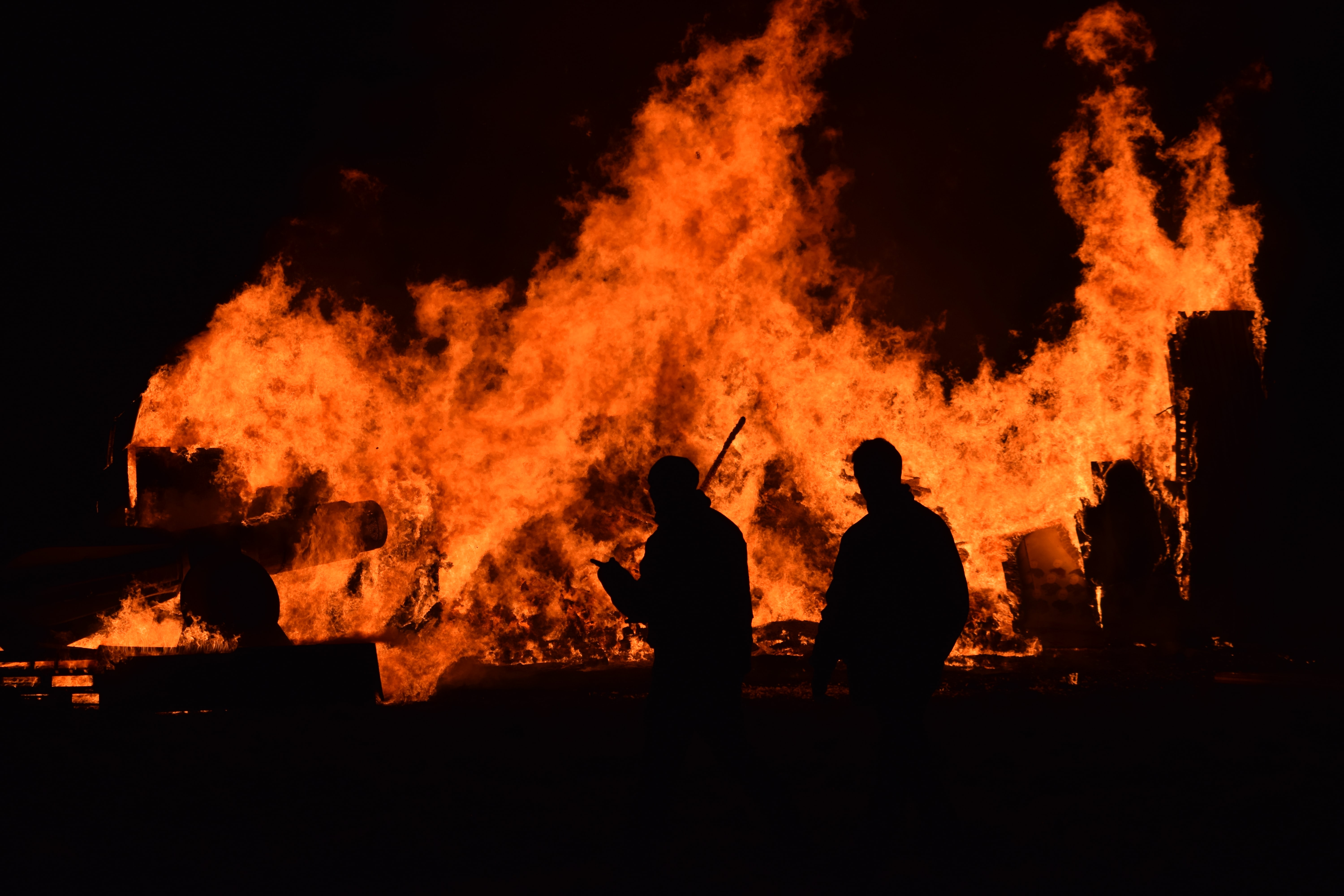
Wildfires have been ravaging sections of the western USA. It happens every years during the hot, dry months of summer, but 2021 is particularly bad. I heard a news report that the acreage destroyed to this point in 2021 is three times that of 2020, and we thought 2020 was bad. A few weeks ago, those of us in the eastern USA could look up into the sky a see the haze fading out the sun, as smoke from western wildfires was so expansive and hit the right wind current that it traveled the long distance across our country. The wildfires are a serious problem deserving serious attention in their own right. They also serve as a metaphor, as it seems our world is on fire in many other ways.
Is there hope for a world on fire? Do you feel like it is hopeless? Lately watching the Delta variant on the rise, it can feel hopeless. Do you know what I mean? Are you wondering if we’re going to have to start wearing masks again? Have you had disagreements or differences of opinion among family and friends about the vaccine? It can feel so frustrating, right?
Or what about politics? Do you feel like it hopeless? Watching politicians disagree about seemingly everything, and rarely trying to reach across the aisle to work together, can be so disheartening. Each side seems to have gravitated to the extreme ends of their belief system, and they caricature the other side as evil. Have you had disagreements or differences of opinions among family and friends about politics?
Or what about sexual ethics? Do you feel like it is hopeless? The school board meetings, the proposals in government for fairness in sports, and the actual human people affected…it’s all so fraught. Maybe you’ve had discussions and disagreements about that too.
Then there is Critical Race Theory. What is true? What is false? It can feel hopeless.
Last week we left Ezekiel in a bit of a cliffhanger. God had transported Ezekiel through a wild virtual reality vision back to his hometown, Jerusalem, where God gave Ezekiel an unsettling tour through the temple. Room after room in the temple, God showed Ezekiel how the Jews living there were worshiping idols and practicing pagan religion. Then God says he has had enough of the Jews’ adultery, and he not only begins leaving the temple, but he also unleashes judgment on the city. While the judgment is awful, God first saves those who remained faithful. Remember that all of this took place in a vision, meaning that it was a prophecy of what was to come upon the people there in Jerusalem. That is where we stopped, with Ezekiel still in the middle of the vision, a vision that mostly seems hopeless.
There is more to come, including an important message from God that will become a major theme throughout the rest of the book of Ezekiel. Let me give you a hint: it’s not hopeless! But why? Check out Ezekiel chapter 11 ahead of time, then I’ll look forward to discussing it further with you next week. I’m very thankful because we’ll have a guest teacher, David Hundert, leading us through Ezekiel 11.








 Engaging Scripture