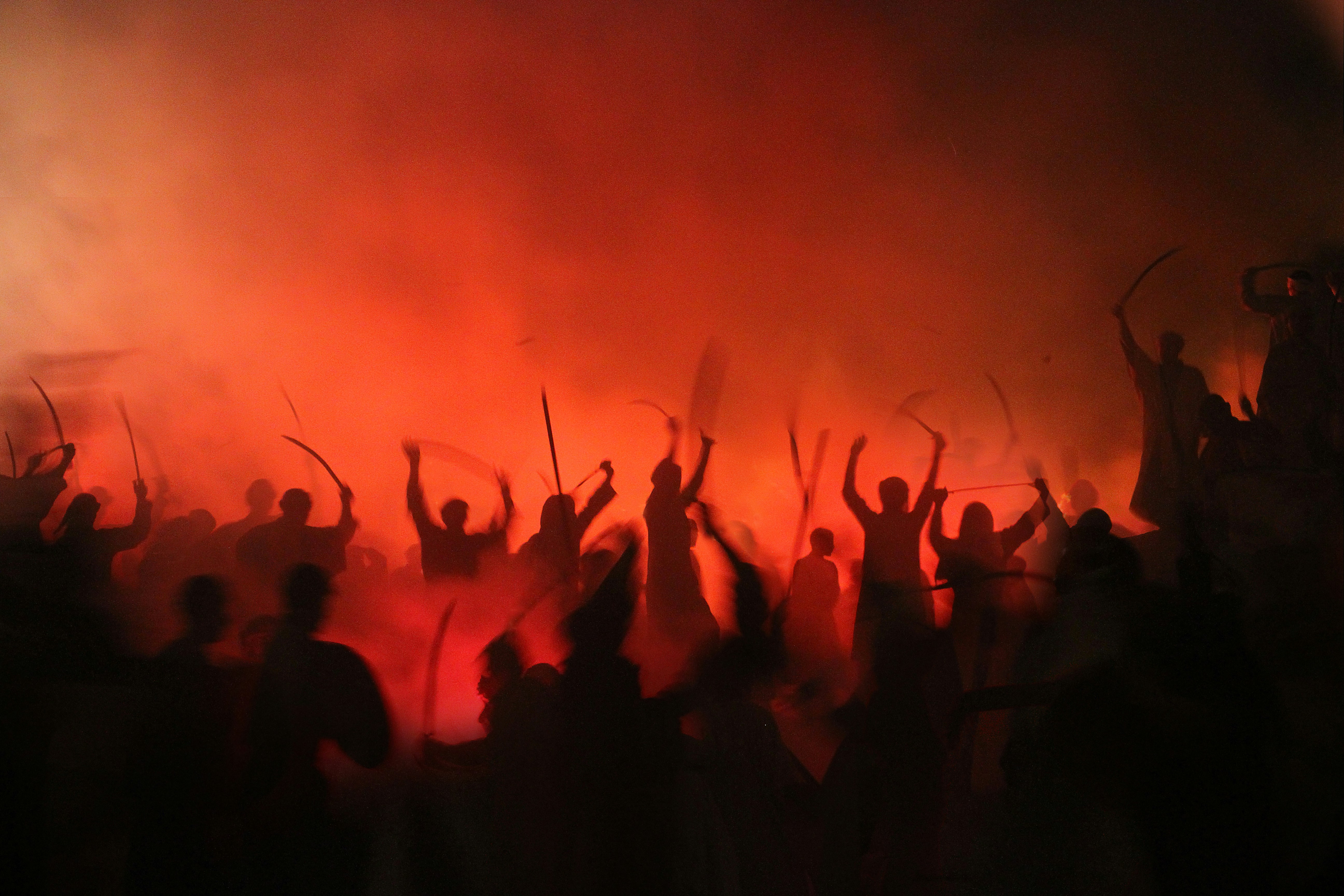
In the previous post, we read something very dark about David, who was supposed to be a man after God’s own heart. In 1st Samuel 27, we learned that David and his men go out on raids, slaughtering people. Men and women. Also, David clearly didn’t want his new king, the Philistine, Achish, to know about it. David seems to be lying to Achish about what he was really doing. In verse 10 David reports to Achish that David fought against his own Jewish people “the Negev of this place and the Negev of that place” when verse 8 tells us David was actually attacking non-Jews. In these lies, David builds trust in Achish’s eyes. Achish thinks, “David is my man. I can count on him. He is not an Israelite anymore. He’s become an enemy to his own people.” But David is lying to Achish. David is not slaughtering Jews.
This goes on for 16 months. And the story of 1st Samuel chapter 27 ends there. David is no longer hunted by the Israelite King Saul. David, his men and their families are safe in Philistine territory. But I have to admit that I get a bad feeling about chapter 27. David is no longer the hunted, he has become the hunter! And though he isn’t killing his own Jewish people, he is killing men and women, while lying to Achish about it.
What is going on here? How can David be so adamant about not killing evil Saul, even as Saul is trying to kill David (as we saw in this post), and yet, here is David leading his army in killing men and women in raiding parties? I think something is off about this.
Some scholars justify David’s slaughter of the people mentioned in 1st Samuel 27, suggesting David was fulfilling God’s promise to give the land of Palestine to Israel. Remember the Exodus story when God frees the nation of Israel from slavery in Egypt and says that he is going to bring them to the land of their forefathers, Abraham, Isaac and Jacob, the land of Canaan, the Land of Palestine, the Promised Land? God kept his promise.
The people of Israel, after being freed from slavery, wander in the desert for 40 years and finally make it to the Jordan River, which is the border to the Promised Land. They cross the Jordan, then fight the battle of Jericho, and little by little Joshua leads the people to occupy the Promised Land. Except that the Israelites didn’t complete the job.
They allowed numerous people groups to remain in the land, and that led to centuries of skirmish and war. Throughout 1st Samuel, we have seen regular conflict between the Jews and Philistines. The Philistines were not the only group that Israel battles. Some scholars believe that David wants to fulfill God’s promise to Israel of taking full possession of Palestine, and so David essentially restarts the conquest that had been on pause for hundreds of years. Thus these scholars see no problem with David slaughtering men and women in nearby towns and lying to Achish about it.
But I have to ask, no matter why he is doing it, is David doing the right thing slaughtering men and women. My opinion is that lying and murder are always wrong. David knew that from the Mosaic Law, from the Ten Commandments! Or can we say that this was all okay in God’s eyes, because David was protecting his men, their families, and continuing the conquest of Palestine that God had commanded Joshua centuries before?
Maybe. I have a really hard time with justifying David’s actions by saying, “God told me so.” Some scholars suggest God told ancient Israel to purge the land because he wanted to provide a clean start for a nation that had been enslaved for over 400 years. Others say God wanted Israel to eradicate injustice in those pagan cultures, some of which sacrificed infants during worship. Still other scholars don’t believe the Old Testament stories of purging are literal history because God’s heart is not in line with purging. Finally, there are scholars who believe we just need to trust God, though we might not understand his ways.
There is no doubt that there is much more to God in the Old Testament than commanding Israel to purge foreign people. There are plenty of places where God commands his people to practice radical justice, mercy and grace to foreigners. My conclusion is that stories like these in the Old Testament are messy. And I am thankful that there is a New Testament.
What I’m getting at is that you and I are not under the covenant agreement between God and Israel called the Mosaic Law. That was only between God and ancient Israel. After the days of David and his son Solomon, Israel would go on to break that covenant. God would declare that covenant broken, and Israel was exiled from the land. Eventually God brought them back to the land, and he promised that he would make a new covenant.
He kept that promise in Jesus. This is why Jesus said to his disciples, at the Last Supper, when he taught them to observe communion, he said the cup represents, “my blood of the new covenant, which is poured out for many for the forgiveness of sins.” Through Jesus’ death and resurrection, then, we enter into a new covenant, a new agreement with God. No longer is God in covenant agreement with a biological people who live on a geographical piece of land. Instead, his covenant is with the church, which is the body of Christ, all those who are true disciples of Jesus.
There are terms of that new covenant. Those terms are the expectations that God has for his people, the church. We are to live like Jesus lived. Christians do not send armies to geographical territory to build God’s kingdom by lying and murdering the inhabitants. The kingdom of God is not advanced by human military might, or human political might. The kingdom of God is advanced as humans, flowing with the Fruit of the Spirit, proclaim the Good News of Jesus in both word and deed to the people in communities where we live, work and play.
We practice the ethics of the Kingdom. Truth-telling, humility, selfless sacrifice, generosity, hope, peacemaking, etc.
Sadly, across our country some Christians have chosen a different way that is not in line with Christ. We’ll talk about that in the next post.
Photo by Hasan Almasi on Unsplash
 Engaging Scripture