I was groaning a lot when I did my taxes recently. I dread doing taxes because the tax forms can be so frustrating. My family has a number of unique circumstances that intensify the frustration. I am pastor, which means I get a housing allowance. My wife operated a business. I have education expenses. Finally we are married and have kids. My 2021 IRS filing required working through 8 forms, some of which include non-filed worksheets that are basically additional forms. Portions of those forms often make very little sense! “Write the amount from 1040 line 11 on form 8812 line 5. Then use the Credit Limit Worksheet in the instructions to figure out line 6. Multiply by .0673. If line 6 is larger than five, multiply by .05. If line 8 is 0, then enter line 7 on Schedule 2 line 5.” And on and on it goes. Sometimes you’re three forms deep just trying to figure one line on one form. Let’s just say I was groaning a lot.
Are you groaning? Maybe it was your taxes. Maybe you are groaning for a different reason. Maybe you are feeling suffering. Paul has a response for that reality of suffering in verses 18-22. Paul’s response to groaning is, surprisingly, more groaning.
Paul affirms that suffering is very real and very hard. But he doesn’t stop there. In verses 18-22 talks about creation as groaning. Pain and suffering are a natural part of life. Natural disasters, sickness, death, humans mistreating other humans. None of it is good or easy, but it is the reality of the world we live in. We live in a broken and fallen world.
You might have noticed that Paul uses the word “groan” a number of times in verses 22-27. Creation groans. We groan. And finally the Spirit groans. This is a physical expression, a sighing when one is feeling deep concern or distress. Maybe you know the feeling. Maybe you have been groaning a lot lately.
Thankfully, Paul says, we have hope. We read about this hope in verses 23-27. We have hope in the Spirit of God, who is at work on our lives. When life is so rough that we don’t even know how to pray, the Spirit prays for us.
In fact Paul says the Spirit is groaning for us! Isn’t that astounding? God’s Spirit is at work in our lives, praying for us. And it is not just a perfunctory prayer. The Spirit is emotional, groaning for us! What hope we have!
The good news just keeps getting better, as there’s more to come, as we’ll see in the next post.
What do you do when you feel the anxiety and the pain and the stress of condemnation from people? Other people can sure be condemning, can’t they? Maybe you have a family member, a co-worker, or a classmate that is like that. They might even be a church member, someone you would call a friend, and they have a condemning attitude. Some people have that look on their face on a regular basis. Some have it in the words they choose, in their outlook on life, in the tone of their voice. Condemnation. How do you handle condemnation? It’s very difficult, isn’t it?
This week on the blog we are studying Romans 8 to learn how the Easter message of resurrection helps us have hope when we are feeling separated and condemned.
At the beginning of Romans chapter 8, notice what Paul writes in verses 1-2.
There is no condemnation anymore! Because of Jesus we can be set free from condemnation. What does Paul say condemns us? He calls it “the law of sin and death.” If we haven’t been set free, we are still under the condemnation of the law of sin and death.
It is especially wonderful to know that God does not take a tone of condemnation toward us. I was recently talking to a pastoral colleague who mentioned that a longtime member of his church left the church because my pastor friend who would not preach hellfire and brimstone sermons. It boggles my mind that some people want to communicate God as a condemning God. My pastor friend took the right approach, refusing to communicate God that way, because God is love.
Some people have responded, “Yeah, but God is also just.” I understand that. Yes, Jesus called people to repent of their sins, and change their lives. But his posture and tone was loving and kind, and his message was, “Believe in me and follow me.” The disciples and followers of Jesus who would write the books of the Bible called the New Testament, wrote about God as a loving God, a forgiving God, a merciful God, over and over. This is why Jesus told the story of the Prodigal Son, who after living a reckless, selfish life, came to his senses and returned to his father. And his father welcomed him with open arms. The father in that story is a picture of God the father opening his arms to us.
In Romans 8, Paul does an excellent job balancing the love and justice of God. In verses 5-17, he makes a great case for why we should turn away from a sinful life.
In the Easter season, we celebrate the resurrection of Jesus because of how we can experience God’s resurrection power in our lives to turn away from sin. That’s why this passage is incredibly hopeful. It reminds us that because of Jesus’ death and resurrection, the way has been opened up for us to become part of God’s family. Paul uses the metaphor of death and life to describe this.
Before we are part of God’s family, it is as though we are dead. But when we become part of God’s family, it is as though we have been given new life, just as Jesus was dead and rose again to new life. Notice especially verses 11-12. There Paul emphasizes that when God’s Spirit is at work in our lives, God’s new life is flowing through us, and one of the primary ways we change is that we no longer live according to the old sinful way of life. There is a new and better way, the way of Jesus.
But living the way of Jesus, and turning away from the way of sinfulness, doesn’t mean that life will become perfect. People will still be people and mistreat us. Sometimes we will give in to temptation, and we will face the consequences of our sin.
Paul has a response for that reality of suffering, and we’ll talk about that in the next post.
What do you think of when you hear the word “Separation”?
Separation is a word that describes the feelings of so many in our world today. Often when we think of the concept of separation, I suspect we are mostly thinking about a relational separation. People who were once close are now separated. At holidays like Easter we might feel that, don’t we? Separation from the loss of a loved one.
But there are many other kinds of relational separation. Business partners can have an argument and separate. People can have an issue in their church and leave the church.
Sometime this kind of separation is needed. I recently listened to a podcast, Deep Cover: Mob Land, about a corrupt Chicago lawyer who fixed cases for the mob. After a number of years, he turned on the mob, informed on them for the FBI, and started testifying against them in open court. As a result he went into the witness protection program. He was separated for his own safety.
Sometimes this kind of separation is destructive: in marriage we use this word in the wedding ceremony, at which time we do not want separation to happen. “What God has joined together let not man separate.” And yet, many have felt the pain of separation that does happen in marriage.
Sometimes the separation is sudden, unexpected. This past week we celebrated Holy Week, which starts with the wonderful joy of Jesus’ Triumphal Entry. Remember how we learned that the Triumphal Entry was like the coronation of the King. It must have been so amazing for Jesus’ disciples to be watching their leader receive the praise that was due him. Except that five days later, as we remembered on Good Friday, things were the farthest from good they could imagine. The disciples were separated from Jesus. It was a sudden, dramatic ripping apart of their worlds. Maybe you know the feeling.
Interestingly, you and I in 2022 can feel the pain of separation in a world that is more connected than ever. Remember how it felt during the pandemic to be separated? Did Zoom help? Yeah. It helped. But it didn’t resolve the longing we had to be together.
E-mail, Facebook, Twitter, Cell phones keep us connected like never before. When I did my missionary internship in Guyana, South America in the summer between my junior and senior years of college in 1995, there was no internet, no cell phones. The missionaries I stayed with didn’t even have a land-based phone line in their home! The only way to stay connected to my wife, who was then my girlfriend, was through two-week old letters and three 15 minutes calls I made to her from a person in the community who had a phone line. That community member first required people to pay them to use their line, then we had to call collect. My calls to my girlfriend ended up costing my in-laws $50 for each of those three 15 minute calls. Believe me, I was worried that our separation would kill the relationship!
Now in 2022 we are electronically connected like never before, yet sometimes we feel so separated. The question we seek to answer is this, in a connected world, where separation is rampant, what does God have to say, and what does this have to do with Easter?
To try to answer that question, we’re going to study Romans chapter 8. Feel free to open a Bible and turn to Romans 8, verse 35. There we read a question about separation: “Who shall separate us from the love of Christ?” Remember that the guy who originally wrote this is one of Jesus earliest followers, a man named Paul. He was writing in ancient Greek, and the Bibles we have in front of us have thankfully translated that Greek into English.
The word Paul uses for “separation” is a word that is translated by a variety of English words: separate, divorce, depart, remove. In Romans 8, verse 35, the specific usage indicates a separation of “objects by introducing considerable space or isolation.”[1]
Paul is talking with a people who are struggling with separation. For you and I, being Christians and practicing our faith in America in 2022 is not a threat. We are used to having freedom and even power in our nation, specifically rooted in our Christian faith and community. Not the Christians in Rome in the first century AD. Those Christians were a tiny minority with no power. It could be said that the world was against them.
Think about it. These Christians were living in the capital city of the Roman Empire. At the time Paul wrote this, Claudius was emperor of Rome from AD 41-54. During his reign the Jews were kicked out of Rome in the middle of riots. You can read about this in Acts 18:2. Roman historians record the event telling us that Claudius kicked the Jews out of Rome on account of someone named “Chrestus,” a common mistaken way of saying “Christos” in the Greek, which where we get our word “Christ”, meaning “messiah.” Messiah, as we learned last week means “deliverer” or “savior.” So when we call Jesus the Christ, we are saying the Jesus is the deliverer, the savior. But the Roman Emperor didn’t see it that way. Jesus wasn’t too popular in Rome. So Claudius kicked them out.
The Christians in the Rome faced a daily reality of being separated. Separated from family, friends, and all they held dear. Many were refugees, some were in hiding, fearing for their lives. Separation was part and parcel of their existence.
How about you? Do you know the feeling of separation? Check back in to the next post as we’ll talk about how Easter matters to those who are feeling the pain and loss of separation.
[1]Johannes P. Louw and Eugene Albert Nida, Greek-English Lexicon of the New Testament : Based on Semantic Domains, electronic ed. of the 2nd edition. (New York: United Bible societies, 1996, c1989), 1:615.
I just walked back in to my office at our church building, because I was outside changing the message on the church sign. It had previously advertised our Maundy Thursday service, and now the new message asks, “Did Jesus really die and come back to life? Let’s talk about that.” How would you answer that question if someone asked you?
I put that question on the sign, because Easter is the day we celebrate Jesus’ resurrection, and because I am hoping that the many people driving by will read the message and think about the audacious claim we Christians make every Easter, that Jesus died and then miraculously came back to life. I hope people stop by and ask to talk about it.
The claim of Easter is wild, when you think about it. We Christians go so far as to say that Jesus physically died and physically came back to life. It was not just a spiritual resurrection. There on the cross, his heart stopped beating, his brain functions ceased, and he was no longer breathing. Then three days later, his heart restarted beating, his brain functioned anew, and he breathed. He now had a resurrection body, by the power of the Spirit.
I would encourage you to talk about that miracle this Easter weekend. Frankly, we shouldn’t talk about it only at Easter. We should be like the apostles, as we read the content of their preaching in the book of Acts, talking about Jesus’ resurrection all year round. If Jesus truly died and came back to life, then we should be going about our lives with that astounding claim ever on our lips. The miracle of resurrection is that life-changing. It is that important.
I wonder, when is the last time you talked with someone about the resurrection? Easter is a perfect season to bring up that conversation because, more than likely, you will be with family and friends to mark the day when the resurrection happened nearly 2000 years ago. We should bring up the topic of the day, because people in our families might not believe in the resurrection. If you’re feeling awkward about it, tell them I asked you to do it, so that it takes the pressure off you.
But that question is only the first of two very important questions. The first question is: “Did Jesus really die and come back to life?” As you ask people that question, perhaps it will lead to the next one: “What it is the significance of his death and resurrection?” To put it another way: “So what?” A man dying and coming back to life is astounding as a biological occurrence. But what does it mean?
On the blog next week, I will attempt to answer that second question. How does the resurrection matter? As you might remember, this blog is based on the sermons I preach at Faith Church. I take the previous week’s sermon, divide it into five parts, and release it on the blog. Earliest this week as I thought about what I should preach for Easter 2022, I was a bit stumped. Of course I knew the topic was going to be the resurrection of Jesus, but what Scripture passage should I focus on?
This is my 12th year in a row preaching Easter sermons. I’ve preached on the resurrection story from each of the Gospels, except for Mark, because, well, that’s just a strange one. I’ve preached on the wonderful resurrection chapter, 1st Corinthians 15. One year I preached on Psalm 103, which seems like it was written for Easter (though it wasn’t). As I thought about the significance of Jesus’ resurrection, I decided to preach Romans 8, which is usually considered to be a Holy Spirit chapter. It is that. But it is so much more.
Let me back up a minute and talk about Romans. Romans is one of the most revered and substantive books of the Bible, and for good reason. Through Romans we learn the importance of the theology of God’s grace. Do a search on the blog, though, and you’ll find I have rarely written about Romans. I suspect the reason for that has to do with the fact that Romans is quite complex. That said, open up your Bible and read Romans 8 ahead this weekend. I think you’ll find it to be familiar, and quite encouraging, especially about the work of the Holy Spirit in our lives. As you read Romans 8, notice how Paul talks about the resurrection. Then join us on the blog next week, and we’ll talk about it further.
In the previous post, we learned that, just as the crowds proclaimed on the first Sunday when they shouted, “Blessed is the coming Kingdom of our father David,” Jesus brings the Kingdom of God in our lives. But God’s Kingdom is not just within people, it is also within cultures and societies. Yes, God wants to change individual people, but he also wants to change societies. When I think about this, I think, “What would happen if a lot of people became Christians?” That would certainly change societies, cultures and the world, wouldn’t it? If so, shouldn’t we focus on just getting people saved?
There is no doubt that Christians should seek to make disciples, just as Jesus demonstrated for us and called us to (Matthew 28:18-20). Every single one of us should see ourselves as disciplemakers for Jesus. The goal of inviting people to enter into apprenticeship with Jesus, to become his disciples, is that more people would experience the abundant life he came to give us. That means, as we saw in the previous post, that those individuals lives would experience transformational change.
This very change has happened many times. In fact, there have been revivals in the past where so many people in a local community began following Jesus that jails emptied out, bars shut down, and the police didn’t have much to do. But that is exceedingly rare. Instead, the advancement of the Kingdom of God involves both individual salvation and societal transformation by means of social action.
For one of my doctoral courses I did research in my denomination’s archives, located at its headquarters in Myerstown, Pennsylvania. My denomination, the Evangelical Congregational Church, for many years published a weekly newspaper, the United Evangelical. Every issue is stored in the archives. I read the issues published during the Civil Rights Era of the 1950s and 1960s, seeking to learn how the EC Church interacted with or commented on the Civil Rights Movement. I was afraid there was going to be nothing.
I was pleasantly surprised to find quite a few articles, editorials and reports from denominational committees. These various articles commented on the events happening in our nation, as cases went before the Supreme Court, as schools were desegregated and as the nation reacted. The general theme of all those articles and committee reports was what we might call the “individual salvation solution.” That approach says, “Just get people saved and the culture will change, so therefore we need to double our emphasis on evangelism.”
The problem is that most of the people who were trying to keep institutions segregated claimed that they were Christian. What needed to change, therefore, were laws and structures in society. In places where segregation was legal, it needed to become illegal. In places where there was segregation, society, culture and the church needed to be desegregated. That meant advocating through means of social action. It meant people risking their lives through non-violent action. Many died. Not just the famous ones like Martin Luther King Jr, but others as well. They were doing Kingdom work.
In God’s Kingdom there is no segregation, as we read in Galatians 3, “in Christ, there is neither Jew, nor Greek…but all are one in Christ.” Therefore, wherever we find segregation, we call it what it is, an injustice. God’s heart is for justice. In his Kingdom justice rules and reigns. So we work to bring justice anywhere we find injustice. Is there injustice in our community? We should be actively looking for it, seeking to eradicate it, and bring justice. We love our neighbor as we love ourselves, so all may know him, so all may know his love, and flourish in his Kingdom.
When Jesus entered Jerusalem on that original Palm Sunday, he was willingly receiving the coronation that was true. It didn’t matter that the people got one part of it wrong. He was not going to be a political or military king. Instead, he was physically and symbolically declaring to all that he was the Messiah, the deliverer, the savior, the King who had come into the world, ushering in the rule and reign of God’s Kingdom. Ever since, you and I, giving our allegiance to the one true King make it our life’s mission to advance his Kingdom wherever we live, wherever we go. You and I are ambassadors of the king, ambassadors of reconciliation, Paul wrote. Helping people become reconciled to the King, and helping them be reconciled to one another.
Palm Sunday, then, is a reminder to us of what is real and important. Our allegiance to King Jesus. Does your life show that you are shouting “Hosanna!” to the King? How and where can we shout Hosanna in a more clear way in our lives and in our communities? What areas of our lives need more connection to the Spirit, more awareness of the king that King Jesus came to be?
What is the Kingdom of God? Jesus himself taught about it, almost from the very beginning of his ministry. As we continue studying the events of Jesus’ Triumphal Entry on the very first Palm Sunday, we’ve been following Mark’s account in Mark 11. Mark tells us that the people in the crowd, as Jesus rode into Jerusalem on a donkey, shouted a curious phrase, “Blessed is the coming Kingdom of our father David.” In the previous post, I suggested that the people were proclaiming Jesus to be the promised Messiah, the king of the Kingdom. While they were correct, they were also wrong. Jesus was the Messiah, he was the King, but he was a very different King of a different Kingdom than what they realized. Jesus was the King of the Kingdom of God. And that is why I ask, “What is the Kingdom of God?”
To answer that question, turn in a Bible to the beginning of Mark chapter 1. Mark begins his gospel, his story of the life of Jesus, by telling us in verse 1 that this story is the beginning of the good news about Jesus the Messiah, the son of God.
Mark then quotes a couple Old Testament prophets that refer to the coming of the Messiah and that there would be a person who would prepare the way for him. That person was John the Baptist, and he had a powerful ministry, calling people to repent of their sins and get baptized, so that the people might be ready for the Messiah who was coming soon. Huge crowds heeded John’s message, and then one day Jesus showed up in the crowds.
Mark tells us that John baptizes Jesus, and at that moment God the Father speaks over Jesus and the Spirit of God descends on him, launching Jesus into ministry. Soon after that, John is thrown in prison, his ministry fades, and Jesus’ picks up where John left off. What is the first thing Jesus preaches? See verse 14-15, “The Kingdom of God has come near, Repent and believe the good news.”
Through Jesus, the Kingdom of God has come near. That’s a very different kind of King. Once Jesus taught his disciples to pray, saying, “Thy Kingdom come, thy will be done, on earth as it is in heaven.”
What is the Kingdom of God? The doctrine of the Kingdom is an approach to human flourishing, rooted in the perfect love of God for all, by which all Kingdom people partake in and share God’s love with one another.
Do you remember the final vision in the book of Ezekiel, where the river flows from the temple and provides flourishing to the land around it? You can read that blog post here. The river made trees grow, blossom and produce fruit. My daughter likes to point out all the blossoming trees in the spring. You see the whites, pinks, purples. The yellow. The grass has turned from brown to green. There is flourishing in springtime. The Kingdom of God is like that, but for humans.
Where the Kingdom of God is, there people flourish. When I use that word, “flourishing,” I am not talking about financial prosperity or vertical job growth or bigger houses or any of the typical metrics of success that we find in capitalism. In the American dream, bigger is better. But not in God’s Kingdom. Remember that Jesus once said, “narrow is the way, and few will find it.”
That doesn’t mean we are satisfied with only a few finding the Kingdom, because God loves the whole world and desires that every single person would become a part of his kingdom. Therefore we strive to help people enter his kingdom so that they can experience the flourishing only Jesus can bring. That flourishing is both the hope of eternal life with him, and the experience of abundant life now. Jesus said in John 10:10 that he came so that people might have life and life abundantly. That abundant life is the flourishing life of God’s Kingdom.
The flourishing life is not stagnant. There is new growth, blossoms, change. There are always more ways that God wants us to grow. He wants us to experience the movement of his Spirit in our lives.
That is why after Easter our next blog series is going to be about the Fruit of the Spirit in Galatians 5. God wants every person to experience the fruit of the Spirit, so that flowing from our lives is love, joy, peace, patience, gentleness, goodness, kindness, faithfulness and self-control. Can you imagine more and more people getting rid of bitterness, manipulation, gaslighting, intimidation, complaining, shouting, hatefulness, betrayal, and divisiveness? Can you imagine more and more people being filled with the fruit of the Spirit? That is the vision of the flourishing Kingdom.
That’s what happen when the Kingdom of God expands into people’s lives. This is what happens when people make Jesus their king. His Spirit enters our lives and begins to change us. When we are connected with the Spirit, we will continue to change to become more and more like him. The apostle Paul described this when he wrote in 2 Corinthians 5:17, “When anyone is in Christ, they are a new creation. The old has gone, the new has come.” When Jesus is our King, we become different people. We become people who flourish from within. How does that sound to you? Do you feel this inner flourishing? If not, I’d be happy to talk with you further. Just comment below!
But God’s Kingdom is not just within people. The Kingdom of God is so much more. Check back to the next post as we learn about God’s vision for his global Kingdom.
Jesus was the Messiah, but he was not the Messiah the Jews were looking for.
When the Jews interpreted messianic passages like Psalm 118, which they quoted on the original Palm Sunday, they concluded that the Messiah was going to be a king of the line of the great king David. This new king would rescue the people of Israel and restore their land to the prominence it had during the days of King David and David’s son King Solomon. Those were the days when Israel was independent, its own sovereign nation, as it had won victory over its enemies. There was peace and prosperity. People came from all over the known world to see the wonders of Solomon’s kingdom. Sadly, it didn’t last.
We know the story of how Israel’s fortunes changed because of our recent study through the book of Ezekiel. Soon after Solomon died, Israel had a civil war, splitting into North and South, and both Kingdoms eventually turned away from God, breaking the covenant between God and his people. Because of their rebellion against God, God allowed the foreign powers of Assyria and Babylon to defeat the Jews, carrying many of them into exile, far away from home, like Ezekiel.
Eventually, though, the people were allowed to return, they rebuilt the temple and slowly the nation got back on its feet. But the nation was severely weakened. It was nothing compared to what it was during those long-gone days of David and Solomon. Whatever the regional superpowers wanted to do with Israel, they could do. And they did. After the Babylonians, there was a succession of powerful nations that ruled the region. The Medes and Persians, then the Greeks, and finally the Romans controlled the land, except for the 100 years of independence when the Maccabees ruled.
During Jesus’ lifetime, Israel was a conquered people. The Jews hated living in a land that was once their own independent nation but now had been occupied by foreign nations for hundreds of years. They longed for a new day. They wrote about that new day. They sang songs about that new day. They searched their Scriptures for God’s promises of a new day, and they found many promises in books like Ezekiel, which we studied in recent months on the blog. God had promised to send a great leader to rescue his people, such as what we learned here. They called this leader the Messiah, which means “deliverer” or “savior.” The Jews believed the Messiah would be a great ruler, of the lineage of David, who would lead the people to freedom in the land. They envisioned a great politician, a warrior king.
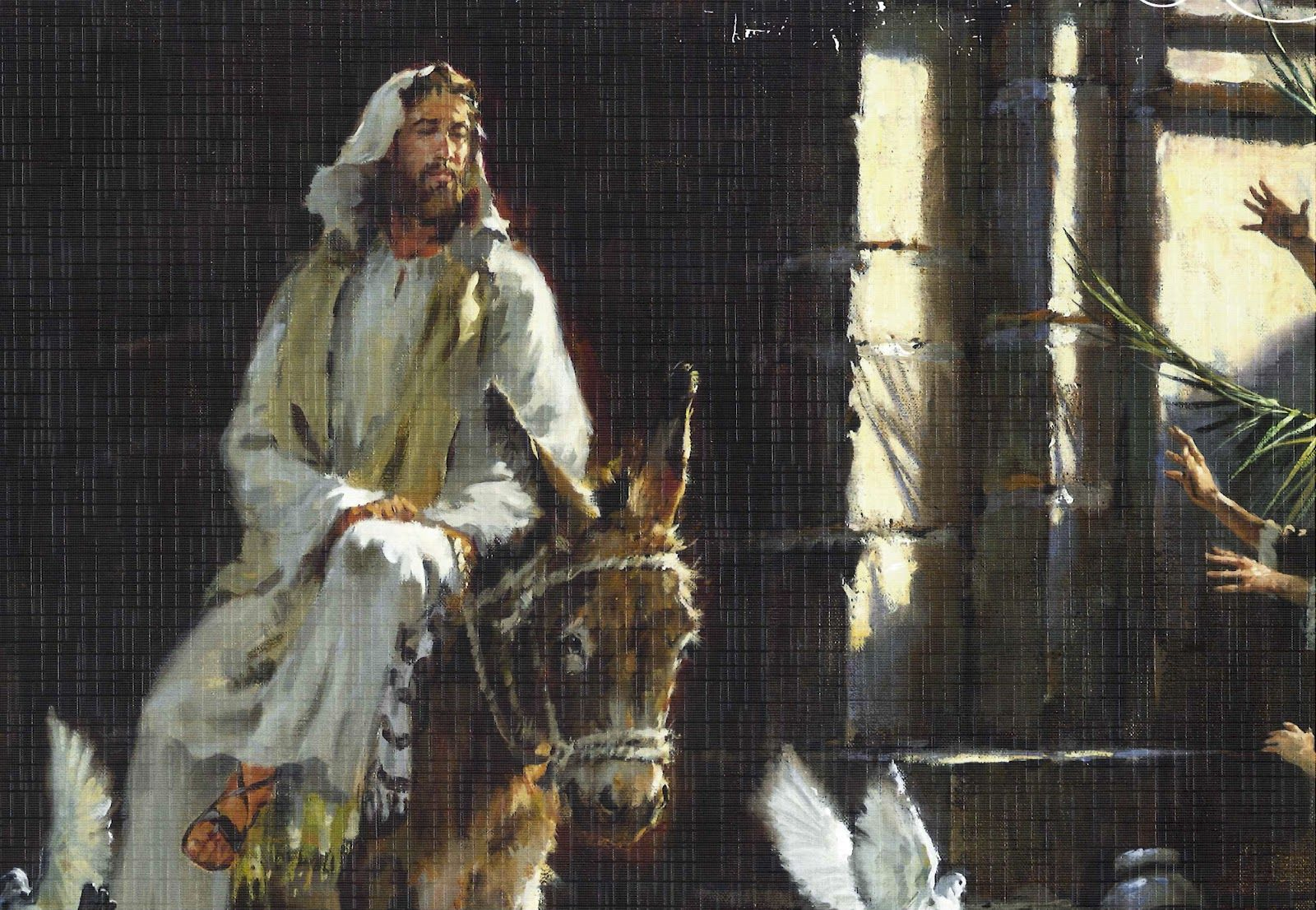
When Jesus came along amassing huge crowds, doing astounding miracles, and speaking with authority to all, he seemed to be a very good candidate to be the promised Messiah. So after three years of a growing ministry, he enters the city of Jerusalem riding on a donkey. You and I read about the donkey, and we can easily think to ourselves, “What a poor choice for a king. Shouldn’t he be riding on tall regal white stallion?” The people in the crowd that day, being good Jews, knew their prophecy. They saw what Jesus was doing, riding on a donkey, and their brains did the rest of the work, reminding them of a famous messianic prophecy.
Turn to Zechariah 9 and read verses 9-17. This was written some 400 years before the time of Jesus.
Doesn’t it seem like verse 9 describes exactly what is happening that original Palm Sunday in Jerusalem? “Rejoice Jerusalem! Your king comes to you…riding on a donkey.” Zechariah 9:9 is another messianic prophecy. To the people watching Jesus, that prophecy was unfolding before their very eyes! In the rest of the passage in Zechariah 9, the prophecy says that this messianic king will save his people, and the prophecy describes the work of the messiah in military terms. You can see why the Jewish people believed the Messiah was going to be a military political ruler.
What this means is that they were correct. Zechariah 9 is about the messiah, and the messiah is Jesus. They were correct to apply this passage to Jesus on that day he rode into Jerusalem on a donkey. Go back to Mark 11, and look at how the crowds explain themselves in verse 10, “Blessed is the coming kingdom of our father David.” They believed that Jesus was, at that moment, about to start a military movement to oust the Romans from the land and restore the land to Israel. Jesus, in their view, would then become the new Davidic king, sitting on a throne, in a palace in Jerusalem.
While they were right, the Jews were also wrong. Jesus was the king, but not that kind of king. Jesus is the king of God’s Kingdom. The people were right to shout “hosanna” which means “save!” from Psalm 118 verse 25, “Lord save us!”, but the people misunderstood the kind of salvation the king would bring. They were focused on themselves, as we all can be. Jesus is the king, and he brings salvation, but Jesus’ salvation is not about freeing a geographical area in the ancient near east so the Jews could have their own land. Jesus is the king of a very different kind of kingdom.
In the next post we’ll learn more about Jesus’ Kingdom.
How does my experiment with the American flag relate to Palm Sunday? You can read about that experiment in the previous post.
As we begin to answer that question, turn with me to Mark 11, and read the story of the first Palm Sunday. We are studying Mark’s account of the story of Jesus’ Triumphal entry because, as I mentioned in the preview post, there is a detail in Mark’s telling of this story that is important. Matthew and Luke don’t include this detail, but John and Mark do.
Who was Mark? For starters, Mark was not a disciple of Jesus. Mark came along years later, long after Jesus returned to heaven and the church had begun. Mark was a missionary in the church, spending time with Paul and Peter. Biblical historians believe that it was Peter who told Mark the stories of Jesus. So you could say that Mark’s is actually “The Gospel according to Peter, as told by Mark.” When we read Mark’s version of the Triumphal Entry, therefore, we are getting an eyewitness account. Peter was there that day. Let’s review the event itself.
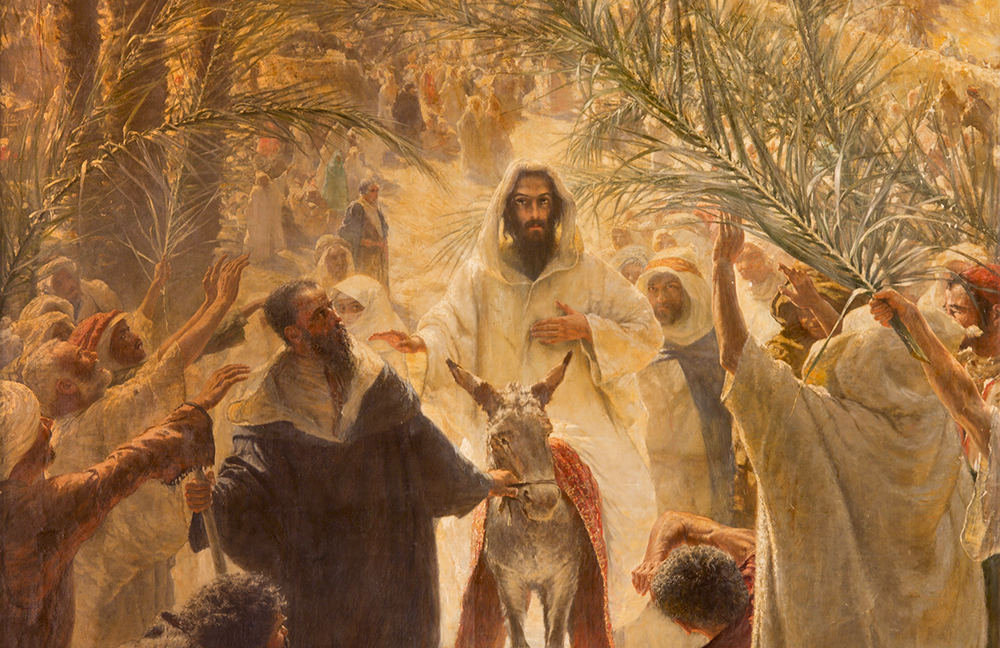
Skim over the story, especially Mark 11, verses 7-10. Here’s a summary: Nearing the end of his three-year ministry, Jesus enters the city of Jerusalem, the seat of government, riding on a donkey, while the crowds spread their cloaks on the ground creating a kind of red carpet entry for him, as they waved palm branches and shouted, “Hosanna! Blessed is he who comes in the name of the Lord!”
Do you know what is going on here? This was a coronation. A coronation is the crowing of a new king. The people identified Jesus as their new king.
Of course not everyone agreed with them. The religious leaders and political rulers did not see Jesus as king. There was already a man that the Jews called “king,” a guy named Herod. He wasn’t the king of the whole land, though, and he did not rule over Jerusalem. Instead, Herod was more like regional governor of the northern part of Israel. Rome was in control of the land, not Israel. So this Jewish “king,” Herod, was subject to Rome. A Roman named Pontius Pilate was the leader in Jerusalem, and Herod and Pilate’s boss, hundreds of miles away in Rome, was the absolute true king of the empire, the emperor, Caesar.
So when Jesus, a popular Jewish itinerant preacher who reportedly did miracles and had crowds numbering in the thousands rides into town on a donkey, to the joy of the crowds, the leadership in the city didn’t seem all that concerned. Not that they were totally unconcerned, though. Rome was always cautious about uprisings, and to keep the peace they could be ruthless in putting down rebellion. Rome had the biggest guns, so it was pretty much impossible to challenge their authority. If Jesus had whipped up this crowd of cheering followers into a riot to overthrow the government, there is no doubt what would have happened. There would be a battle between the barely-armed crowd and the heavily-armed Roman military. The Jewish crowd might kill some Roman soldiers, the uprising might last a few days, but Rome would win.
That is not to say, though, that the Jews wouldn’t have tried. The really might have tried, especially if Jesus told them to form a militia and start fighting on his behalf. I say that because previously many others had tried. In fact, there was a family of Jews in the roughly 400 year period between the Old and New Testament that defeated the Romans and took back control of Israel for approximately 100 years. That family was called the Maccabees, and the Jews looked back on them with reverence. There were almost certainly plenty of people in the crowd that day cheering Jesus, hoping that he would start a movement like the Maccabees. Most, if not all, the Jews wanted to be free of Roman occupation.
Furthermore, by what they are saying about Jesus, the people seem to give us evidence that they might have believed Jesus was going to lead an uprising. How do we know that? Look at Mark 11, verses 9-10.
Verse 9 is familiar, as we quote or sing it almost every Palm Sunday. “Hosanna! Blessed is he who comes in the name of the Lord.” That is a quote from Psalm 118 verses 25-26. Why did the Jews shout these verses?
Psalm 118 is often considered to be a messianic psalm, meaning that the ancient Jewish scholars interpreted this psalm as talking about the Messiah. You and I hear that word “messiah,” and my guess is that most of us instantly, in our minds, connect “messiah” to Jesus. Jesus, we Christians believe, was the promised Messiah, and that belief has been true in Christian thinking for nearly 2000 years.
But for the Jews who wrote Psalm 118, and for the Jews who were shouting verses from Psalm 118 as Jesus entered the city of Jerusalem sitting on a donkey, they had made no previous connection between Jesus and this Messiah figure. Actually, we could say that the crowds at that Palm Sunday were some of the first people to make the connection.
While they were correct, they were also very wrong. In the next post we’ll learn how.
I did a little experiment this past fall. It was a sociological and theological experiment. At first, I didn’t tell anyone about this experiment. Not even my wife. I knew that if I told her, the experiment would be shut down fast.
To introduce the experiment, I have a question for you. How many of you fly the American flag at your home, or on your vehicle or something like that? For those of you who don’t fly the flag, how could you be so unpatriotic and unAmerican??? Just kidding. We don’t fly the American flag at my house either.
But that brings me to another question. How many of you fly the Christian flag? I would be surprised if many did. Driving around my community, I see plenty of American flags, but not a single Christian flag. And that reality gave me the idea for the experiment.
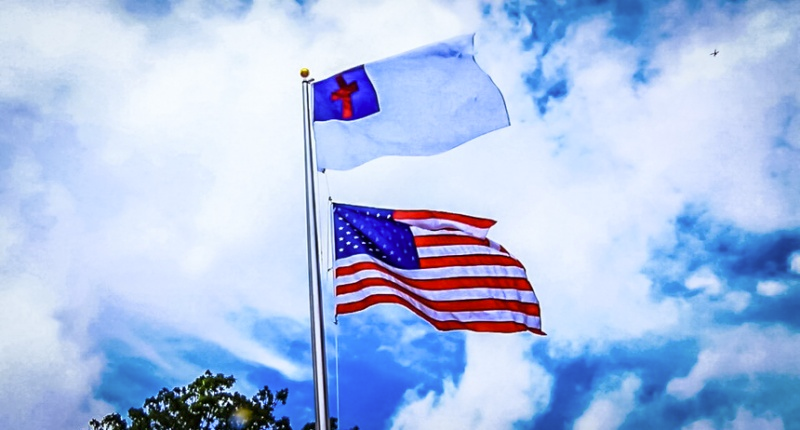
As walk back and forth from the church office to the church mailbox out along the road, I often look at the flags flying in our church yard. We fly he American flag and the Christian flag.
We’ve never been able to find flags that last long. Maybe a year. Maybe two if we’re lucky. Outdoor flags deteriorate fast because we fly them 24/7/365. The US flag code allows for flags to fly 24/7 if they are lit in the dark. Otherwise you have to take them down overnight. We have ground light shining on our flag pole, which means the weather takes its toll on our flags
Last fall, I noticed our Christian flag was fraying, so I lowered the flags, cut off the frays, and with the flag draped over my shoulders, an idea hit me.
The US Flag code says that whenever the American flag is flying among other flags, the American flag should be highest. It’s not a law, but a code of honor. Its symbolic, right? This symbolism has long gotten under my skin as a Christian. This is the theology part of the experiment. Outside our church, when we fly the American flag above the Christian flag, we could be interpreted as believing or proclaiming that America is above Jesus. But we don’t believe that. Not even close.
So I switched the flags, looking around to see if any people in the cars passing by would notice. Then I raised them with the Christian flag on top. I felt nervous, and as I quickly walked back inside.
Did anyone notice? How many people are even aware of the flag code? How many people would care? I doubt many of you reading this were aware of the flag code. For the first few days, I remained a bit nervous. But there was no response. Two months went by without a peep, and I forgot about the experiment.
Then one person from Faith Church mentioned to me they noticed the flags. I don’t know if I had any visible reaction on my face, but I felt the nerves as I explained that I was doing an experiment. They understood, and the experiment continued.
Two more weeks went by. Then one day a woman left an anonymous voicemail at the church office. Was she a community member, was it a tourist? Who knows? She did not identify herself. But she said she saw the flags, and she wondered if someone made a mistake when hanging them. The American flag should be on top. Then she got really stern, saying that it was total disrespect to American veterans.
At that point, I played the voicemail for my wife. She thought the experiment was a very bad idea because people driving by would naturally assume that Faith Church was trying to make statement. But Faith Church wasn’t making a statement. Faith Church didn’t even know about it. I was just doing an experiment. She was right. So I changed the flags back, a bit begrudgingly. I tell you this story because our flags relate to Palm Sunday.
Check back to the next post, as we’ll talk about that further.
We observe Palm Sunday every year, but did you ever wonder why?
I get why we celebrate the birth of Jesus, and of course his death and resurrection. Those are, by far, the three most momentous events in his life. But why Palm Sunday? It’s not nearly as important as Christmas and Easter, right? Why do we celebrate a day that is less important?
There are a few other days on the Christian calendar that we might say are on a similar secondary level of importance, along with Palm Sunday. We give a slight nod, for example, to Jesus’ Ascension. Then for the coming of the Holy Spirit at Pentecost, we change the sanctuary colors to red. But we don’t make a day out of these second-tier holidays. We don’t normally sing special songs about them. I have rarely preached about the Ascension and Pentecost on those Sundays, except for when I was preaching through the Gospels or Acts, and often those scripture passages didn’t align with Ascension and Pentecost Sundays.
Some Christians are very committed to observing the events of the Christian calendar, some having a special day for nearly every Sunday of the year. I live in Lancaster, Pennsylvania, perhaps most famous for our Amish community. The Amish make a big deal of Ascension. Liturgical churches that follow the lectionary have numerous other special Sundays.
But us evangelicals? Not as much. We have tended to focus on two seasons of the Christian calendar. The four weeks of Advent that culminate on Christmas Eve, and the seven weeks of Lent that culminate on Easter. Actually, the Baptist church I grew up in didn’t celebrate Advent or Lent. Just Christmas and Easter.
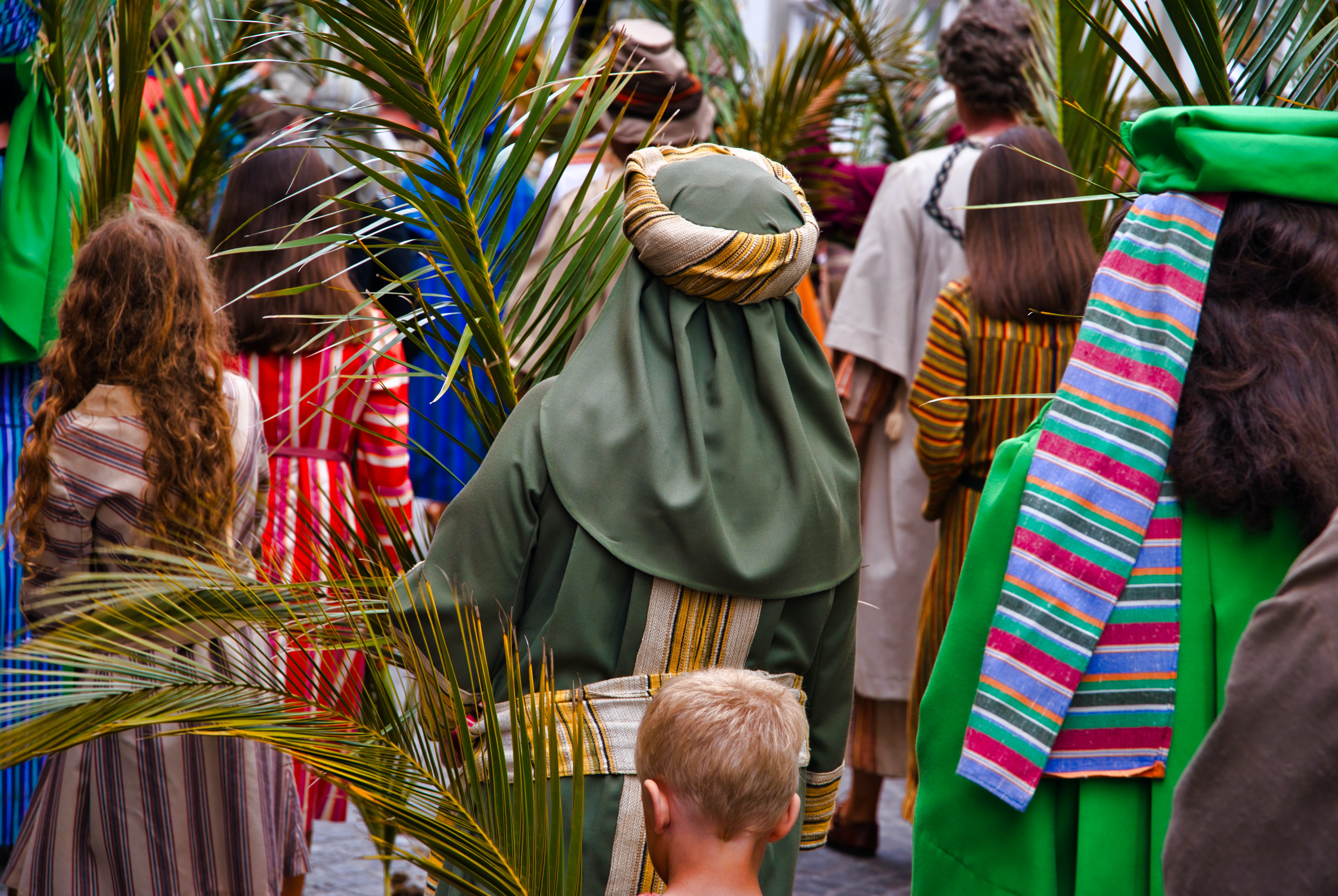
Perhaps because Easter is such an important event, the most important event, Christians through the centuries have created an entire week building up to it. Next week we will celebrate Maundy Thursday and Good Friday. Tomorrow we kick off Holy Week with Palm Sunday. What is so important about Palm Sunday? We always sing songs about the events of that day, we wave palm branches, and often have a sermon about Jesus’ Triumphal Entry. Why, though? What’s the big deal with Palm Sunday? Is it just fun to give kids palms and watch them parade around the sanctuary?
Yes, it is. But that’s not why Palm Sunday is special. You can probably remember the basic details of the first Palm Sunday in your mind, having heard it so many times. Or you can review it in any of the four Gospel accounts. This coming Sunday we’re going to be following Mark’s account, which is nearly identical to the other versions, but Mark mentions something unique that, of the four, only John also alludes to.
Skim through the four stories of Jesus’ Triumphal Entry, and see if you can find the unique feature in Mark 11 and John 12. It is this feature that I believe is so important, and why we make a big deal about Palm Sunday. Then join us on the blog starting as we talk about it further!






 Engaging Scripture