Everything happens for a reason? [False ideas Christians believe about…God’s involvement in our lives. Part 1]

Image result for order and disorder

How involved do you think God is in your life? Does he seem distant? Or does he seem close? Maybe he shows up, but only rarely?

With this post we begin a series fact-checking common sayings related to God’s interaction with the world.  This is very much related to what we talked about in the previous series of posts, as we talk about God’s involvement in our lives especially when we are going through difficult times.  We start wondering what God thinks about our pain, and what he might have to do with it, and if he will step in and free us from our pain.  When the answers to our musings don’t come easily, we can spout ideas that make us feel better. But are they true? Let’s take a look at the phrases we’re going to be fact-checking in this series:

  1. Everything happens for a reason.
  2. God is in control.
  3. Let go and let God.
  4. God works in mysterious ways.

You might be surprised to see some or all of these included in this list!  Why would a Christian possibly need to fact check the phrase, “God is in control?”  Am I suggesting that God is not in control?  We’re going to find out!  But we start with…

Everything happens for a reason.  Does everything actually happen for a reason?  By asking that question, I don’t mean to insinuate that everything might not have a cause.  All things have a cause.  When we say “everything happens for a reason,” however, we are usually looking for the good that could come out of a difficult time.  The silver lining, we call it. 

In fact, when we are going through a hard time, we often NEED to think that everything happens for a reason.  We need to make sense of pain and difficulty.  We would struggle even worse, emotionally, theologically, and philosophically, we think, if there was no reason for the hardship we’re facing.

So are there any passages in the Bible that could support the idea that everything happens for a reason?  The go-to verse is Romans 8:28: “And we know that in all things God works for the good of those who love him.”  It sure sounds like this verse supports the phrase “everything happens for a reason.” But does it?

Scan through the whole chapter, and you’ll see that Paul is talking about suffering and how the Holy Spirit actually prays for us when we don’t know what to pray.

The NIV starts a new paragraph at verse 28, and I would like to suggest that might not be a good editorial choice, as it seems that Paul was actually continuing a line of thinking throughout the whole chapter.  Look at the near context, for example, in verses 26-27, and you’ll find Paul teaching that the Holy Spirit is praying that God’s will would be done in our lives, and thus it follows in verse 28 that we know that all things work together for good to those who love God. 

That doesn’t mean that we will agree with God’s will for us, or that we will even know what God’s best for us is.  God doesn’t promise in this passage to explain it all to us.  Instead, what Paul is saying is that we can trust that there is definitely spiritual work going on in the spiritual realm, and it is for our good.  We just might not now realize it.

This morning’s devotions from An American Lent (Sun. March 17, 2019) spoke to this when they said, “But, he is also the God who is able to reveal his goodness in the midst of the most horrific circumstances. He is everywhere and so his goodness can be found there too.” But we might not always find it.

To say that all our sufferings happen for a reason places a far too heavy burden on us to figure it out!  Sometimes, and maybe even most times, bad things happen because the world is a fallen world.  What does it mean that the world is a fallen world?  That it is always bad, always evil? NO.  But instead a broken and fallen world demonstrates at least three tendencies, and we’ll review those in the next post.

How to walk through pain [False ideas Christians believe about…difficulty. Part 5]

Photo by Thiago Barletta on Unsplash

How should we respond in the midst of pain?

The psalmists often lament, crying out their complaint to God as to why he is not answering their prayer.  This is why we are fact-checking statement about dealing with difficulty. The post you are reading is number 5 of 5. If you’re starting here, I encourage you to go back to the first post, as we fact-checked statements like “God helps those who help themselves,” and “This too shall pass,” finding that we Christians are too quick to dole out these mantras and can actually increase a person’s pain. Many going through hard times are actively seeking God, remaining faithful to God, even if it seems God has grown silent and is nowhere to be found. So what can we say to people that will help them?

First of all, we need to check out motivation and pause before we say or do anything. Remember that difficulty is called difficulty because it is difficult.  We struggle.  We feel anxiety, panic, stress, and fear.

Perhaps the best initial response is simply to give the person a hug, and affirm that you love them and are here for them. Then pray for them, out loud, right then and there. You don’t need to make any statements about the pain going away. Just like the lamenters in the psalms do, just ask God to be there.

Then listen. Allow the person to talk. We Christians would do well to practice the discipline of empathy, learning to mourn with those who mourn, as Paul says in Romans 12:15.

As difficult as it can be in those situations, the proper response is to continue to trust in God, following the way of Jesus. 

It is okay to try to encourage someone with the phrase, “this too shall pass”, but be empathetic to remember that the person is struggling, and it might not pass. These statements are proverbial, meaning they are generally true, but there are exceptions.  And those exceptions are what we need to be very attuned to.  People and their struggles don’t fit neatly into categories. 

It is okay to try to point someone to God in the midst of their struggle, but remember that they might have been seeking God already for days, months, and all they are feeling is distance.  In those moments, it is okay to lament, to complain to God, saying “How long O Lord, are you going to make me wait?”

My wife recently heard someone speak about losing their child.  They said they turned to their spouse at that moment and said, “This will forever change us.  How we move forward in this will determine exactly what changes it makes.”  This couple decided to pray hard and regularly for God to grow them and teach them through this pain that will be with them forever.  I can tell you, as we know them on the other side of their pain, that that is exactly what happened.  There are other situations where I’ve seen pain, and people have simply just asked God to remove it.  Sometimes he does, but sometimes it is not removed.  Some people battle for years with bitterness and anger and negativity. How we walk through difficulty matters. We are not promised it will be taken away.  We are not guaranteed to be able to handle it on our own.  Sometimes stuff happens because our own choices, or because of others’ choices.  Sometimes stuff happens because of how poorly we handle it or how badly we respond to other’s actions.  Stuff happens because we live in a fallen world with sickness and disease.  Through it all God is here.  He hasn’t left.  Let’s invite Him into our mess and ask him to change us and grow us to be more like Him, even as we do the work to make things different in the midst of it.

This too shall pass? [False ideas Christians believe about…difficulty. Part 4]

Photo by Cristofer Jeschke on Unsplash

Are the difficult times in life good or bad? You might read that and think, “How could difficult times ever be good?” Well, when we experience suffering, we tend to feel more helpless and needy and thus we pray more. Increased levels of communication with God, as with any relationship in which greater communication almost always results in being closer to the person, leads to a good change: increased intimacy with God. Maybe difficult times, then, are good? 

So many of us have experienced a deep closeness with God during the hard times.  Therefore, we sometimes say that the phrase, “During times of suffering, you’ll be closer to God.” But is it true?

What we have seen in this series fact-checking phrases that Christians commonly believe is that, like the two-liner statements in the biblical Proverbs, many of these phrases are not guaranteed promises, but they are statements that are generally true.  The same can be said about “during suffering, you’ll be closer to God.”

While generally true, we need to see that this statement is sometimes false, given that some people have gone through suffering and lost their faith!  So this statement is not a promise.  Suffering often brings us closer to God, but it also sometimes crushes faith.  We need to be very sensitive to that.  Many people in the midst of suffering are having a crisis of faith.  God gave us free will, and there are many responses to difficult circumstances.

And that brings us to our next statement.  When people are in the midst of suffering, we say, “This too shall pass.”

How many of you say this?  Or have heard it said?  It is a go-to phrase for many. Is it in the Bible?  Nope. So why do people say this?

Because people in the midst of struggle are really having a hard time, and they need hope.  So we tell them “this too shall pass,” trying too give them hope that the pain will eventually finish.  But is that true? 

Generally, yes.  Most difficult times have an end date.  Yet in the midst of the difficulty, it is very, very hard for us to be comforted by a possible good future.  We are in the pain now, and we can think that the rest of our lives will be this way.

So there is a tension in the reality of life. Whether it is a health situation or a financial situation or a difficult relationship, it is generally true that they almost always pass, get resolved. But not always. Look, for example, at 2 Corinthians 4:16-18.  Paul reminds us that our troubles will all pass. Here’s the thing thought: the pain might not be done until we die and are pain-free in heaven.  But it will pass. 

That is a harsh reality…this too might not pass until we die.

One of my first acts as senior pastor was to gather a bunch of people to meet with an elderly man in our congregation to pray for him and anoint him with oil.  He was sick and was hoping and praying for healing, and God did not answer that prayer for healing.  James 5 even says that God will heal.  Instead, a few months later that man passed away.  The sickness did not pass on this side of heaven.  Paul tells us in 2 Corinthians that he, himself, had what he called a “thorn in the flesh” and he asked God numerous times to take it away.  We don’t know what the thorn was.  Could be a broken relationship.  Could be a health problem.  Could be an enemy.  But God never takes it away from Paul. 

So again, we have a proverbial phrase.  Pain generally will pass and things will go back to normal.  There are most often seasons in life.  And seasons come and go.  Writing this in the northeastern United States in early March, I am personally ready for the warmer temps of spring!  In parenting, there are seasons.  We recently had an interesting conversation with one of our college-age sons.  He was home for a visit, and somehow we got to talking about these seasons in life.  My wife mentioned that once our kids turned 12-15 years old, we as parents suddenly lost most of our knowledge and became dumb and irrelevant.  But once the kids turned 19-20, we parents amazingly became smart again!  There are seasons, and the statement “this too shall pass” reflects how that is generally true.  Most often, the difficulty comes and goes. 

But not always.  So again, be sensitive to those in pain.  They are in the middle, struggling.  Encourage them and be with them in the pain.  But, do not give false promise that it will guaranteed be taken away.  That is not a promise God gives.  We can and should hope for that, work towards that and pray for it.  But, that is different than saying that God has made it a promise.

As we talked about earlier, in the pain, many can have a crisis of faith.  Sometimes we think “God why are you allowing me to go through this?”  And it seems to us that God is silent.  Nowhere to be found. 

So how should we respond in the midst of pain? Check back in to part 5, and we’ll explore how to have a healthy approach to the difficulty in life.

God helps those who help themselves? [False ideas Christians believe about…difficulty. Part 3]

Photo by J W on Unsplash

“If you are unemployed and need a job, and you pray for a job, don’t expect God to give you a job if all you do is collect unemployment while you sit on the couch all day watching Netflix and eating chips. Stop making excuses and get to the unemployment office!”

What do you think of that quote? Kinda sounds true, doesn’t it?  We even have biblical examples of this.  Nehemiah, for example, when he was leading the people to rebuild the wall around Jerusalem, and they were being threatened with an attack, he didn’t just pray for God to rescue them.  He prayed and posted a guard. 

Or take dieting, another contemporary example. If you want to lose weight, it is good to pray about it, asking for strength, but you must also do the work of eating healthy and exercising. 

Why am I talking about this combination of prayer and work? Because the next phrase we’re fact-checking is “God helps those who help themselves.” We’re in the middle of a series looking at commonly-held ideas Christians have about dealing with difficulty. Earlier in the series we suggested that “God won’t give you more than you can handle” (here and here) is a phrase Christians should discontinue. But what about “God helps those who help themselves”?

Dealing with difficulty must be seen as the responsibility of both God and us.  So this phrase seems like a good one.  For the most part, I think it is a good phrase, but I do have one important clarification.

Does God ONLY help those who help themselves?  We can sometimes think like this.  When people are struggling, we can become very judgmental about them, very cynical, as it doesn’t seem like they are doing as much as we think they should do to deal with their difficulty. So we start thinking, “God will never help them.”  Or we can become very negative thinking, “God SHOULD never help them.”  Almost as if it would be wrong for God to help them because they aren’t doing enough. 

Doesn’t God, though, sometimes help those who don’t help themselves?  What if you are in a situation where you can’t help yourself?  Is it okay to pray for God’s help?

Sometimes we need God to intervene!  We can’t put God in a box.  He often responds uniquely to our pain, sometimes in surprising ways.  We would do well to be careful about becoming judgmental against those who are struggling, when we start feeling they should be doing a lot more to get themselves out of the difficulty. 

As Christians who are part of church families, we should not force people to handle pain all by themselves.  We are a part of community with a mission to love and help one another.

A few weeks ago, our home’s hot water started running out way faster than it should have.  It had happened years ago, and the plumber changed the heating elements on our water heater as they got corroded with build-up.  So I thought, I’m going to do it myself this time, and save money.  I bought the new elements, and I looked up a couple YouTube videos to learn what to do.  It seemed simple!  I put the socket on the bottom element to try to remove it, and though I pulled hard, it wouldn’t budge.  I tried harder, and the socket slipped, and my hand slammed into a sharp part of the heater, cutting it up, blood dripping everywhere.  I learned quickly that I needed help.  So I contacted a friend from church. He’s got the right tools and much more experience! The next evening he came over, and sure enough, helped me out.

Sometimes that’s what we need in our of struggles; people with more tools and experience in different areas than we have.  This is why God wants us living in community, in church families.

Remember the story of lame man?  His friends brought him to Jesus for healing, but the house where Jesus was teaching was so crowded, they couldn’t get in the door.  Their solution was to open up a hole in the roof, as roofs in those days were made of materials that you could open up.  They dropped the guy down on a stretcher right to Jesus.  Take notice of a prime detail in the story: the lame man could not go to Jesus himself, so his friends brought him.  It could be said, “that man didn’t help himself.”  But it didn’t matter.  His friends stepped in on his behalf, sought Jesus, and Jesus responded.  In fact Jesus says that he healed the man because of his friends’ faith!

Does that mean that if you seek Jesus you will be brought out of whatever circumstance you are in?  Does this mean that if you remain in a difficult circumstance it is because you aren’t working hard enough and so Jesus has decided he won’t help you?  Not at all.

This is why when people in our church are in hardship, we should be the loving community that visits them, makes meals for them, prays for them, loves them.  We don’t expect them to do it all alone. 

The general rule, though, is that when we ourselves are in hardship, we should pray and work towards healing and resolution.  And thus, the statement “God helps those who helps themselves,” has some value, but it absolutely needs the clarifications we discussed.

Check back in to part 4 of the series as we fact-check “During times of suffering you’ll be closer to God.”

When life crushes you [False ideas Christians believe about…difficulty. Part 2]

Photo by Mwangi Gatheca on Unsplash

Have you been there? The feeling of life crushing down on you, and you just want to crawl into a ball. Most of us have experienced that awful feeling, probably numerous times in our lives. We feel we can’t handle life, and wonder if we are failures. In the middle of the pain, we raise all sorts of questions about God and how he feels, and where he is, and if he cares.

In part 1 of this series fact-checking ideas Christians believe about dealing with difficulty, I introduced the phrase “God won’t give you more than you can handle,” and concluded that the first part of that statement is false. 

But what about the second part of the statement: “More than you can handle”?  What is that referring to?  What is more than you can handle?  That’s the image I mentioned in part 1 when God supposedly gives a person “boxes of pain” like a health crisis or a job loss, but as God keeps giving them more boxes (again, supposedly), the load eventually becomes too much, crashing down on a person, ruining them. In life this is very real. It could be a mental breakdown, it could mean declaring bankruptcy, it could be a divorce, or even death. 

I have two concerns with this.  

First, the statement “God won’t give you more than you can handle,” insinuates that God would never allow a person to go through such an awful situation that they would break down or die.  Look at real life, though, and you see that plenty of Christians regularly go through awful situations where they break down and die.  Think of Christians who are persecuted for their faith. Throughout history many thousands upon thousands have died for their faith.  But we don’t need to go to the extreme of death. People of all kinds regularly go through extremely difficult situations, and they feel overwhelmed by the pain. Clearly God allows people to go through more than they can handle. So this second phrase of the statement is also wrong. 

The second problem I have with “God won’t give you more than you can handle” is that this statement can create the expectation that a Christian should be able to handle everything flawlessly, even the horrible situations in life.  It gives the impression that if we have a breakdown of some kind, whether a divorce or an emotional breakdown or a bankruptcy, then we are failures as Christ-followers. Because God apparently wouldn’t give us more than we can handle, our breakdown is our fault, our lack of faith. Many people have borne that guilt, finding it to be a crushing pain on top of the difficulty they’re already facing.

Is God like that? Does he expect us to be so filled with faith that we should never struggle no matter how bad life gets? Not at all. Therefore my conclusion is that this statement is not true, not biblical, and we should stop using it. 

What is true is that God is with us in the midst of our pain.  He will never leave us.  We can go to him for strength and for wisdom and for comfort.  He is always available.

In 2 Corinthians 1:3-7, the Apostle Paul says that God comforts us in the midst of our pain!  That is the truth we need to cling to. If you have felt the weight of the world crashing down on you, know that God is ready with open arms to forgive if you need to be forgiven, to comfort if you need to be comforted, and to guide you if you need wisdom. He doesn’t give you more than you can handle, but life sometimes does, and know that God is for you and with you.

Check back in to part 3 when we fact-check the next phrase about dealing with difficulty: “God helps those who help themselves.”

God won’t give you more than you can handle? [False ideas Christians believe about…difficulty. Part 1]

Photo by Rohit Guntur on Unsplash

If you’ve ever been going through a really difficulty time, you may have heard one of the following statements:

  • God won’t give you more than you can handle.
  • God helps those who help themselves.
  • During times of suffering, you’ll be closer to God.
  • This, too, shall pass.

We hear them regularly, don’t we?  We interact with people going through hard times, and often we struggle to make sense of it.  Where is God in the midst of my pain?  Will I make it through?  What do we say to people who are struggling?  We want to be there for them, we want to encourage them, but we are concerned that we are going to say the wrong thing.  It’s easy to fall back on sayings that we’ve heard before, maybe that were said to us during our pain, and we hope that we will sound wise and helpful.  In those confusing moments, what often comes out of our mouths?  One of these statements! 

But are they true?  Or are they false?  Let’s fact check them. This post starts the third week in a sermon series I’m preaching at Faith Church on false ideas Christians believe. We’ve covered sin and the Bible, and now we’re fact-checking statements about dealing with difficulty.

First up is “God won’t give you more than you can handle.” Are there any Bible verses that might prove or disprove this?  How about 1 Corinthians 10:13?

On the surface, this seems to be a verse that proves the statement definitively.  But a closer look reveals that this verse is not about difficult times, but about temptation. 

But, Paul says here, “There is no temptation so powerful that it has the ability to overpower us to the point where we are incapable of resisting it.  God is faithful.  He will provide a way for us to stand up under it.” 

And yet some of us have faced incredibly difficult temptations that have overwhelmed us. Is the verse wrong? No, the verse is right. God is faithful. When we succumb to temptation, James 1, tells us it is because we choose to indulge the temptation: “When tempted, no one should say, ‘God is tempting me.’ For God cannot be tempted by evil, nor does he tempt anyone; but each one is tempted when, by his own evil desire, he is dragged away and enticed. Then, after desire has conceived, it gives birth to sin; and sin, when it is full-grown, gives birth to death.”

So maybe the phrase is wrong? Let’s examine it. It starts with “God won’t give.” Taken by itself, it describes God as doing the giving.  Is that what God does?  Go around giving people trouble?  Hardship?  Pain? 

I know it says, “He won’t give you more than you can handle,” but that presumes that God does give in the first place, and the context of the phrase is difficulty, so does God give us difficulty? 

The image we get when we use this phrase is of a person walking carefree down the sidewalk, and enjoying a nice sunny spring day, and all of a sudden God pops up and says, “Oh hey, I am giving you this box to carry.”  Could be a box of bad health, or a box of job loss, or a box of broken dishwasher.  You name your pain.  The person holds the box, and it is heavy.  They don’t want to be carrying it.  But God gave it to them.  And then God shows up again and gives them another box.  More pain. More difficulty.  And now they are struggling.   With one box, it was bad, but manageable.  Now with two boxes, whew…it is really taking its toll.  And then God shows up again.  A third box.  The hits just keep on coming.  Now the pain in tripled and overwhelming.  They won’t make it much further.  God shows up again and gives them a fourth box.  They fall down unable to handle it, the boxes of pain crashing over them, doing them in

Is God a giver of pain like that?  No!  We read Jesus saying that God is a giver of good gifts in Matthew 7:9-11, and James says the same thing in James 1:13-17.

So where does all the trouble and difficulty come from?  Many places.  Our own bad choices can result in pain, other people making bad choices affect us, and the broken and fallen world we live in.  There is also a biblical concept that God punishes, or disciplines or corrects those he loves.  Is that how God gives out difficulty to us?  That he is punishing us?  Is all our pain actually punishment?

The phrase came up in our Deuteronomy study in chapter 8.  It is in more than one of the Psalms, and Proverbs 3:12 and which is quoted in Hebrews 12:6.  It’s also mentioned in Revelation. 

These passages describe God’s correction as very different from the many difficulties we face in life.  God is not looking around just randomly punishing people, saying “I love them so much.”  Instead, punishment occurs after a disobedience, and for the most part, that punishment is God lovingly allowing us to face the consequences of our bad choice.  But know this, in our pain, he is right there with us. 

So as we fact-check the first part of that statement, I say it is totally false.  We need to see God as the giver of good gifts, as the parent who loves us, and thus allows us to go through the consequences of our bad choices, but who never leaves us.  Therefore God is not deciding who can handle difficulty and then doling out bad circumstances based on that. Check back in for part 2 where we fact-check the second half of the phrase: “God won’t give you more than you can handle.”

Practical suggestions for reading the Bible [False ideas Christians believe about…the Bible. Part 5]


Photo by Gift Habeshaw on Unsplash

Did you know that a billionaire guy in England has built an amazing state of the art chocolate factory?  His chocolate is known for its astoundingly creamy taste, and he attributes this to his unique manufacturing process.  No other chocolate factory has anything like it.  It is a chocolate river that ends up in a waterfall, so I guess you would call it a chocolate fall.  The churning of the chocolate as it crashes to the bottom of the chocolate fall creates its unparalleled creamy taste.  As you can imagine his process is top-secret, and no one is allowed in there so they don’t steal his method.  But in a genius marketing move, he decided to send out a handful of golden tickets hidden in random chocolate bars, distributed around the world.  The people who discovered the golden tickets were going to be treated to a special all-access behind the scenes tour of the chocolate factory. 

Let me pause the story right there and ask: Am I telling truth? 

Nope.  Not one bit of it.  It is a completely false story.  And yet, my guess is that a whole bunch of you know exactly what I’m talking about.  What story is this?

Did you guess Charlie and Chocolate Factory, which features the factory owner, Willy Wonka?  It was first a book, and more recently has been turned into movies.  Here’s the thing.  While that story is based in reality, we all know it is fiction.  Yet none of us is concerned about that.  We’re used to that.  In fact, we know that Roald Dahl, who is the author of that story, had a reason, or an intent, trying to communicate something to us.  He was using literature to teach a lesson. 

If you have read the book or seen the movie, what would you say is the lesson?  “Don’t be selfish,” maybe? 

What this reminds us of is that we need to understand genre!  We need to see that even fiction literature can be used to teach a lesson. Jesus did this in his parables.  He created stories about realistic things, but to teach a lesson.

In other words, we do not need to read the Bible with hyper-literalistic precision in order to keep the Bible pure, and to keep our faith in God.  Instead, ask: “What was the author’s intent?  What can I learn about God’s heart from this?  What should I do with that information in my life now?” 

I believe that the Bible is truth.  We can read the Bible and learn what God and the human author were trying to teach us. It is one very important way God lovingly communicates to us about the way of his Kingdom.

Therefore, I conclude this series with some other important points to keep in mind.

First, every time you are about to study Scripture, whether publicly or in private, remember what the Apostle Paul said in 1 Corinthians 2, that we have the promise of the Spirit’s guidance.  Pray for God’s Spirit to help you understand what you are reading.

Next, before you seek to apply Scripture to your own life, try to understand how the original audience would have understood it.  This is what we saw many times in the Deuteronomy study.  That means identifying the genre you are reading. It will also mean having an awareness of the historical and cultural situation of the original audience.

Learning genre and what a passage meant to the original audience might require you to get help.  There are plentiful resources you could turn to, but one that I have found very accessible and helpful is The Bible Project. They have created artistically gorgeous and biblically rich videos that will help you learn genre and historical context of each book of the Bible. 

Next, seek the principle in the passage that could relate to all time periods and cultures. Then with that principle in hand, test the principle by asking “does this fit with the teaching of the many books of the Bible?” 

For example, if you are reading Psalm 1, you could conclude that the principle is “don’t make friends with sinners.”  But when you cross-check that with the rest of the Bible, you realize that Jesus made friends with sinners, so maybe there is another way to look at Psalm 1. 

Once you have the principle in hand, then you can apply it to your life. As James says, “do not just be hearers of the Word, do what it says.” Back to Psalm 1, we could amend the principle to “be on guard against falling into temptation by regularly immersing yourself in the teaching of God’s word.” We can then apply that to our lives by creating a plan for consistent study of the Bible, and even doing so with others to add encouragement and accountability, working together to understand and apply God’s Kingdom ways to our lives.

Examining the literal approach to reading the Bible [False ideas Christians believe about…the Bible. Part 4]

Did you ever hear the phrase that we need to read the Bible literally? In part 3 of this series we saw that a literal reading of some parts of the Bible leads to very bizarre results. Maybe the concept of reading the Bible literally should mean something else?

Take Jesus.  Jesus was a master of creating stories to teach principles.  We call them parables.  Some literalists will say that Jesus was telling true stories.  But that viewpoint is absolutely unnecessary, and in some cases odd, when you look at the details of the stories Jesus told.  Some of the details are purposefully exaggerated or fictional or even impossible.

For example, Jesus tells the story of the rich man and Lazarus, and how the rich man went to hell and Lazarus when to heaven with Abraham, and get this, they could see each other.  Can you see from heaven into hell?  The literalists say, “Yes, because that is the precise detail that Jesus mentioned.”  But nowhere else in biblical descriptions of heaven and hell is there anything like this.  So it is much more likely that Jesus was teaching an important principle through a story.

And that is okay.  We tell stories like this all time.  Fairy tales and fables.  No one believes Star Wars is real, but that doesn’t matter.  Even though every Star Wars film begins with “A long time ago, in a galaxy far, far away,” those movies are not about real historical events. What’s more, the author doesn’t want us to believe it is real.  Instead, the author creates a fictional story through which we can still learn about good and evil.  This happens frequently in literature and film, and we have no problem with that.

The Bible, too, has many such fictional stories. 

“But, Joel,” you might say, “that is a slippery slope. What about the story of creation in Genesis 1-3, or the stories of Job and Jonah.  Are you saying these parables?  Don’t they have to be history?”  Some say that unless we believe in the historical viability of every single story in the Bible, then we are going down a slippery slope that will lead to throwing the whole Bible in the trash.  That’s why some people feel way more comfortable saying that it is best to just read the whole Bible literally.  It can be hard work doing the research and investigation to determine if a particular part of the Bible is fiction or non-fiction.  I submit to you, however, that doing the work is worth it.  Not just a little bit worth it either. It is preeminently important because if God, inspiring human authors, meant for a particular part or book of Scripture to be fiction, then we should want to know that.  We do not need to be afraid of that.

Take Jonah.  I know that in our church there are actually disagreements about the genre of Jonah.  Some think Jonah is history.  Some think it is parable.  There is good biblical evidence for each. 

Here’s what I tell people in the end:  This is not a question of God’s power.   Can God make a big fish swallow a guy, keep that guy alive for 3 days inside the fish, and then spit him out?  If we believe in the resurrection of Jesus, then we have to believe in the power of God to do everything described in Jonah.  No question there.  God could easily have done it.

But did God do it?  This gets to the question of whether the story of Jonah is history or parable? While there is evidence for both sides of the argument, we have to admit that we may never definitely know.

Either way, parable or history, we can still learn the same things about God and his heart!  That takes us back to the question:  What is the author trying to say?  What does God want us to know through the story of Jonah? God can communicate what he wants using either fiction or non-fiction. So let us do the work of looking at the evidence, weighing the options, but ultimately seeking for God’s heart in the process. That is an important method for reading the Bible. Next in part 5 of this series, we’ll look at more important methods for reading the Bible.

How genre is vital to the Bible [False ideas Christians believe about…the Bible. Part 3]

We read the instruction manual for our car differently than we will read Shakespeare’s sonnets, right?  We read the Declaration of Independence different than we read Huckleberry Finn.  As we should.  The authors of each of those documents are utilizing different literary genres to accomplish a purpose. 

Genre is a fancy word that just means “category.”  It is often used to describe different kinds of literature or movies or music.  The Bible, too, includes poetry, lists, history, law codes, letters, parable, prophecies, and more.  Therefore, one of the first things we should do when we start reading something in the Bible is ask, what genre am I reading? 

That goes back to what we already said when we discussed inspiration: the author of each books in the Bible is actually two authors, a combination of God and humans.  God inspired humans to write, so both are the author.  Thus we ask what did God and the human author try to communicate to us?  One of the first steps to determining the message of the text is to answer another question: what literature category or genre did they use to try to communicate?

We are so used to asking and answering this question that we do it without thinking.  You do it all the time. 

When you pull out your car’s owner’s manual, you are in information mode.  You brain automatically assesses that this an instruction manual, and therefore you aren’t going to treat it like poetry. 

Think about it.  Imagine trying to read your car owner’s manual using the principles that we would use for reading poetry!  It would go like this: “The spare tire is located in a hidden compartment in the trunk?  Hmmmm…That must have a double-meaning and Honda is trying to tell me something…but I’m so bad at figuring out this stuff…why don’t they just speak plainly???”  Uh…no…all that manual is trying to say is that there is actually a spare tire hidden in a compartment in the trunk. 

Likewise when I am reading the Psalms in the Bible, I am reading a collection of poetry.  If I want to understand what God and the human author are trying to communicate, I will need to read each psalm like I read poetry because God and the human author used the principles of poetic writing to create the psalms. 

And that brings us to the idea of taking the Bible literally.  Remember our second phrase that we are fact-checking?  “If everything in the Bible is not literally true, the whole thing falls apart.”

What people mean when they say that the Bible is 100% literally true is that it is actually inspired by God.  This is where we would differ with other religions who say that their holy books are also from God.  We believe that only the Bible is divinely inspired.  Therefore the Bible is trustworthy as teaching God’s truth. 

That is not to say that other holy books or movies or songs only and always teach lies.  If a book or song includes the teaching, “Love everyone,” we Christians can affirm that as truth, because it is consistent with the teaching in the Bible.  If another book or movie or song taught something like, “it is okay to hate people who are jerks” then we would disagree with that, because it is not consistent with the teaching in the Bible.  In other words, we believe the Bible is a foundation for truth.

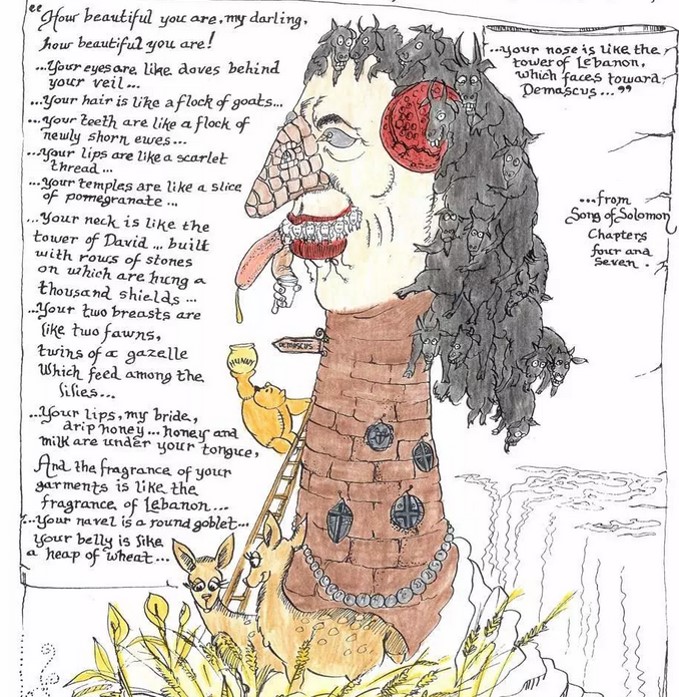
But where this statement gets messy and needs to be fact-checked is when people don’t pay attention to genre.  Let’s look at a very specific example from the Bible to show you what I mean. Take a look at this picture.

How do you feel about this picture?  That the person is attractive?  Beautiful?  Or that it is really weird? 

What you are looking at is a literal artistic rendering of the woman described in the Bible in the book called the Song of Solomon.  This is what you get if the writer is describing this woman literally.  Her neck is a tower.  Her hair is a flock of goats.  Her temples are slices of pomegranate. 

Literalists will say that all Scripture needs to be read on that kind of level.  “Literal,” to them, means that these poets in the Song of Solomon are describing each other exactly as they saw it, with precision, almost scientific precision.

Did the author of Song of Solomon know an actual person like this?  A freaks of nature?  Or should a literal reading the Bible mean something else? Check back in to part 4, as we’ll tackle that question.

What is the Bible? [False ideas Christians believe about…the Bible. Part 2]

What is the Bible?

“Well, that’s obvious, Joel,” you might say, “the Bible is the Word of God.” 

Yes, that is the obvious answer, but it is not enough.  It is true that the Bible is the Word of God, but it also needs some explanation that we don’t normally think about.  As we saw in part 1 of this series fact-checking our beliefs about the Bible, there is another Word of God more ancient than the Bible. So how is the Bible also the Word of God?

Let me illustrate by asking another question: Where did the Bible come from?  Did it just drop out of sky, like a miraculous gift from God?

We Christians do not believe anything like that.  We have a very different belief about the Bible.  What is the Bible?

The Bible is actually not one book.  It is a library of books, written over a long period of time by many different people, all inspired by God. 

We Protestants believe that there are 66 books in the library we call the Bible, and those books were written by about 40 different people, over a period of what might be 1400 years. 

That’s quite a different image than a book just dropping out of the sky.  We do, however, believe God was very much involved.  Those human authors were inspired by God.  So what does it mean that they were inspired by God? 

Let’s look at some passages from the Bible that talk about this.

In 2 Peter 1:19-21, we read “Men spoke from God, as they were carried along by the Holy Spirit.”  So the writing of the Bible was not a human-only thing.  And it was also not a God-only creation. In the original language the word “carried along” is another one of those word pictures: the biblical writers were moved just like wind filling a sail.

This concept is very much reflected in 2 Timothy 3:16 where the Apostle Paul writes, “All Scripture is God-breathed.”

These two verses describe the miraculous and mysterious process of inspiration.  It is a process where we believe that God was at work, communicating along with the unique perspectives, skills, experiences, languages and customs of the human writers.  This is very different from saying that a writer of songs was inspired.  Right now, for example, my favorite song is “No Longer Slaves.” I find it to be powerful, and I want to listen to it every day, multiple times each day.  I would say the writers of the song are inspired! But they are not inspired like the Bible is inspired.  We Christians believe that the Bible is unique in that God was involved in helping the human writers as they wrote.  He didn’t overpower them to the point where they became robots, shutting off their minds.  He worked with them.  It was a wonderful combination of creator and created working together to create something new. 

What we see, then, is that the Bible is a library of books, written by many different people over a period over a period of many years, inspired by God.  So when we say that the Bible is the Word of God, that’s what we mean, that God inspired human authors to write the various books.  In other words it is also very appropriate to say that the Bible is also the word of people.  Real people. 

We should never say that the Bible is only written by people, and we should never say that it is only written by God.  That’s why we fact-check the statement, “the Bible is the Word of God,” because there is more to the story…people were involved. And one of the most important ways that the human writers included their own personalities and interests was something called genre. We’ll look at how important genre is next in part 3.