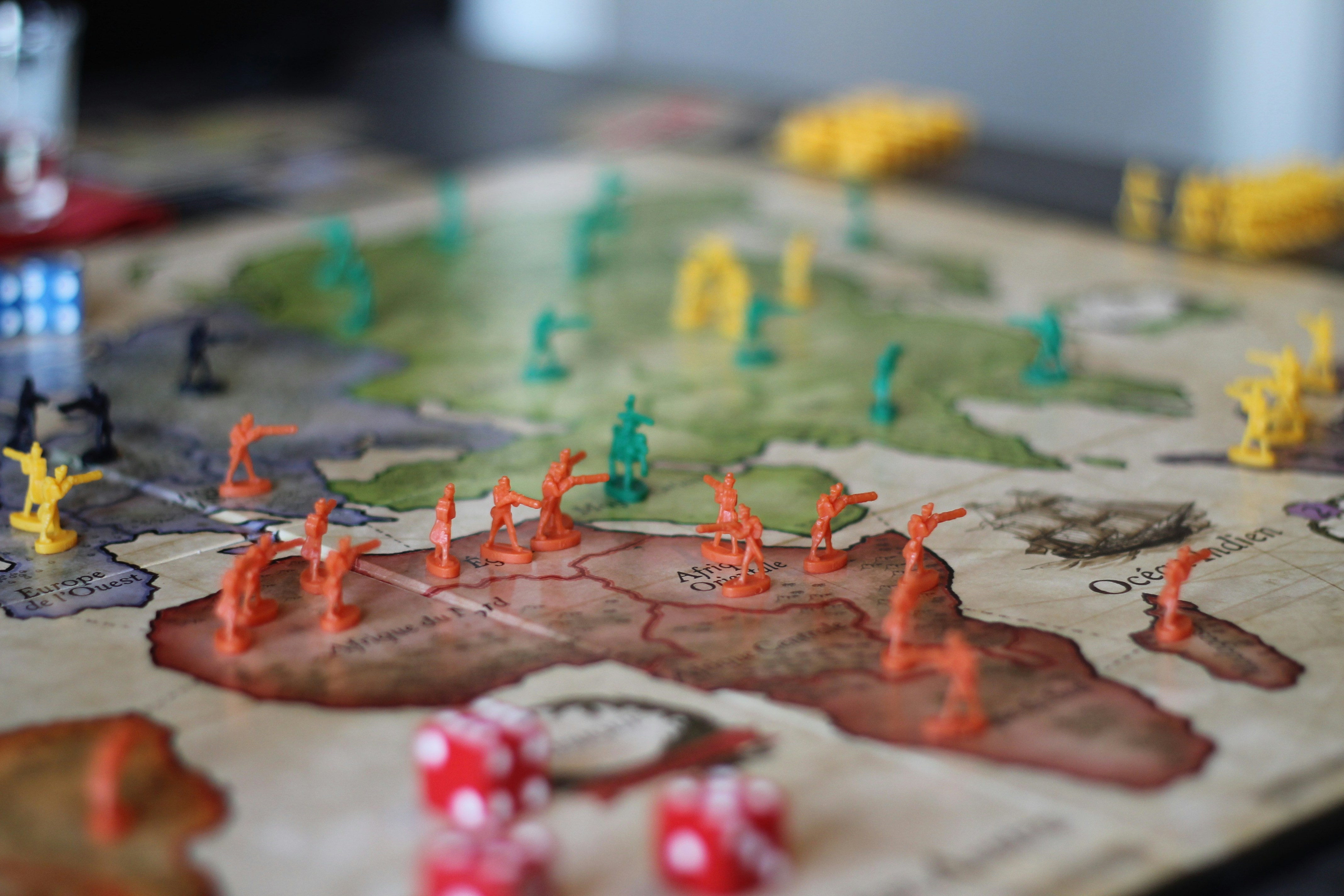
Have you ever been playing the game of Risk, when you had a much larger army than another player, so you attack them? You are very confident that you will defeat them. Even if they roll well, you will win a war of attrition. But then it happens. They roll sixes over and over, slowly whittling down your army, and eventually, they successfully defend their territory and you call off the incursion. Super frustrating, isn’t it?
As we continue the story of the life of David, a scenario like that will happen. It will be a smaller military facing a larger force. Who has the large military that won’t do so well? Who has the smaller victorious one? Let’s find out.
When we left David last week, he had just been made King of his tribe, Judah. When Saul was king, he ruled over all 12 tribes of Israel. So why isn’t David made king of the other 11 tribes? In 2 Samuel chapter 2, verse 8 and following we learn that even though Saul and his three oldest sons were killed in battle, Saul had more kids who could become king. Next in line was Ish-Bosheth, and Saul’s military commander named Abner takes charge, installing Ish-Bosheth as king of the other 11 tribes of Israel.
Unity in Israel has now been broken. On one side is the tribe of Judah, with David as their king. On the other side are the 11 tribes with Ish-Bosheth as their king.
Think about this scenario a moment. What Judah did by making David king was revolutionary. I mean that in the true sense of the word. Judah revolted against the other 11 tribes. Judah did not wait for a national consensus on who should be the next king of all Israel. Judah did not follow the cultural practice of primogenitor, which says that a king’s next of kin becomes the next king. Judah took matters into their own hands and made David their king. But in the other 11 tribes, Abner follows the law of primogenitor, and he installs Saul’s son, Ish-Bosheth, as the king of the 11 tribes.
This is an honor and shame culture, and what Judah did by installing David as their king is major act of shame and dishonor toward the other 11 tribes. It would be totally normal, then, for those 11 tribes to not only install the person they believe to be the rightful king, but also to defend their honor. Can the 11 tribes allow the 1 tribe to just rebel without any response? You can imagine the tension between the tribes is crackling. I also suspect you will not be surprised at what happens next.
War breaks out between Judah and Israel. It is another instance of ancient representative warfare. We heard about represntative warfare in 1st Samuel 17, when the armies of Philistia and Israel were facing off against each other. Instead of both armies fighting a war with a high body count, the Philistine giant Goliath would walk out into the space between the armies and challenge any Israelite soldier to a fight. Winner takes all. The Israelite soldiers were scared to death of Goliath. No one would accept the challenge. No one, that is, until David came along with his slingshot and took Goliath down. Now, many years later, we have another representative battle. This time it is between the Israelite tribe of Judah, David’s men, led by the commander Joab, versus the other 11 tribes of Israel, Ish-Bosheth’s men, led by their commander Abner.
The representative battle will work differently this time: twelve men from each side will fight hand to hand. Winner takes all. Shockingly, all twenty-four men use the same approach and quickly kill each other. Suddenly, war breaks out involving both armies. In the end, the men of Judah, David’s men, are victorious. Like the improbably Risk scenario, one tribe beats eleven tribes. Though we don’t know how many soldiers were involved, it is reasonable to believe that the eleven tribes had more soldiers than just one tribe. Still, that one tribe is the victor.
Here’s another unique feature of this battle. Until just recently, many of these soldiers would have been on the same side. When Ish-Bosheth’s father, Saul, was king, he was king over all 12 tribes, including the tribe of Judah. After Saul dies and Judah makes David their king, there are now a bunch of soldiers in Judah’s army who used to be fighting for Saul. Like Abner and Joab. They were on the same team only a short time before this.
Here in 2 Samuel chapter 2, then, when war breaks out between Judah and the rest of Israel, it is a battle between soldiers who used to be on the same team. Imagine that. It sounds a lot like what happened in our own US Civil War, when some family members were split between North and South and had to fight against each other.
As we continue reading, the story focuses on the two generals, Abner and Joab. David’s commander, Joab, has a brother Asahel who is a fast runner. In the middle of the battle, Asahel wants the top prize. He wants to get the other general, Abner. It doesn’t matter to Asahel that these men used to be friends. The civil war has pitted them against each other, on opposite sides. He wants to kill Abner. He wants to known as the guy who took down the opposing general.
It does matter to Abner, however, that these used to be friends. While Asahel is chasing his, Abner yells back to him, “Asahel, stop chasing me! I don’t want this to come to blows. I could never face your brother.” Abner is concerned about his relationship with Joab, even though Joab’s brother Asahel is trying to kill Abner! You gotta respect Abner for trying to avoid conflict.
But Asahel has that prize in his mind. Azahel won’t give up, so Abner seems to think he has no other choice but to strike Asahel with his spear, and kill him. It is one of those sad, sad moments, when you know pain could have been avoided, should have been avoided, if the other person would just relent. But they don’t relent. The push and they push and they push, until horror cannot be avoided.
How will Joab react to Abner killing his brother? We find out in the next post.
Photo by Dave Photoz on Unsplash
 Engaging Scripture
One thought on “The horror of war in ancient Israel – 2 Samuel 2:8—3:39, Part 1”