It’s that time of year when Christmas cards come flooding in. Have you been sending and receiving them? Last year when my in-laws’ 2023 Christmas card came, I noticed something very interesting about the accompanying letter. They gave an update about everyone in the family, except me and one of my brothers-in-law. They named every single other person, including our other brother-in-law who lives in Portland. But me and my brother-in-law? Nothing. I spent a whole month in India last year. I think that’s kind of noteworthy. No mention of it.
Were we on the outs? Were our in-laws upset at us? Just forgetful? I sent a text message to my brother-in-law immediately, “Did you see their Christmas letter? Guess who is not included?” We had to bring it up to our father-in-law, since he is always teasing us. We said to make up for that slight, our Christmas presents better be really good.
So yesterday, when my in-laws’ 2024 Christmas card and letter arrived in the mail, I opened the card and out fell this year’s letter. I skimmed through it, looking for my name.
Would you believe that for the second year in a row, there was no mention of either my brother-in-law or me in the letter? This year neither of our wives were mentioned. Are we on the outs? No. Well…at least I don’t think so. We know our in-laws love us. They do not have to mention us in the Christmas letter. But situations like these can make you wonder.
Have you ever been on the outs?
In this second week of Advent, we’re going study Ephesians 2:11–22, and we’re going to meet some people who are on the outs.
Ephesians is one of the letters that the great missionary apostle, Paul, wrote to a group of Christians in the ancient city of Ephesus while he was on house arrest in Rome. In Ephesians 2:1–10, Paul writes that in his mercy God saves us by his grace through our faith, not by our works, and yet we are created in Christ to do good works. In verses 1 through 10 Paul teaches the doctrine of salvation.
That brings us to verse 11. In these verses, Paul will talk about the astounding affect salvation has not just in our personal lives, but also in the world around us. A very common evangelical way of understanding salvation is that when individuals are saved, they now have hope of eternal life in heaven. That’s not wrong. But what Paul will talk about is how salvation is so much more expansive than just personal future salvation. Paul will show us that what Jesus accomplished matters now. How Jesus’ salvation matters has everything to do with peace. But on his way to talking about peace, Paul says something that might sound strange when he introduces us to the group of people who were on the outs.
In verse 11, Paul writes, “Therefore, remember that formerly you who are Gentiles by birth and called ‘uncircumcised’ by those who call themselves ‘the circumcision’ (which is done in the body by human hands).”
There are some curious words in that verse. The first curious word is Gentiles. Paul is writing to Gentiles. What is a Gentile? A Gentile is a person who is not a Jew. That ethnic distinction is a big deal pretty much throughout the entire Bible. The Old Testament is the story of the Jews. The New Testament is the story of the church, which is started by a Jew (Jesus) among Jews in Jerusalem. God pushes those Jews to share the good news about Jesus first to non-Jews in Palestine (like the Samaritans), and eventually throughout the Roman Empire. Paul was a Jew who was the leader in that missional movement, and many non-Jews, aka Gentiles, became Christians.
So Paul is writing to Gentile Christians in the Greco-Roman city of Ephesus. He had spent lots of time with them, which you can read about in the books of Acts chapters eighteen through twenty. He was with them for more than two years. He knows them. He knows they are Gentiles. He knows their heritage. Notice, though, that Paul uses the word “formerly.” Something about these non-Jews had changed. Something was different. They used to be on the outs. Did they become Jews?
This past week I received the following text messages, each from a different person. Do you see a theme?
“Prayer request: feeling pretty overwhelmed this week with everything going on, having a hard time managing stress.”
“I’m at urgent care now. Been having tightness/pain/gas build-up(?) on the left side of my chest on and off for a week now.”
“I’m pretty exhausted and cynical about a lot right now. It’s all a bit raw.”
“I’m so angry right now.”
My guess is that all of us experience these kinds of thoughts and feelings. I sure do. The text messages paint a picture of real life. In our real lives, we face all sorts of conflicted situations. Broken relationships, financial worries, health concerns, doubts about faith and the future. We long for peace in a fraught world.
Maybe you know the feeling. This coming week we continue our blog series studying the traditional themes of the Advent Season. I encourage you to read Ephesians 2:11–22 ahead of time, as that passage will guide us as we search for peace.
This week I once again welcome guest blogger, Kirk Marks. Kirk is a retired pastor of 30 years who now works in international fair trade.
Are you feeling any hopelessness about something in your life? Maybe you feel you’re losing hope within. If so, even if just a little bit, you might resonate with the ancient Hebrew prophet, Habakkuk. He was losing hope.
In the previous post, we began studying the prophet Habakkuk. He complains to God, and God, surprisingly, doesn’t give a satisfying response. So Habakkuk complains a second time. God gives Habakkuk an answer, but like before, it’s not much of an answer. (See previous post.) Here’s what God says to Habakkuk: “Write down the revelation and make it plain on tablets so that a herald may run with it. For the revelation awaits an appointed time; it speaks of the end and will not prove false. Though it linger, wait for it; it will certainly come and will not delay.” (Hab 2:2–3)
When we’re looking for hope, being told that we need to wait a while longer isn’t always a message that we want to get. But Habakkuk eventually gets that answer. Our English translations do not do justice to God’s answer. It’s much more powerful in the Hebrew. Turn to Habakkuk chapter 3 for the answer. Habakkuk cries out to God again, “Lord, I have heard of your fame; I stand in awe of your deeds, Lord. Repeat them in our day, in our time make them known; in wrath remember mercy.”
Then in verse 3, God answers all of Habakkuk’s complaints. God answers all Habakkuk has prayed about and looked for. Two words say it all, “God came.”
“God came from Teman, the Holy One from Mount Paran. His glory covered the heavens and his praise filled the earth. His splendor was like the sunrise; rays flashed from his hand, where his power was hidden. Plague went before him; pestilence followed his steps. He stood, and shook the earth; he looked, and made the nations tremble. The ancient mountains crumbled.”
Last week Joel wrote about God being like a superhero. Habakkuk says the same thing. God comes in power, God responds, God is there in the midst of all of Habakkuk’s hopelessness and struggle. God’s answer is that he comes.
Habakkuk goes on to talk about how God comes and splits the earth and dries up the rivers and comes in all this power and glory, using what we might say sounds like superhero language.
At the end of the book, Habakkuk says, “I heard and my heart pounded, my lips quivered at the sound; decay crept into my bones, and my legs trembled. Yet I will wait patiently for the day of calamity to come on the nation invading us. Though the fig tree does not bud and there are no grapes on the vines, though the olive crop fails and the fields produce no food, though there are no sheep in the pen and no cattle in the stalls, yet I will rejoice in the Lord, I will be joyful in God my Savior.” (Hab 3:16–18)
Habakkuk is saying that he’s learned he can’t put his hope in the circumstances. He can’t put his hope in the things that might happen or might look good. Instead he puts his hope in the God who comes, who has promised to come, and ultimately who will answer his complaints.
God does have answers to the problems that are our world faces, to the troubles and the circumstances that we live in. You might be facing feelings of hopelessness. You might be feeling hopeless about something in your life. Maybe you feel you’re losing hope within. To all of that God has already given us an answer, and that answer is that he comes. He has come in the person of his son, Jesus Christ. He has come into our world to meet us, to be us. God came as a human being in the person of Jesus Christ. God came because he loves us. He came with tremendous promise to be with us, to help us, to love us, to care for us, to meet us even in the worst of life’s circumstances, and to give us hope.
He promises to us that out of even the most difficult situations he will indeed bring good things, and in him there are good things to come. Think, for example, how Jesus Christ died on a cross for our sins, but three days later rose again and now lives. He’s our living hope.
We have a living promise that God can overcome anything, even death. Even in the face of death, there is hope, hope for abundant life now and life eternal. We can live in that hope because of what God has given us. Our hope needs to be in him. Our hope needs to be in his promises, because he has proven that he can deliver on those promises, the epitome of which is bringing Jesus back from the dead.
God delivers on his promises every day by meeting us in the midst of our life situations. Our hope is in him no matter what the hopelessness of our circumstances might be, no matter what the difficulties might be. God comes. God is there with us. God brings us the hope
I began this week of posts here about Advent Hope by asking, “Where do we find hope?” The answer we found in the Beatitudes (post here), and in Habakkuk (previous post and this post), is there is hope in the promises of our heavenly father who loves us, who has already come to us, and who will come to us again. He will come to our circumstances, come to our difficulties, come to our struggles, come to our most basic need, come to us at the end of this life and give us life and life eternal for all things.
I’m so thankful that I can put my hope in the one who has promised and is ever faithful to come and deliver.
This week I once again welcome guest blogger, Kirk Marks. Kirk is a retired pastor of 30 years who now works in international fair trade.
My favorite Old Testament minor prophet is Habakkuk. Habakkuk had a message of hope from God for people, but Habakkuk’s message doesn’t start out very hopeful.
Here’s how Habakkuk begins, “How long, Lord, must I call for help, but you do not listen? Or cry out to you, ‘Violence!’ but you do not save? Why do you make me look at injustice? Why do you tolerate wrongdoing? Destruction and violence are before me; there is strife, and conflict abounds. Therefore the law is paralyzed, and justice never prevails. The wicked hem in the righteous, so that justice is perverted.” (Hab 1:2–4)
That doesn’t sound very hopeful, does it? But I suspect Habakkuk’s message sounds familiar. Doesn’t that sound like a lot of what we hear from a lot of our world and culture even today? “Justice isn’t working. Our justice system is paralyzed. It’s not bringing the results that we want. I see violence everywhere I look.”
We hear sentiments like that frequently. Violence is a big problem in our world today. Wrong is being tolerated. What Habakkuk is complaining about 2500 years ago sounds very familiar to us. Habakkuk is saying, “God, I don’t see you doing anything about these things that I’m upset with.”
Habakkuk is a strange book because God actually responds to him in a way that makes no sense. God doesn’t seem to answer Habakkuk’s question.
So Habakkuk comes back to God with a second complaint. In Habakkuk 1:13, he says, “Your eyes, God, are too pure to look on evil; you cannot tolerate wrongdoing. Why then do you tolerate the treacherous? Why are you silent while the wicked swallow up those more righteous than themselves?”
Once again Habakkuk complains to God about the injustice of this word. Habakkuk is doing what Jesus taught us to do in the Beatitudes, which I mentioned in the previous post. Habakkuk is hungering and thirsting for righteousness as he cries out to God.
Then Habakkuk gives an interesting illustration in verses 14–17, “You have made people like the fish in the sea, like the sea creatures that have no ruler. The wicked foe pulls all of them up with hooks, he catches them in his net, he gathers them up in his dragnet; and so he rejoices and is glad. Therefore he sacrifices to his net and burns incense to his dragnet, for by his net he lives in luxury and enjoys the choicest food. Is he to keep on emptying his net, destroying nations without mercy?”
What is the point of Habakkuk’s illustration? He’s saying he sees the human race like fish in the sea. If you’ve ever fished, when you catch a fish, that fish is helpless. Once he’s got that hook in his mouth, he can’t do anything. Once he’s caught in a net, you’ve got him and you’re in control. Habakkuk says that’s how this world seems to him.
There are some people who have all the power, and everyone else are just like fish in their nets. The powerful rejoice, catching people in their nets and living in luxury. The world keeps going that way, leaving us wondering, “Does might make right?”
Does the mightiness of the mighty and the power of the powerful mean they are right? Does it mean that’s okay? Is that the way it’s always going to be? The questions we’re asking today, Habakkuk was asking 2,500 years ago. Where is the hope in all of this?
Habakkuk says in chapter 2, “I will stand my watch and station myself on the ramparts I will look to see what you will say to me and what answer I am to give to this complaint.”
Here’s Habakkuk, remaining hopeful in hopeless times, saying, “I’m waiting God What you gonna do? What are you gonna say?”
God gives an answer, and in the next post, we’ll discover what God says.
This week I once again welcome guest blogger, Kirk Marks. Kirk is a retired pastor of 30 years who now works in international fair trade.
A couple years ago, I reached a direction-changing point in my ministry career. Some things that I had worked very hard on for a long time, and that I had looked forward to, I saw coming together. Life was going in a really good direction for the next chapter of my ministry and my work. But there’s always the possibility that things won’t go as you hope they’re going to go.
I saw that possibility too. It was either all going to come together in a new opportunity that I was really looking forward to, or it could go sideways. That tension really got to me, so much so that I sought out a friend of mine who is a psychologist. We sat down, and I talked about how this scenario was affecting me. I told him very honestly, “If things don’t go the way I want them to go, I honestly don’t know how I’m going to get out of bed the next day.”
He said, “Kirk, even if this goes as badly as you can possibly imagine, if this goes the opposite of what you’re looking forward to, there’s still going to be a way forward for you.”
I remember thinking at the time, “How can he know that? How can he know that that’s going to be the case? I really don’t think I’m going to be able to get out of bed if this goes sideways.” But what I realized later, what he realized and was trying very gently to say to me, was that I had put my hope in the wrong things.
I was hoping in a circumstance, hoping for something to happen, and I was not hoping in a God who’s above those circumstances and is at work regardless of how those circumstances work out.
Indeed, the situation did not go the way I hoped.
And I was able to get out of bed the next day. Actually, the event that didn’t go as I wanted was the first domino in a series of dominoes, a series of events I never thought would happen. Yet I was able to get out of bed then, and I was able to get out of bed every morning since. There was indeed a way forward.
We can put our hopes in the wrong things. Circumstances working out the way we want is one of the wrong things that we can put our hope in.
Let’s talk about putting our hopes in the right things. From my story in this post and the previous two posts here and here, perhaps you’ve gotten a sense of where I get wisdom from.
I get wisdom from the experiences that I have had.
I get wisdom from preachers who preach good sermons that matter.
I get wisdom from good counsel, like my friend who told me that I would be able to get out of bed.
I get wisdom from theologians who write great books and think great things.
I’ve accumulated some wisdom from those sources. But of course, the main source of wisdom that we have is the wisdom that God reveals to us in his word through his son Jesus Christ and the written word in the scriptures.
It’s in the scriptures that we find direction and hope. The Sermon on the Mount is filled with the hope and promise that Jesus’ coming brings (Matthew 5—7). What did he say in the Sermon on the Mount? We’re going to look at the Beatitudes.
He said, “Blessed are the poor in spirit, for theirs is the kingdom of heaven.” (Matthew 5:3)
There’s a promise about hope. There’s a kingdom that is coming. A kingdom that we can have. A kingdom that comes to those who are poor in spirit.
Jesus also said, “Blessed are those who mourn.” (Matthew 5:4).
Think about how strange that sounds. Shouldn’t it be the opposite? “Blessed are those who don’t have to mourn because those bad and mournful things don’t happen to them.” But that’s not what Jesus said. He said, “Blessed are those who mourn for they will be comforted.” You hear the hope and promise in that. That in our worst mourning, there is a promise of comfort that only God can provide.
Next, Jesus said, “Blessed are the meek. They will inherit the earth.”
I think we feel most hopeful in this world when we’re working towards something, when we’re pushing against something, when we’re moving in a direction, we’re doing something. We feel really hopeful then.
But when we’re meek, when we can’t fight back, when there’s nothing to work at, when we’re defeated, then we feel the least hopeful. Jesus says when we’re meek, we’re blessed. For we’re going to inherit the earth.
So many people work, try to achieve and accomplish to earn an inheritance, and yet notice Jesus makes a promise that when we pursue meekness, the inheritance is going to be given to us. There’s great hope in meekness.
Jesus goes on to say, “Blessed are those who hunger and thirst for righteousness. They will be filled.”
Perhaps you know the hopelessness that comes seeing the unrighteousness of this world, the unfairness that people have to live with and the injustice of systems around us that we seem not to be able to do anything about. That was the hopelessness that I faced in the coal regions and people had in their hearts, as I mentioned in the two previous posts.
Blessed are those who hunger and thirst for righteousness, who deeply desire that something would be different about the circumstances. Why? Because they will be filled. God will one day do something about what we feel so hopeless about.
Jesus goes on to talk about who is blessed and even says crazy things like, “Blessed are you when people insult you and persecute you and falsely say evil against you because of me.”
That doesn’t sound like blessing to me, but he says, When you are persecuted, yours is the kingdom of heaven.” There is tremendous hope, tremendous promise in what Jesus says as we seek to live out those things, to be meek, to be merciful, to be the things that Jesus describes, to be poor in spirit, to love our neighbors, to love our enemies, to forgive those who harm us. We seek to live in that way.
We live in great hope because God has promised us great and marvelous things and resolution of the hopelessness in this world through living in the way that follows Jesus. Do you see the difference between the way we use the word hope in the English language today and this hope that I am talking about? We use the word hope in the English language today very, very glibly.
Anything that we want to happen, we use the word hope for, right? “I told you “I hope it doesn’t snow this week. I hate snow. I hate this cold weather.”
“I hope my team does well and makes it to the Super Bowl.”
“I hope I get the stuff on my Christmas list.”
Anything that we’d like to see in the future, we say we hope for it. In and of itself that isn’t bad. In fact, it’s important to stay optimistic about the future, to think positively about what’s coming. We should avoid pessimism, miserably and negatively thinkin about what’s coming.
But the way we use the word hope sometimes has no ground or promise to it. “I hope it doesn’t snow,” but I have no control over that and thus no certainty about what’s going to happen.
I have no guarantee of any of these things in the future that I may or may not want to come. That’s very different than the hope that we find in Scripture and the hope that we’re talking about as a theme of Advent. That hope that we have is rooted and grounded in the promises that God has given us.
That’s why we have hope in him because the God who loves us, who is before us, who is our Heavenly Father, promised that he will always be with us. That he’ll never leave us or forsake us. That he has good plans and not bad for us.
That he has life and life eternal for us. Those are all good things to hope for and want to have in the future, and they’re promised to us by God who loves us.
The theologian I mentioned in the previous post, Dr. Moltmann says it this way: hope is nothing else than the expectation of those things which faith has believed to have been truly promised to us by God. Faith believes that God is true. Hope awaits the time when that truth will be shown.
Faith believes that God is our Father. Hope anticipates when he will show himself to be Father toward us. Faith believes eternal life is given to us. Hope anticipates that it will in time be revealed. Faith is the foundation upon which hope rests, but hope nourishes and sustains our faith. And thus it is through faith that man finds a path to true life but it is only hope that keeps him on this path.
Thus it is that faith in Christ hopes in its assurance of what God has promised to us. You see the difference? Hope is indeed based on the promises that God has made to us. So we look to him in hope.
This week I once again welcome guest blogger, Kirk Marks. Kirk is a retired pastor of 30 years who now works in international fair trade.
While I was serving in the coal regions (as I mentioned in the previous post), I graduated from seminary, and after seminary I sought opportunities to continue my education. I participated in a program after seminary called Preaching Today, which is an educational program run by the folks at Christianity Today to help young pastors better hone their skills in preaching to a changing culture. At the time (late 1990s), I received a cassette tape in the mail every month that had several sermons on it from leading pastors around the country and the world, and a recorded seminar on the art of preaching. As I listened, Preaching Today really helped me grow as a preacher.
While I was serving churches in Pennsylvania’s declining anthracite coal region, thinking about all of the matter of hope and how important it was for my ministry, I heard an Easter sermon on one of those cassettes. I can’t remember the name of the preacher—I wish I could—but I do remember the sermon was about the hope of the resurrection. The preacher said something that really resonated with me, giving words to what I was experiencing with my people facing hopelessness. He said, “Hope is to the human soul what oxygen is to the human body.”
Think about that. Your human body can be in great shape and can have a lot of things going for it, but if it lacks oxygen for even a relatively short period of time, that’s very, very dangerous and can even be fatal. Perhaps you’ve heard stories of otherwise very healthy people suffocating or drowning because they lose oxygen, or they can’t get oxygen.
Just as oxygen is absolutely vital to our physical bodies, so is hope to our souls. In this video, notice how the young man makes mention of his mother not being able to breathe when terrible news came to their family.
That’s that feeling in our soul when we lose hope. Hope is like oxygen to our souls. I remember, too, in the middle of my time in the coal regions trying to bring hope to lots of hopeless people and I shouldn’t mischaracterize that.
In the churches that I served in the coal regions, I had the privilege of serving two of them. There were many fine people who had found that they could put their hope not in an industry or not in economics, but had put their hope in the Lord Jesus Christ and were trying to live in light of that hope. I had the privilege of helping them to do that as their pastor; it was a wonderful experience as we tried to share that hope with others.
In the middle of my time there, a new district superintendent in the E.C. Church, became the leader of the geographical area in which my church was located. I remember vividly the day he came and met with me. We sat down in the basement of one of the churches I was serving and he said, “What is it that you are trying to do here at Christ Church in Lavelle?” I remember loving to hear that question because I was able to tell him the same thing that I am writing in this post about how we were trying to bring the hope of Jesus to a very depressed area of the country.
I responded to the district superintendent, “I’m excited to share the hope of the Lord Jesus Christ with the people,” and I showed him a recent weekly bulletin. On those bulletins, we printed a tagline that said our goal was to share the hope of Christ with a needy world.
He seemed unimpressed by that.
He said to me, “Well, yes, Kirk, but what are you doing to get more people to come to your church? What are you doing to reach out to kids so that more people will come? You know, your budget is very tight here. What are you doing to make sure you have enough money to see things through to the end? This is a very old building here. What are you doing to keep this building up?”
He didn’t seem to want to talk about hope.
He wanted to talk about a lot of other practical things about the church. I remember being disconcerted by that, but unafraid to continue to preach the message of hope. That wouldn’t be the first time or the last time that I would have a disagreement with denominational leadership about what gospel ministry is all about.
As ministers of the gospel, we are to share hope.
Then something else happened that gave words to my understanding of hope.
In the year 2000, I read a book. It wasn’t a new book. It was an old book, a classic book of theology written in 1964 by a German theologian named Jürgen Moltmann, Theology of Hope.
In that book, Moltmann writes that from first to last, not only in its conclusion, Christianity is hope. It is forward-looking. Christianity is forward-moving, and therefore always revolutionizing and transforming the present. Moltmann points out that the God that we find in the Bible is the God of hope. In Romans chapter 15, verse 13, the Apostle Paul writes that God has the future in view. God encounters us in the promises he makes to us about the future and therefore we await in an active hope.
Moltmann gave words to what I was trying to say in my pastoral ministry in the coal regions. Christianity isn’t just a thing we do. It’s not just a religion. It’s not something we’re a member of. It’s not just a belief system. It isn’t even a faith. It’s a hope.
Christianity is the thing we’ve put our trust in for life, for eternity, for how to live this life and how to really know what it means to have life. Christianity is that hope, and we find it in the promises that God has given to us. I’m grateful to Dr. Moltmann for that insight.
Dr. Moltmann actually passed away this year, well into his 90s, a legend in Christian theology, and a great help to me in understanding this matter of hope. I want to tell you, too, that this matter of hope isn’t just something that I preached about and thus was limited to my pastoral ministry.
Hope is a personal thing. I had to live in that hope as well as preach about it. There have been numerous times in my life where my hope was challenged, and it became thin and maybe even weak sometimes. In the next post I’ll tell you about one of those experiences.
This week I once again welcome guest blogger, Kirk Marks. Kirk is a retired pastor of 30 years who now works in international fair trade.
When I shared with my family that I was going to be preaching the first Sunday of Advent on the theme of hope, my youngest daughter, Margaret, said, “Oh, wow, dad, that is Kirk Marks CORE.”
I thought that was really cool, after I Googled it and found out what she meant. Google Translate will translate Gen X into Gen Z, and back the other way. I have to do that in my house.
Margaret was observing that the theme of hope is deep in my heart and thus very, very important to me and the ministry that I’ve had the privilege of serving in over the last thirty years.
So to begin Advent, I would like to share with you a bit of my journey with the theme of hope. Then in future posts, we’ll talk about what exactly we mean in the church by hope, which is somewhat different than the way we throw the word hope around in our culture today, such as “I hope it doesn’t snow this week” or “I hope it gets warmer.”
We use the word hope that way, but we’re talking about something very different when we talk about hope in the church and what the scripture tells us about hope. And then we’re going to look at a prophet of hope from the Old Testament who gives us a hopeful message that speaks to us in this Advent season.
My personal journey with hope really begins when I started in pastoral ministry back in the early 90s. I served my first church in the coal regions of Pennsylvania.
My wife Debbie and I traveled there, and our daughter Emily was just a baby. I began to see very quickly that people I was ministering to were dealing with a sense of hopelessness and a loss of hope.
Some of that came from the economic hopelessness of the area and the times in which we were living. The coal regions of Pennsylvania were an area that thrived and boomed because of the coal industry, which for over a hundred years brought lots of jobs, opportunity and flourishing to the anthracite coal regions of Pennsylvania. Beginning in the 1960s, that all began to wane.
By the time I got there in the early 90s, the coal industry was depressed, people had lost jobs, and families had been fragmented. There was a lot of economic hopelessness. That hopelessness bled out into other areas of life, as there were terrible problems with drug and alcohol abuse and family fragmentation. These problems were rooted in people having lost hope.
There was also at that time discussion that coal might come back. Those jobs might come back. Coal mines might reopen. While it didn’t seem very realistic to me, I realized that people put their hope in the possibility that the coal industry would come back and save them.
Into that context, I saw a tremendous opportunity to preach a different message of hope, to share with people the hope that they could find, not in an economic plan, not in an industry, but in the Lord Jesus Christ.
I soon found that it wasn’t just the area’s economic struggles that were the problem. As I talked to colleagues ministering where people were in different economic situations, and as I got to know pastors in other countries and cultures, such as Mexico and Japan, I learned that hopelessness was pervasive. It seems like it’s the sickness of the human soul.
A loss of hope is a terrible, terrible thing.
Yet, the gospel message has an answer and a promise through its message of hope. I found tremendous direction for ministry in sharing the hope of the Lord Jesus Christ with people. In the next post, we’ll find out how.
Two days ago, the Friday after Thanksgiving, my wife and I lugged our Christmas decoration boxes down from our attic. It’s time to glam up our house for Christmas. My guess is that you have done or soon will do the same.
Last week at Thanksgiving dinner one of my nephews told me that they have 100 boxes of lights that they are going to put up this year. I looked at him with disbelief and said, “Are you serious? 100 boxes?” He said, “Well maybe 40 boxes.” They are trying to win the unofficial neighborhood Christmas light competition this year. Even with only 40 boxes of lights, I suspect they’re going to have a good shot at winning.
It is wonderful to get into the Christmas spirit!
We’re doing the same in our church family because today, Sunday, December 1, is the first Sunday of Advent. Our church family invites people to participate in worship by lighting the candles on the Advent Wreath and reading a short liturgy during Advent.
We place the Advent wreath in the front of our sanctuary, and we shine the color purple shining from the floor lights. The wreath and lights are symbols of the season of Advent.
When I see the purple color during Advent, I think of the color of a bruise. Bruises appear when damage has been done, but healing is taking place. Advent is a lot like that. During Advent we enter a period of introspective examination, and that kind of examination can sometimes hurt. It is often painful when we are confronted with the truth about ourselves. But facing the truth is usually the first step in healing.
What I am talking about is our relationship with Jesus. Is there any way that you need to confess and repent? Confession and repentance can be difficult, but confession and repentance can also lead us to grow more like Jesus. That’s why Advent is a time of spiritual preparation before we celebrate Christmas. During Advent, we are getting ready to remember the first coming of Christ, and in so doing we are also readying ourselves for his second coming, which is precisely what he said we should do.
As we do nearly every year, we will be pausing the current blog series to have a Advent series. This year we return to the traditional Advent themes of Hope, Joy, Love and Peace. My prayer is that these devotionals will also help you prepare for the great celebration of Christmas by reflecting on those important Advent themes.
To start us off this coming week, I welcome Kirk Marks who will be blogging about Advent Hope.
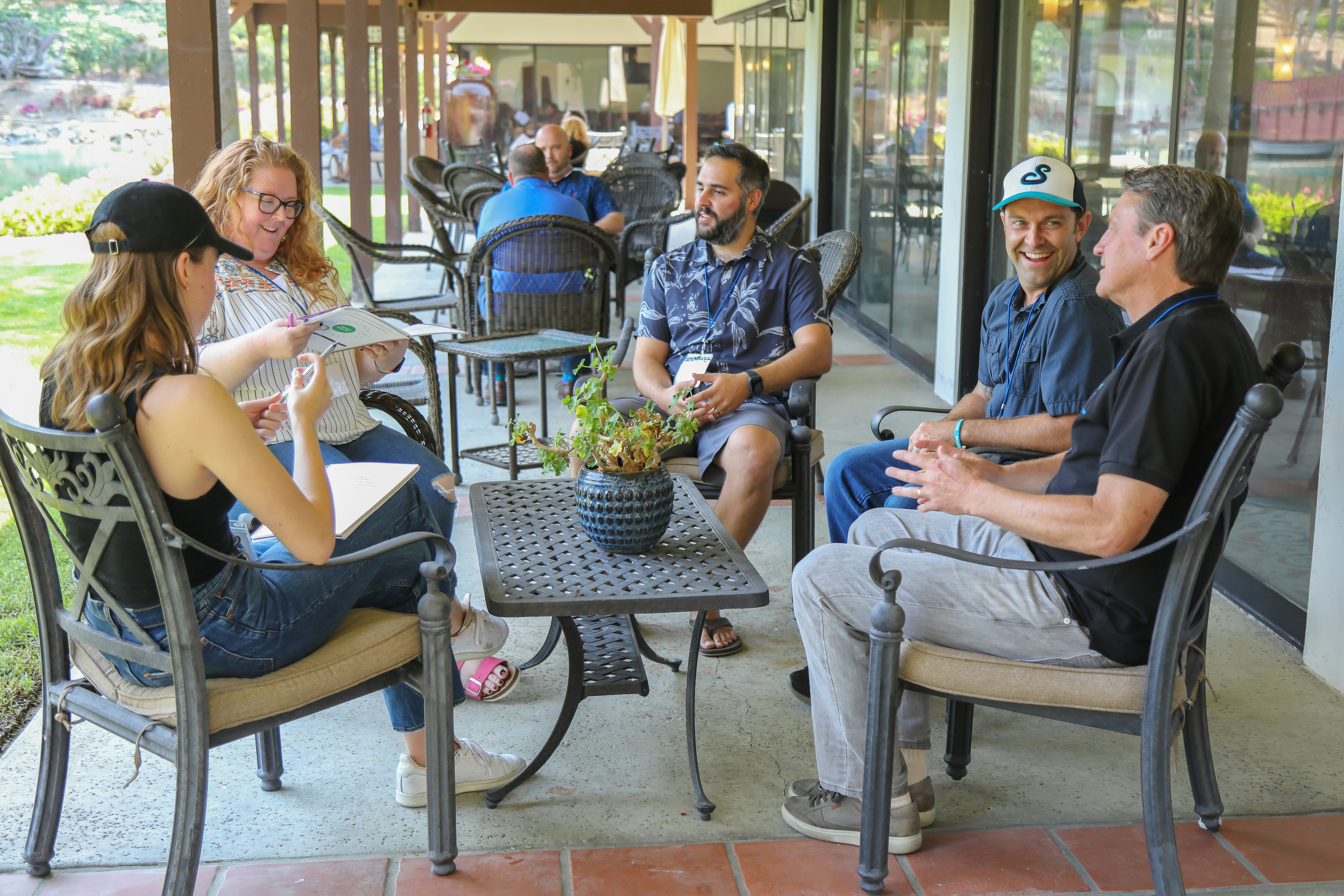
What do you think is the most important trait of a disciple of Jesus? My selection of the picture above could give the idea that I think a small group discussion is most important. While I think those kinds of bible studies or accountability groups or discussions are really important, there is another trait that I believe it most important.
I learned about this trait when I did a college missionary internship in the summer between my junior and senior years of college. I spent the summer in Guyana, South America, working with a team of missionary church planters. The leader of the group was a Guyanese man who had studied Bible and ministry in the USA, and then returned to Guyana to plant churches. In time he, along with missionaries and Guyanese ministers, started numerous churches. I’ll never forget a conversation I had with the leader about how he chose the man who would be his #2 leader. He could have mentioned all sorts of qualities or characteristics. What he said stuck out about this Guyanese man, and what led the leader to choose the man as his #2, shocked me. Keep reading to find out.
This week on the blog we have been studying 2 Samuel 22 / Psalm 18, and we have been following David Dorsey’s observation of a parallel structure used to write the psalm. So we have found matching points A and A’. B and B’. What about C and C’?
Look at verses 21-25. “The Lord has dealt with me according to my righteousness; according to the cleanness of my hands he has rewarded me. For I have kept the ways of the Lord; I am not guilty of turning from my God. All his laws are before me; I have not turned away from his decrees. I have been blameless before him and have kept myself from sin. The Lord has rewarded me according to my righteousness, according to my cleanness in his sight.”
Not guilty? Blameless? Cleaness? Wait a minute. David can’t be serious. He committed horrible sins. Adultery, Lying, murder. Either David wrote this before his sin with Bathsheba, or he is having a serious memory or self-awareness problem. Before Bathsheba, this was pretty much true. After that sin, this is not true. So I’m not sure. Even if this was written before his sin, it sounds like he is being super arrogant and boastful. I find this section difficult, and frankly don’t know how anyone could write it seriously. But what is the theme? God rewarded David because of his (David’s) cleanness or righteousness.
Still, there is a lesson to learn from this. We are called to pursue righteousness, to follow the ways of the Lord. To obey God. Jesus would say to his disciples that those who obey are the ones who love him. In other words, we don’t show our love for him by saying, “I love you.” That is a good thing to say. But we show our love for God through our choices.
Let’s see if we can find a matching point C. We are looking for the theme of blamelessness. Look at verses 31 and 32, “As for God, his way is perfect: The Lord’s word is flawless; he shields all who take refuge in him. For who is God besides the Lord? And who is the Rock except our God?”
Anything about blamelessness in those two verses? Sure is. And in fact the same Hebrew word is used. Look at verse 31, “As for God, his way is perfect.” Perfect, blameless. Same thing, right? This time, David is not describing himself as blameless, but he saying that God is! God is the perfect Rock in whom we can find refuge. David knows all about finding refuge. When he was a fugitive from Saul, running, hiding, he stayed in caves. He called them a stronghold. Now David says God is his perfect stronghold.
We have another match. And that brings us to the unmatched center. All that remains is verses 26–30,
“To the faithful you show yourself faithful, to the blameless you show yourself blameless, to the pure you show yourself pure, but to the devious you show yourself shrewd. You save the humble, but your eyes are on the haughty to bring them low. You, Lord, are my lamp; the Lord turns my darkness into light. With your help I can advance against a troop; with my God I can scale a wall.”
David has left us a major clue in these verses to declare loud and clear that he wants his readers to know that this is his central point. Do you see it? Something changes in these verses. Something about God that is different from the sections before and after it, C and C’.
What changes is that David speaks to God directly. Look at the pronouns. You, your, yourself. In the surrounding C and C’ sections of the psalm, David is not speaking directly to God.
Even more importantly, in my opinion, is what David says in verses 26–30. This is David’s central point: God exalts the humble and brings low the proud. Everything comes down to that. It is a grand reversal. Those who are low, God brings high. Those who are high, God brings down low.
I have come to believe that humility is perhaps the most important trait of a disciple of Jesus. It is having a healthy self-awareness that knows we must place our faith in Jesus, and continue to abide in him, depend on him. The greatest sin just might be self-sufficiency.
God saves the humble, David tells us, but he brings the haughty low. Clearly, then, the position we want to be in is the position that God will save, the humble position. But humility so often goes against our human nature. To be humble is to depend on others, to rely on God, to admit we don’t have it all figured out, to have a healthy self-awareness, to ask for help, to ask for prayer.
Humility is when we have people holding us accountable for how we spend our money, how we use our time, how we treat others.
I mentioned the Guyanese church leader who chose his #2 for a shocking reason. The reason is right in line with what David says about humility in 2 Samuel 22 / Psalm 18. He chose the man for his #2 because that man was willing to clean up baby’s vomit in the church nursery. That man was humble. He demonstrated what Jesus taught his disciples when he washed their feet before the last supper (John 13:12–17),
“When he had finished washing their feet, he put on his clothes and returned to his place. ‘Do you understand what I have done for you?’ he asked them. ‘You call me “Teacher” and “Lord,” and rightly so, for that is what I am. Now that I, your Lord and Teacher, have washed your feet, you also should wash one another’s feet. I have set you an example that you should do as I have done for you. Very truly I tell you, no servant is greater than his master, nor is a messenger greater than the one who sent him. Now that you know these things, you will be blessed if you do them.'”
Humility looks like Jesus, God who took on human flesh so that he might eventually give his life for us. What can you do to become more humble, more like Jesus?
Did you know that God gave King David super powers?
This week we’re studying 2 Samuel 22, and in the verses we’re looking at today, David is focused on super power.
As we observe 2 Samuel 22, our guide is Old Testament scholar David Dorsey. Dorsey notes that 2 Samuel 22 (repeated as Psalm 18) has evidence of a chiastic structure (see post here for what that kind of matching parallel writing is all about). In the previous post, we observed the first matches, Points A and A’.
Now we come to the super power sections. Dorsey suggests that Point B is verses 5 through 20. In these verses, David is remembering when he was near death multiple times in his life. Whether he was facing Goliath, or Saul was chasing him, or he was in battle, David often found himself at death’s door. What did he do in those moments? In verse 7 he remembers how he cried out to God, and God heard him.
Then in verses 8–17 David writes an amazing description of God. When God is angry, the earth shakes. Smoke flares from God’s nostrils and fire and hot coals from his mouth. He parts the heaven and rides down to earth on angels surrounded by storm clouds. When he shows up, God shoots lighting arrows at David’s enemies, and he blows a powerful wind blast laying everything bare. God is more super than all superheroes.
Then in verse 18, we read about God rescuing David. In verse 19, God is David’s support, and in verse 20, God brings David to a spacious place, which means a place of safety.
This is incredibly fantastic imagery. God is mighty!
Now let’s scan down to the matching verses and see if we can find evidence for a match. If it is a match, we should see the same themes. God the superhero. Crying out to God, God’s rescuing David from his enemies, God as David’s support, and God bringing David to a spacious place.
The matching verses begin in verse 33. Scan down through verses 33 to 46.
In the previous section, God came with massive superhero power. In this matching section, David says that now God empowers David. In verse 33, God arms David with strength. In verse 34, he makes David fast and a good climber. In verse 35, he trains David with the bow. How about that? God makes David strong as Superman, speedy as the Flash, a climber like Spiderman, and as deadly with a bow as Green Arrow. Four superheroes all wrapped up in one! No surprise that in the next few verses, David describes his over his victory enemies, because of God’s empowerment. So it’s a match of superhero theme.
But what about the other themes? Crying out to God, God’s rescuing David from his enemies, God as David’s support, and God bringing David to a spacious place.
Let’s keep looking for them. Do you see anything about crying out to God? Look at verse 42. David is so empowered by God that now David is chasing his enemies, and we get a surprise. It is David’s enemies who now cry out to God, but God does not answer them.
Next, in this matching passage does David talk about God rescuing him? Look at verse 44. “You delivered me.” It’s another match.
Does David describe God as his support? No. Hmm. Like we discovered in the previous post, is this perhaps a difference between 2 Samuel 22 and Psalm 18. Yes, it is. In Psalm 18, verse 35 we read “your right hand sustains me.” Same Hebrew word. Support, Sustain. It’s a match.
What about God bringing David to a spacious space? Look at verse 37, “you broaden the path beneath me”. In both verse 20 and verse 37, the same Hebrew word is used to describe a spacious space that God is rescuing David to.
Again, these sections are a match. I’ve been using superhero language, but superhero language don’t do these section justice. God is so much more than a superhero. Superhero language actually limits God, and David’s point is that God is not limited in the least. When God empowers David, God is not turning David into a superhero or some demi-god. In this section, David is simply praising God, giving God the credit for victory over his enemies. David is correctly saying, “If you look over the years of my life and you see all those victories, and how I became king, you need to know that God did this. Do not praise me. Praise God. Give God the credit, because he is the true victor.”
So we have found matching points A and A’ (in the previous post) and above in this post B and B’. What about the rest of 2 Samuel 22 / Psalm 18. Check back tomorrow as we discover David’s central point.








 Engaging Scripture