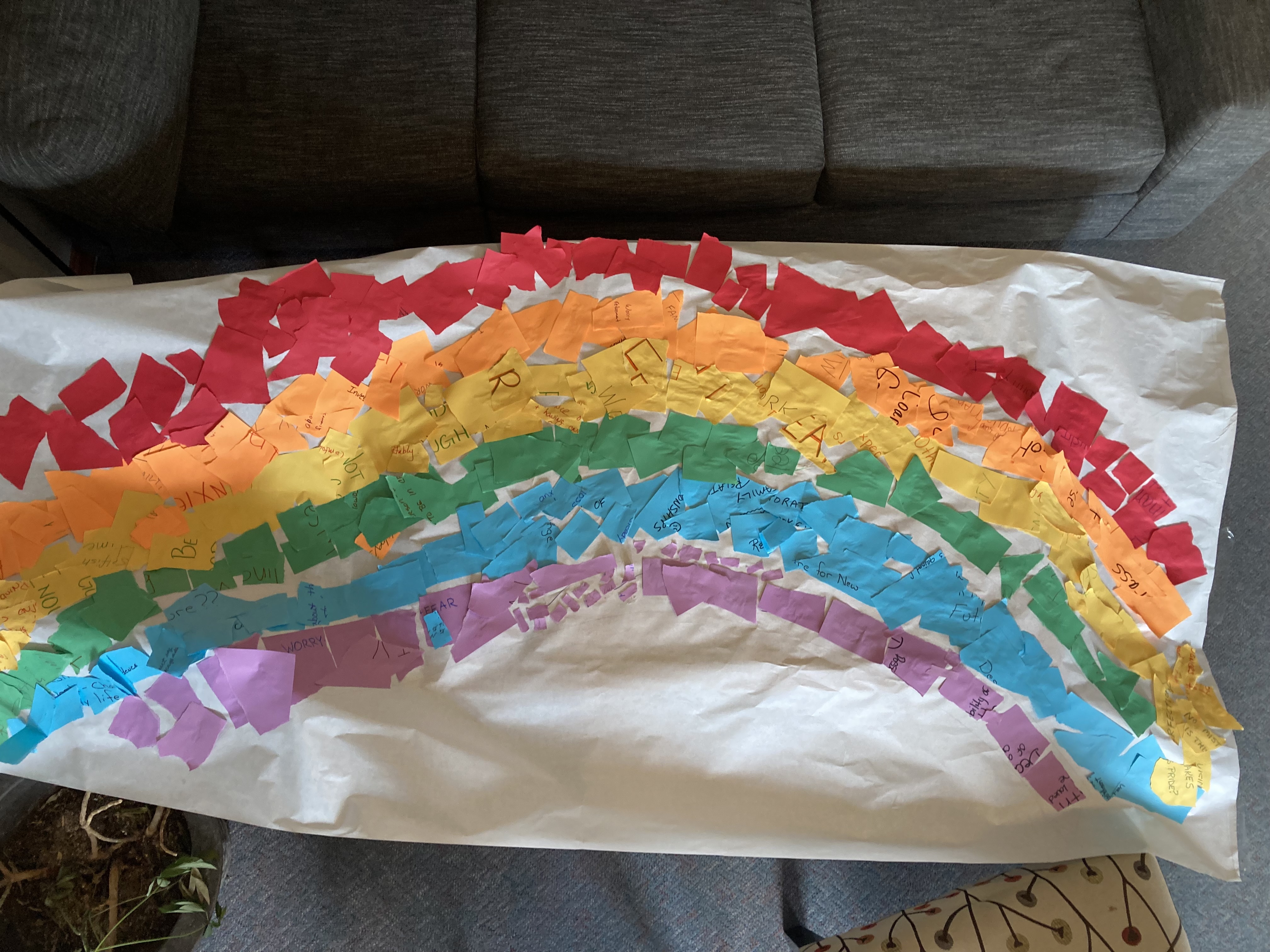
During worship this past Sunday, we did an art project. You can see it in the picture above. We’re going to frame it and display it in our church lobby. Why? It has everything to do with the Sabbath Year.
In Leviticus verses 1 through 7, we learn about the Sabbath Year.
“The Lord said to Moses at Mount Sinai, ‘Speak to the Israelites and say to them: “When you enter the land I am going to give you, the land itself must observe a sabbath to the Lord. For six years sow your fields, and for six years prune your vineyards and gather their crops. But in the seventh year the land is to have a year of sabbath rest, a sabbath to the Lord. Do not sow your fields or prune your vineyards. Do not reap what grows of itself or harvest the grapes of your untended vines. The land is to have a year of rest. Whatever the land yields during the sabbath year will be food for you—for yourself, your male and female servants, and the hired worker and temporary resident who live among you, as well as for your livestock and the wild animals in your land. Whatever the land produces may be eaten.”’”
Just as the people are to rest one day of every week (the sabbath day), so the land is to rest one year out of every seven. For farmers, does that mean that in years one through six they had to store up even grain to make it through year seven? Maybe. But what is more likely is that they divided their land into seven parts, so that one-seventh of the land was lying fallow every year. You always lived off six-sevenths of your land. The other seventh portion of land was at rest, given over to God.
Notice in verses four and five, the sabbath year covers plants that produce annually. In my garden, fruit-bearing trees, berry bushes, some pumpkins, and tomatoes just come back all by themselves. But in the sabbath year, the people are not to plant or prune. They are not to reap or harvest. They let the fields go.
It seems to me that verses six and seven could contradict with verses four and five. In verses four and five, the people are not to plant or harvest during the sabbath year. But in verses six and seven, what the land yields during the sabbath year is for them to eat, and their servants, workers, and animals. But if they can’t harvest, how will the eat? It seems the point of the passage is that the land is not to be used for profit. It can however be used to sustain a family. In other words, God is saying, “Entrust yourselves and the land to me. It is good for the land to rest. But I am not intending that you are to starve.”
What that means is that a landowners income is only sixth-sevenths of what it could be. That’s 85.7%. Who wouldn’t like a 14.3% raise? The sabbath year is God saying, “I want you to trust me with that 14.3%.”
There is a short parallel passage in Exodus 23 that brings out a nuance about the Sabbath Year: “For six years you are to sow your fields and harvest the crops, but during the seventh year let the land lie unplowed and unused. Then the poor among your people may get food from it, and the wild animals may eat what is left. Do the same with your vineyard and your olive grove.”
The Sabbath year is to benefit those in need. The 14.3% that Israel gave to the Lord is for the benefit of those in need. In that passage, therefore, we see God’s heart. God’s heart is for us to trust in him so that those who have less will be cared for.
Notice how the Sabbath Year attacks the prevalence of greed. Jesus once taught in Luke 12, verses 13-21, “Someone in the crowd said to him, ‘Teacher, tell my brother to divide the inheritance with me.’ Jesus replied, ‘Man, who appointed me a judge or an arbiter between you?’ Then he said to them, ‘Watch out! Be on your guard against all kinds of greed; life does not consist in an abundance of possessions.’ And he told them this parable: ‘The ground of a certain rich man yielded an abundant harvest. He thought to himself, “What shall I do? I have no place to store my crops.” Then he said, “This is what I’ll do. I will tear down my barns and build bigger ones, and there I will store my surplus grain. And I’ll say to myself, ‘You have plenty of grain laid up for many years. Take life easy; eat, drink and be merry.’” But God said to him, “You fool! This very night your life will be demanded from you. Then who will get what you have prepared for yourself?” This is how it will be with whoever stores up things for themselves but is not rich toward God.’”
Trusting in God and being sacrificially generous is a theme running through all three Sabbaths: the Sabbath day, the Sabbath year, and the Year of Jubilee. Be rich toward God. Store up treasure in heaven by living simply, and serving the mission of God.
That brings me back to the art project to help us all think about how we can break the hold that possessions have on us. We handed out colored pieces of paper. Using big letters, we asked everyone to write something that they want God’s help to break free from. Something they might be struggling to entrust to God. Could be a relationship, finances, job, social media, an addiction, or another bad habit.
Then together we tore the papers into pieces. Not tiny pieces though! Maybe eight to ten pieces.
Then everyone came forward to paste the pieces in the shape of a rainbow, the sign of God’s promise of care and provision. This is a symbolic act of worship to God, showing our hearts’ desire to trust in him, because he has promised to care for us.
After we display the mosaic in the church lobby, people will have a visual reminder of their desire to trust in God.
In the next post, we begin to look at how the Sabbath Year has led to the contemporary practice of sabbaticals.
 Engaging Scripture