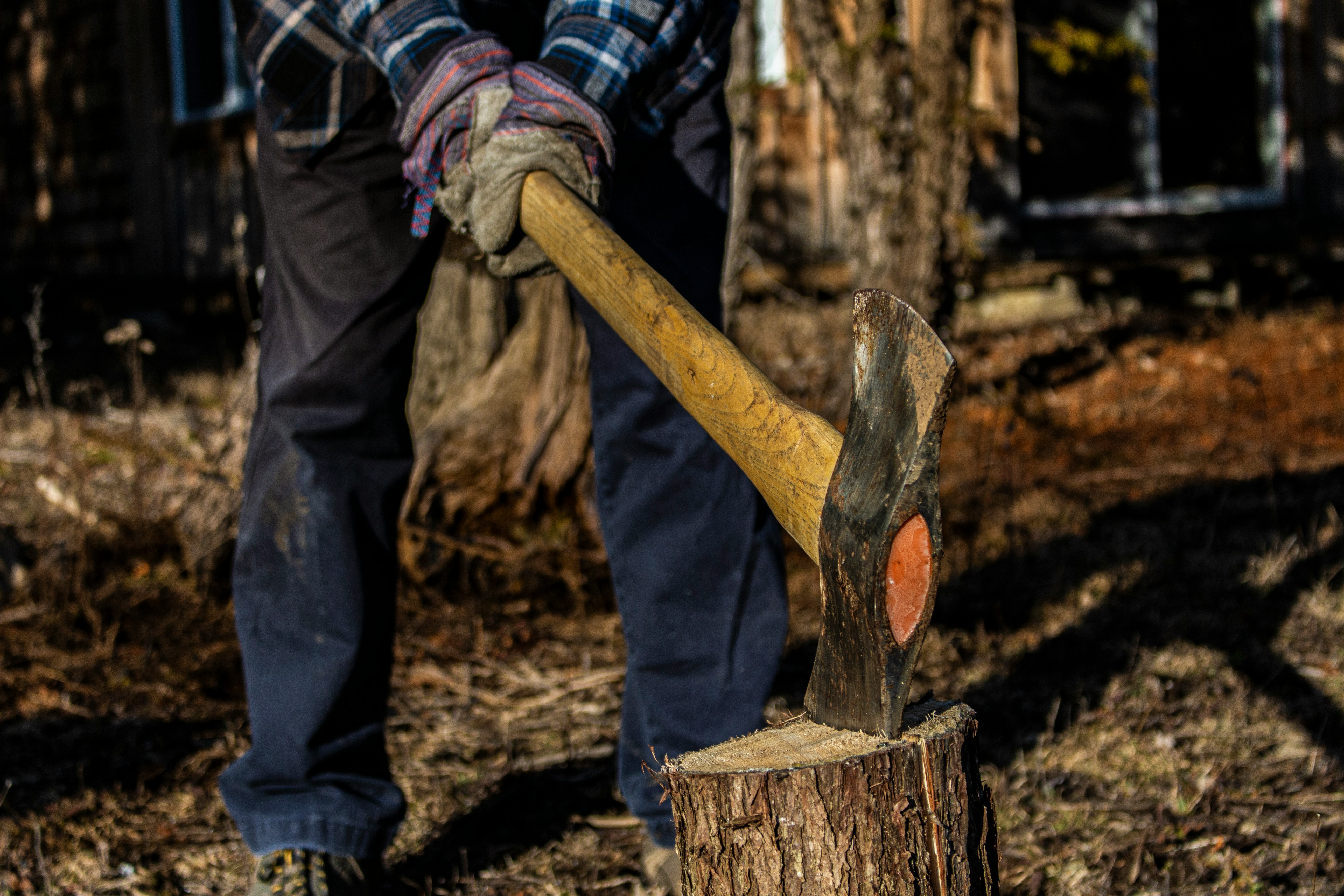
I was outside this past weekend splitting firewood, and a very uncomfortable feeling came over me. The feeling was one part sick in the stomach and another part unsteadiness. I was afraid I was going to faint. I walked inside my house to get a drink of water, closed my eyes, and I saw a bright light behind my eyelids.
I was having a migraine, but not the kind that hurts. That migraine was from heat exhaustion.
We’ve been in a weeks-long heat wave here in the northeast USA, with near nonstop heat and humidity. That morning I had run/walked with my dog for four miles, totally soaked with sweat. I got cooled down in the a/c, got breakfast, and relaxed.
After a few hours, with dry clothes on, went outside again and mowed our grass. That took about 90 minutes, and again I was dripping with sweat. Back inside, I enjoyed the a/c, got lunch, and watched some TV.
A couple more hours later, with new dry clothes on, I went back outside to split wood. I have a lot of splitting to do to get ready for winter. If you’ve ever split firewood by hand with an axe, you know it is great exercise. I filled up a wheelbarrow with logs needing split, split them, and stacked them. I filled up a second wheelbarrow, but after whacking a couple logs, my body started having the symptoms of heat exhaustion. My body was telling me, “You’re done.”
We humans have our limits. As we age, we feel those limits more quickly. We need rest.
Given what Christians historically believe about God, he does not need to rest. God has unlimited energy. God could work unceasingly, and it would never affect him. Ever. 24 hours per day, 7 days per week, 365 days per year, every year. He is omnipotent, all-powerful.
But he rested anyway. Why?
In Genesis chapter 2, we read the famous story of the God who rests after his six-day work week creating the universe: “Thus the heavens and the earth were completed in all their vast array. By the seventh day God had finished the work he had been doing; so on the seventh day he rested from all his work. Then God blessed the seventh day and made it holy, because on it he rested from all the work of creating that he had done.”
Why did God “bless the seventh day and make it holy.” After working on the previous six days, his act of rest on the seventh declares that rest is a very good thing.
God rests as an example to us. He knows that we humans do not have unlimited energy. We humans are not omnipotent. Though we sometimes think we can go and go and go, we can’t. Caffeine sure helps. But we need rest. God knows that. He wants us to have an abundant flourishing life. One of the ways we experience that flourishing life is by rest, pausing to see God’s character, his goodness. So God sets an example for us to follow. We do well to follow the example of God, resting.
Sabbath, then, is quite loving and gracious of God. He knows that we need rest, a break, and he does not require us to live in a way that is impossible for us. He cares for us.
God’s care shows up in the Exodus account when he rescued the people of Israel from slavery in Egypt. After they journeyed into the wilderness, however, things got intense. In Exodus chapter 16 and 17, we read that people of Israel grumble against their leaders Moses and Aaron, accusing them (and God) of leading them out into the desert to die. Though they were enslaved in Egypt, they say, at least they had food.
Can you imagine being a working people who are now unable to work? For all your life, you’ve worked in order to put food on your table. You’ve worked hard. Slavery actually. It was brutally hard. The Egyptian Pharaoh squeezed every ounce of energy out of the Israelites. If you are a Hebrew enslaved in Egypt, of course you hated it, and cried out to God for it to stop. And God did stop it. But now you’re in the wilderness desert now. There is no work and no food.
Just then God steps in. In Exodus 17, verses 4-5, God says to Moses,
“I will rain down bread from heaven for you. The people are to go out each day and gather enough for that day. In this way I will test them and see whether they will follow my instructions. On the sixth day they are to prepare what they bring in, and that is to be twice as much as they gather on the other days.”
God provides! And did you notice how God provides not only new work and new food, but God also lays a foundation for rest. Each day they are only to collect enough of the bread from heaven, the manna, for that day. So each day has a bit of sabbath rest built in. You’re not supposed to work 24/7.
And then each week has a longer rest. On the sixth day, the people were to gather double bread, manna. Why? In Exodus 17, verses 21-23 we learn that,
“Each morning everyone gathered as much as they needed, and when the sun grew hot, it melted away. On the sixth day, they gathered twice as much—two omers for each person—and the leaders of the community came and reported this to Moses. He said to them, “This is what the Lord commanded: ‘Tomorrow is to be a day of sabbath rest, a holy sabbath to the Lord. So bake what you want to bake and boil what you want to boil. Save whatever is left and keep it until morning.’”
What a beautiful system of work and rest, a system that depends on God. The people can’t solely depend on themselves and their abilities. The people work, but they don’t overwork, and instead, God provides just what they need.
Except that some people didn’t seem to place their trust in God’s system. We meet them in the next post.
Photo by Jennifer Lim-Tamkican on Unsplash
 Engaging Scripture