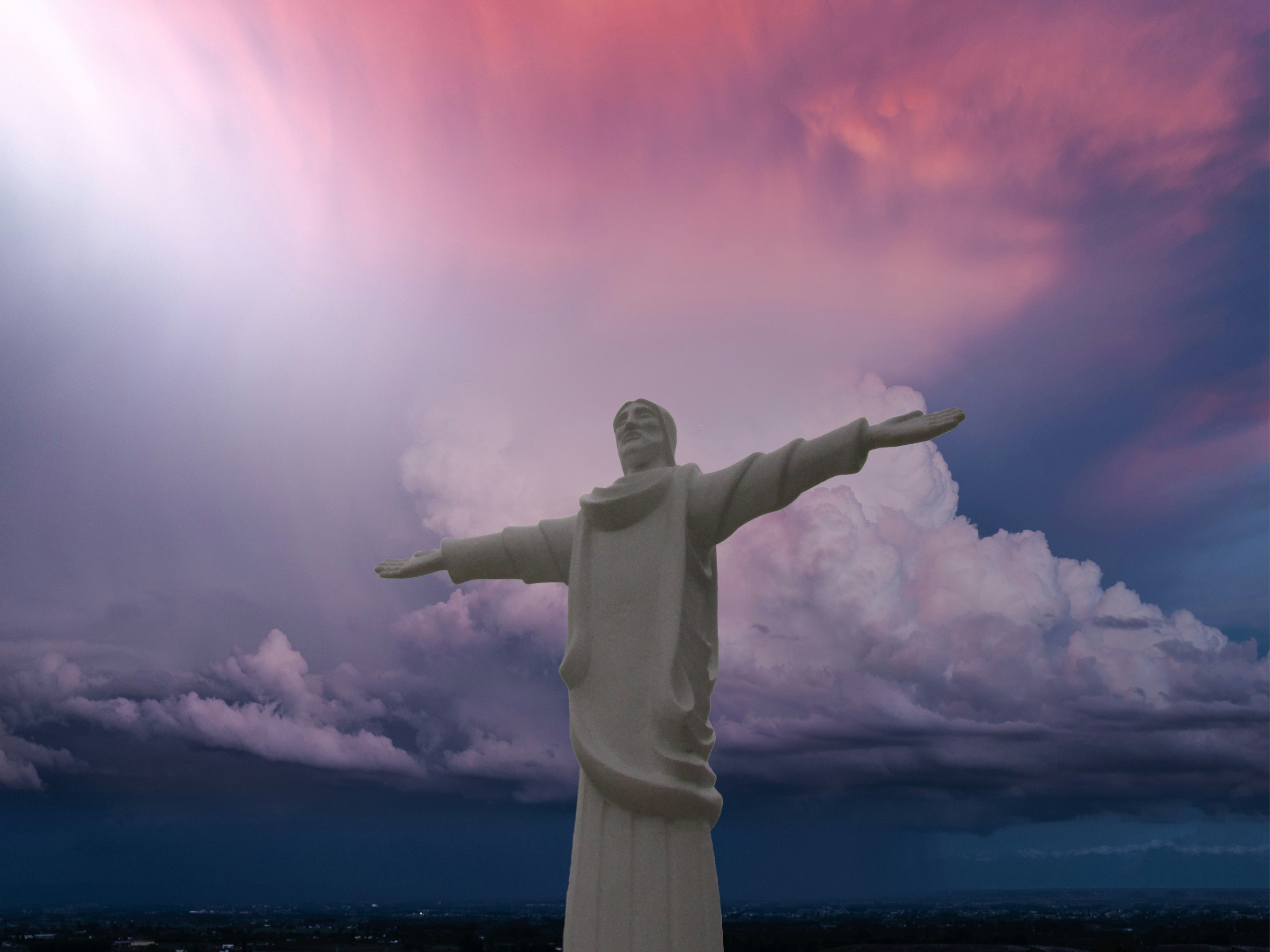
Editors Note: I had planned to write one of my regular five-part series, based on my sermon about Jesus’ Ascension, but my week did not allow the time. So here is the whole sermon.
Does your church celebrate Ascension? I’ve been pastor at Faith Church 23 years, and I don’t think we’ve ever celebrated Ascension Day. What does Jesus’ ascension matter?
It’s so easy to just skip right by it. Something else is coming. In fact, next week is Pentecost Sunday.
And as Pentecost is the beginning of the church, when the Holy Spirit comes, we can look at that as if that’s the main event in the life of the church that we’re looking forward to. The empowerment of the Holy Spirit. And yet, Ascension is something that I’ve come to believe is incredibly important.
There are a number, specific number of days between Jesus’s resurrection and the Ascension.
In Acts 1-3, it says there were forty days, and all these 2000 years later, we continue to count out forty days from Easter to mark Ascension Day. What was happening during those forty days?
Jesus was spending time with his disciples. He was instructing them. He was telling them all sorts about the kingdom. And yet, did they get it? In just a moment, I’m going to suggest that even though Jesus was crucified and risen, even though he spent forty days, after he was risen, instructing them about the kingdom, they still didn’t quite get what he was talking about. Before we come down too hard on those disciples, as if they were particularly dull, let’s remember that they were regular humans like us, and we can be slow to understanding too.
We learn about the forty days before the Ascension, and the Ascension itself in two places in the Bible. The first one is in Luke 24, right at the end of the chapter, and it is brief.
Luke mentions the location, Bethany, which is not far outside of the city of Jerusalem. You can get there easily in less than a day’s walk.
Next Luke tells us that Jesus blessed his disciples. He wants to confer his mantle of mission upon them.
Then Luke describes Jesus’ Ascenion, and he concludes with a detail I find surprising. After Jesus ascends to heaven, the disciples leave worshiping with joy and praise. And I find that reference very curious because if I were one of Jesus’ disciples, and Jesus has just left me, I would not be happy.
Why are the disciples worshiping? Why are they praising God for this?
If I’m one of the disciples at that moment, I think I would be very sad. I wouldn’t want him to leave. It seems like it would be so much better for him to stay.
Think about it: wouldn’t it be better for Jesus to just stay, set up his kingdom on earth, and have the disciples be his emissaries to establish the kingdom? Apparently Jesus had a very different plan, to leave. Why, then, are his disciples happy? All we learn is that that they stayed continually at the temple, waiting.
I find Luke’s account to be quite mysterious. This is the very end of Luke’s gospel, and it finishes on a cliffhanger. Luke clearly planned this ending. He leaves us wanting more, desiring the rest of the story!
Thankfully, Luke’s gospel has a sequel, the Acts of the Apostles.
Acts 1 starts just a bit before the end of Luke. Acts also covers the Ascension, but it is a bit more extended discussion of the events. When you picture the Ascension, or when people preach or teach the Ascension, they most likely use this version in Acts chapter one, verses six through 11.
As I mention, the account starts before the Ascension. Jesus mentions that the disciples should wait in Jerusalem, where they will receive power from the Holy Spirit, and then they will be his witnesses. And as he’s discussing this with his disciples, the disciples say something to him. They ask him a question that leads me to believe that all of Jesus’ teaching and disciping them for three years, his crucifixion, his resurrection, and his final forty days of teaching between the resurrection and ascension, did not fully land in their hearts and minds.
Here’s their question: “Lord, are you at this time going to restore the kingdom to Israel?”
There’s a significant context beneath that question. Imagine the rollercoaster of emotions that the disciples would have experienced in the past three years. They’ve seen his miracles, heard his incredible preaching, the way that he confronts the religious leaders, and the fact that the religious elites cannot hold a candle to Jesus. The disciples were watching Jesus always able to best the religious leaders, defeating any challenge that they bring to him.
The disciples see people healed dramatically, raised from the dead even, all as Jesus proclaims the message of the kingdom. Over the course of his ministry the crowds are growing. It seems as though Jesus is the promised leader that God had said from the Old Testament was going to come, the Messiah.
In that regard, the disciples are correct. Jesus was the Messiah. The problem is that they had a faulty understanding of what the Messiah was to be about. Remember, the Jewish people at that time were under occupation.
They were not a free people. The Romans controlled their land and had been controlling it for many years. No surprise, people don’t like to be occupied.
People don’t like it when they’re not free. Imagine how we would feel if we didn’t have freedom. Freedom is the hallmark of our nation’s history.
We would not like it if another country was controlling us. That’s what the Jews were going through in Jesus’ day. Roman soldiers all over the land. The Roman governor was the ultimate authority.
Of course the Jews longed for the days they read about in their Scriptures when their famous kings like David and Solomon and many, many others were in charge and they were free. That national freedom was what they believed the Messiah was all about.
In Acts chapter one, as Jesus is telling the disciples they’re going to be empowered to be his witnesses, they have visions of glory in their heads. Not of God’s glory, but of national glory. They have visions that God will restore the kingdom to the days and the power and the prosperity just like it was in King David’s time. Just like it was in King Solomon’s time.
They believed that they were properly interpreting their Old Testament Scriptures. It seemed like everything was pointing to this. That he was the one that was going to restore the kingdom, and some of their reasoning had to do with where they were standing.
Where were they standing when the ascension took place? Well, if you scan ahead to Acts chapter one, verse 12, we learn they are on the Mount of Olives. From that vantage point, they would have seen the temple in all its glory. The disciples were looking at the massive temple mount when they asked this question, “Are you going to restore the kingdom to Israel?” What’s more, there is a scripture though that is in their minds as they’re standing on the Mount of Olives.
They’re looking at that central, most important, most holy building in the capital city.
In Zechariah 14, verses one through nine, the Lord prophesies returning to Jerusalem where he will stand on the Mount of Olives and restore the kingdom.
The disciples know this prophecy. From hundreds of years before, they know that the prophet said that the Messiah would come, and he would stand on the Mount of Olives and he would restore the kingdom.
It’s a glorious vision of God fulfilling his promise to the nation of Israel. And there they are standing on the Mount of Olives that day with Jesus who by all appearances, especially after he died and rose again, seemed to be the Messiah. They think the prophecy is being fulfilled.
This is it. Jesus is about to restore the kingdom. Jesus is about to launch a military movement to remove the Romans from our land so they can be free.
Imagine the disciples thinking, “We get to be right here with him!” They think that they are experiencing the fulfillment of this glorious promise right before their very eyes. In many ways, they were doing a great job of interpreting scripture.
But Jesus has a sobering answering. To their question, “Lord, are you going to restore the kingdom?” He simply says “It’s not for you to know.”
In other words, Jesus is saying to his disciples, “We’re not talking about that. You’re missing the point.”
Can you imagine being told that? I wonder if they were super confused. I wonder if they were despairing.
I would be thinking, “What do you mean? I thought we were figuring this out right. I thought you were the Messiah. You’ve kind of even told us you’re the Messiah. We’ve just spent 40 days with you, Jesus, where you’ve been walking us through these Old Testament prophecies and showing how you’re the fulfillment. What do you mean you’re not going to restore the kingdom to Israel right now?”
The disciples still didn’t fully get the mission of the kingdom. The kingdom of God was no geographical or national or ethnic. Jesus’ mission is about righteousness and justice, not about political victory, not about political power, not about geographical authority. It’s about righteousness and justice.
In Jesus’ answer to his disciples, he is revealing the difference between information and power. So often we want the information. We want to know when Jesus is returning. But Jesus says, “I’ve got something completely different and better for you. I want to give you power. I want you to wait, disciples, in the city until the Holy Spirit comes upon you and gives you power for the mission of the kingdom.”
Then Jesus says, “That empowered mission is that you’ll be my witnesses.”
In the original language, that word witnesses is the word martyr. In contemporary English, a martyr is someone who dies for their faith. That’s not what the word originally meant. The word martyr originally described someone who tells the story of what they’ve seen and heard and experienced. A witness.
The reason why we equate martyr with someone who dies for their faith is because so many of the early Christians dies for their faith. It was only much, much later that the concept of dying for your faith got connected to that word.
The mission of Jesus is not to necessarily give our lives for our faith. We might have to. But what Jesus is saying here is that the mission of Jesus is to be witnesses, to tell the story of how God has been at work in our lives, to tell the story of what we have seen and heard.
All of us have been the beneficiaries of God’s great work in our lives.
How has God worked in your life? How has he kept his promises? What answers to prayer have you seen? How has God shown himself to be faithful?
Recently I taught a class here using the book Presence-Based Witness, and the book emphasized our role as witnesses. We have seen something. We have observed how God has been at work, and so then we tell that story. It’s a delightful way to think about our identity in Christ. We get to share the stories of God’s good work.
Jesus says to his disciples, “You’ll be my witnesses,” and then Jesus leaves them.
He returns to the domain of his Father. He’s sitting at the right hand of the Father currently and has been for ever since that day. What do we do with this? What does it matter?
Jesus had told his disciples, “It is for your good that I am going away, because unless I go away, the counselor will not come to you.” (John 16:7) I have trouble with that verse a little bit.
If I was one of the disciples, I get it that they’re worshiping. I get it that they’re praising God. He has given them the mission of the kingdom, and that is amazing. But there is part of me that would be thinking, “I don’t want you to go away, Jesus.” Think about the difference between seeing Jesus in person, being able to actually go to a person, as opposed to the invisible Holy Spirit?
The beautiful difference between the two is that we don’t have to go to the city of Jerusalem, where Jesus has set up a palace and a throne to go visit him. Because if he never left, that’s what it would have meant. Instead, because Jesus ascended to heaven, we have the incredible gift of being the receptors of the Holy Spirit.
Paul writes in 1 Corinthians chapters three and six, that we are the temple of the Holy Spirit. We don’t have to travel to a faraway place to go and meet God, because God lives with us. That is one of the beautiful promises of the ascension.
In Ephesians four, verses seven through 13, Paul writes, “He who ascended gave some to be apostles, prophets, evangelists, shepherds, or pastors, and teachers, to prepare God’s people for works of service, so the body of Christ may be built up.” This relates to the mission that Jesus conferred upon his disciples, and through every generation it has continued, because we are the beneficiaries of that mission. All of us have received gifts from God to be able to serve him.
Some apostles, some prophets, evangelists, shepherds, teachers, each of those five roles are vital for the work of the kingdom. What this verse reminds us is that when Jesus ascended to heaven, he said to his disciples and to us, “I am giving you the mission of the kingdom. The mission of the kingdom is your mission. You are the ones who have the responsibility and the privilege to continue that mission.”
Sometimes I think that’s a little scary. Sometimes I think, “I don’t want that mission, Jesus. I don’t want your mission.”
I’d much rather sit back and watch TV or spend my time doing any number of other activities.
Maybe you’ve thought something like that before, or maybe that’s just what you do. Not saying that watching TV is wrong, or reading books, or however you want to spend your time.
But how often do we think to ourselves about the reality that when Jesus ascended, he gave the mission of the kingdom to each one of us?
Another scripture, Hebrews 4:14, says, “Therefore, since we have a great high priest who has gone through the heavens, Jesus, the son of God, let us hold firmly to the faith we profess.” This is using some Old Testament imagery of the high priest, but saying that Jesus is the great high priest.
Because he is the example who has gone before, let’s hold firmly to that faith. Let’s be people who are passionate about the mission of his kingdom. It does not matter if you’re the youngest one in the church, or the oldest, or the in-between. The mission of the kingdom is for all of us. Let’s hold firmly to that. Let’s stay true to that. Let’s ask ourselves those questions of how am I following the mission of the king?
In 1 Peter 3:21–22, “Jesus Christ has gone into heaven and is at God’s right hand with angels, authorities, and powers in submission to him.” It’s so amazing to think that the king has granted his authority to us to pursue the mission of his kingdom.
The ascension of Jesus speaks to all of that. I hope a theme is coming through: the ascension motivates us to mission.
The ascension of Jesus says that we will be filled with power so that we can be his witnesses. He has given us the authority to serve the mission of his kingdom.
But know this, Jesus has not left us alone. His spirit, the Holy Spirit, is with us. And we praise God for that, that we have the empowerment of the spirit to serve him.
So what’s the significance of the ascension? The ascension reminds us of triumph, that Jesus won the victory. In 1 Corinthians 15:54–57, Paul writes that “death has been swallowed up in victory, thanks be to God. He gives us victory through our Lord Jesus Christ.”
Just as he has victory, so we too can experience his victory.
In the ascension, we also see his exaltation to the throne. In Philippians 2:10–11, “God exalted him to the highest place, and every tongue will confess that Jesus is Lord.” The ascension also reminds us, Jesus not only won the victory, but he is exalted as king.
Finally we learn about his lordship in Colossians 3:1, “You have been raised with Christ. Set your hearts on things above, where Christ is seated at the right hand of God.”
Because he ascended, we look to him as Lord. He is the one who has won the victory. He is the one who is exalted, and he is our Lord.
We see all of this in the ascension. So set your hearts on his mission. The ascension launches us on mission for Jesus.
Photo by Bettina Otott Kovács on Unsplash
 Engaging Scripture