After years of waiting, running, hiding, and battling, David is king of all Israel. He has conquered Jerusalem, built a palace there, and brought the Ark of the Covenant into the city.
And yet, in the middle of all that blessing from God, David is unsettled.
Maybe you’ve had that feeling after a very busy season of life. For weeks, months, or years, you work hard to accomplish a goal. Long hours, waking up early, staying up late. It’s grueling, but finally you are done. You take time to rest, and much to your surprise, you can’t rest. You’re used to hard work, and you feel weird or even guilty for taking life at a much slower pace. You are unsettled, and you wonder if you should just go back to work. You’re antsy.
I know people who are excited about retirement. I know some people who cannot retire. Not because they need finances; they don’t need more income. They’re just antsy. They want to do something. I’ve definitely heard some people say that they retired and got busier than ever. Others retire and find out that they are bored. They want to do something. And they should. Retirement is a golden age for serving the Lord and the mission of his Kingdom.
It seems that David is feeling some of that. Here’s how 2 Samuel chapter 7 begins:
“After the king was settled in his palace and the Lord had given him rest from all his enemies around him, he said to Nathan the prophet, ‘Here I am, living in a house of cedar, while the ark of God remains in a tent.’ Nathan replied to the king, ‘Whatever you have in mind, go ahead and do it, for the Lord is with you.’”
We got a preview of the prophet Nathan last week when Emily Marks blogged through the story of David and Bathsheba (read her first post here). As she mentioned, we know very little about the prophet Nathan. In 1 & 2 Chronicles there are two references to Nathan that tell us he was central to the highest levels of Israelite society. He had access to David, and as we saw last week, he confronted David. So when we read in 2 Samuel 7 that David is talking with Nathan, David sees Nathan as a trusted, godly advisor. David sees Nathan as someone who will give him God’s perspective.
What does David need advice about? It’s pretty much a no-brainer. David wants to build God a temple. He doesn’t say those words, of course, but that is exactly what he means. David is living in a nice new palace, while the Ark of God is in a tent. No, David thinks to himself, this will not do.
David’s heart is to give God glory and honor. Nathan, whether he knew precisely what David was hinting at or not, says, “Go for it.” Actually, Nathan says more than that. Nathan says, “God is with you in this idea.” That comment gives us a sense of Nathan’s stature. He is a prophet who speaks for God. Nathan is very confident “You know it, buddy. Yes. You do that thing.” And why not? David wants to glorify and honor God with by getting that Ark out of a lowly tent, and into a temple that is fit for his dwelling. Of course!
Except that Nathan is wrong. God comes to Nathan with a different message. Look at verses 4–7,
“But that night the word of the Lord came to Nathan, saying: ‘Go and tell my servant David, “This is what the Lord says: ‘Are you the one to build me a house to dwell in? I have not dwelt in a house from the day I brought the Israelites up out of Egypt to this day. I have been moving from place to place with a tent as my dwelling. Wherever I have moved with all the Israelites, did I ever say to any of their rulers whom I commanded to shepherd my people Israel, “Why have you not built me a house of cedar?”
I don’t believe Nathan was wrong to answer David as he did in verse 3, “Go for it, God is with you.” David’s desire to build a temple for God is truly a wonderful idea. So why does God disagree? There are many reasons. In verses 5-7, we hear the first reason why God does not want David to build the temple, and it is a shocker.
God is okay with a tent. He never once told anyone to build him a permanent dwelling. Think about a minute. God is okay living in a tent. When I say God lives in a tent, I do not mean that God has a body. Instead, I’m referring to the Ark of the Covenant and the presence of God. The Ark, that small gold-covered chest with angel statues on top, was like the throne of God, and God’s presence would rest on the Ark. In the tent.
What tent are we talking about? Way back in Exodus, just a couple months after God freed the people of Israel from 400+ years of slavery in Egypt, the whole nation was living in tents. They were on their way through the wilderness to the Promised Land of Canaan, and they stopped at Mount Sinai, where God renewed his ancient covenant with them, giving them the Ten Commandments and the Law, including detailed instructions for his tent.
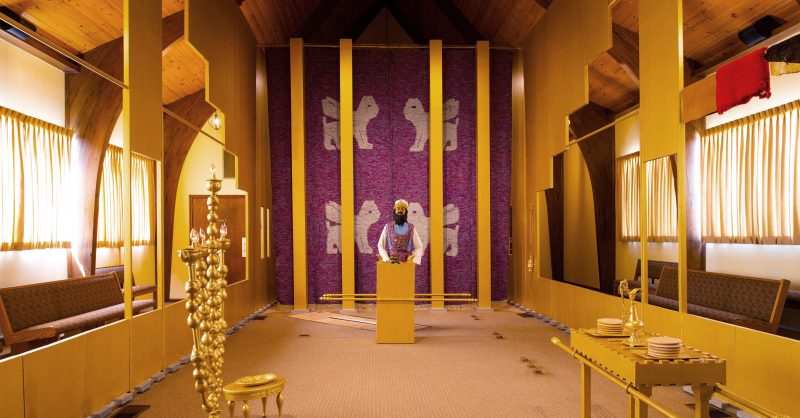
God’s tent is called the Tabernacle. In Lancaster, Pennsylvania, where I live, there is a reproduction of the tabernacle. It is very interesting to visit, but the reproduction doesn’t do it justice because that Tabernacle is inside a building. Here’s a photo:
The actual Tabernacle was a tent made of animal skins. It was about the size of a two-car garage. You would not be blown away by the Tabernacle if you were passing by on your camel. In fact, you would probably have no idea that it was all that different from the tents of the families and tribes encircling it. You would see something like this:
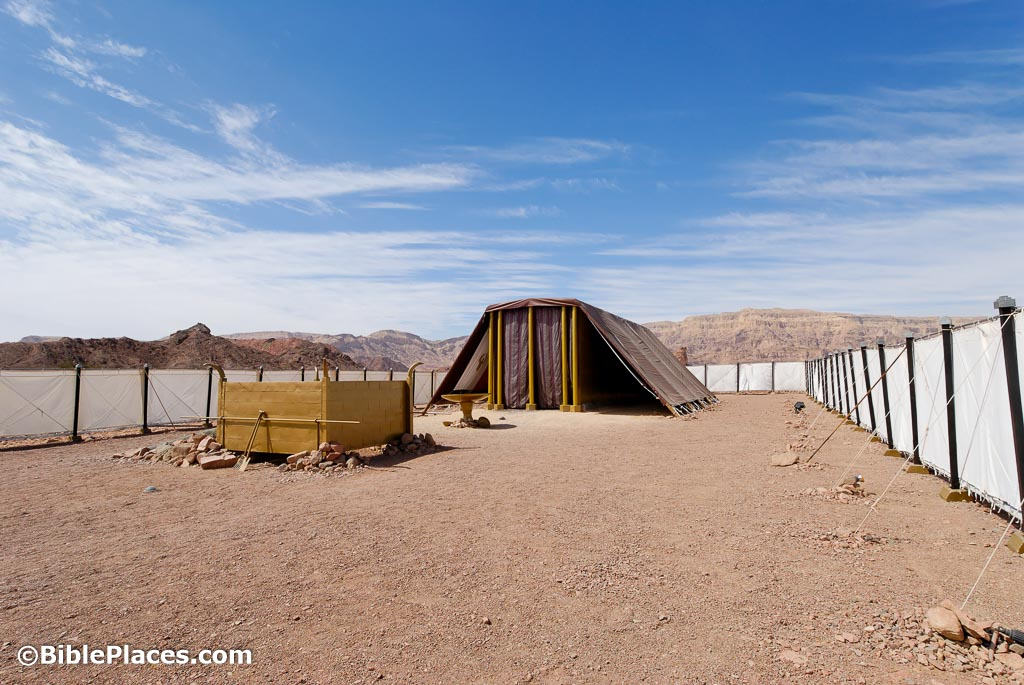
Tiny, right? If it wasn’t for the fencing and altar outside, you’d likely not give it a second glance. But inside that tent was the Ark, and God’s presence resided there. That made the Tabernacle incredibly different from all the other tents. It was God who made the tent special, not the tent itself.
Think about this again: God was content to live in a two-car garage tent. The God of the Universe is okay with an animal skin tent. When the people were on the move, they folded up the tent like any other tent and they carried it to the next stop. What does that tell you about God? It tells you that our amazing God, the Almighty, is humble and he wants to be with his people. That’s mind-boggling.
Photo by Alexander Vilinskyy on Unsplash
 Engaging Scripture