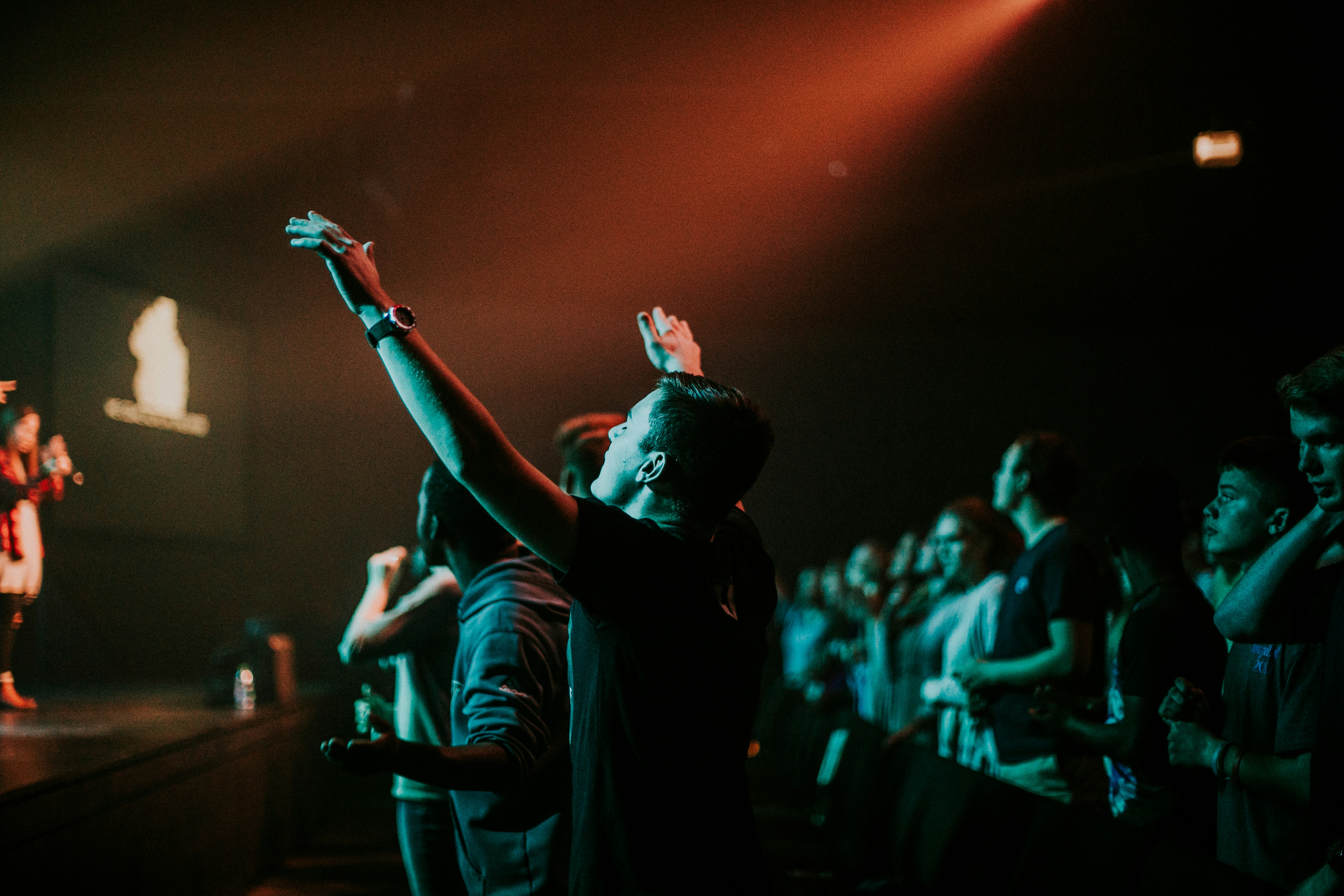
One of the controversial issues during my undergrad years in Bible College was how people should worship God, particularly the validity of the practice of raising hands. A few people did it from time to time during the college’s weekday chapel services. A very few people. So I will never forget one particular chapel service when the president of the college got up in front of the student body and sternly told us that there would be no raising of hands during chapel at our school!
To my recollection, the church I grew up in didn’t have people who raised their hands in worship. I don’t remember anyone calling it bad or forbidding it, because they didn’t need to. It just never happened. At Bible college, when I saw those few people raising their hands, it felt foreign. I was used to people saying “Amen” during worship or every now and then clapping in tune with the songs. So when the president of the Bible college said “there will be no raising of hands” it stuck in my mind. As you can tell, that was 30 years ago.
Then there was our church mission trip to Costa Rica in 2009. That was a whole new ball game. From time to time people raise their hands here at Faith Church, but in Costa Rica, it was a way, way more than that. We all raised our hands and then some. We even had a conga line, dancing, at one worship service. I was soaked with sweat.
That brings me to David. We’ve been studying the Life of David through the Old Testament books of 1st and 2nd Samuel. David was a shepherd, a musician, a poet, a fierce warrior, and passionate lover of God. This week we’re going to observe an instance in which David worshiped God, and he had someone yell at him just like the president did at my college.
Last week we studied 2 Samuel 5, and we learned that after waiting at least ten years, David has finally become king of all Israel. He restarts the conquest of the Promised Land, defeating the Jebusites, gaining possession of Jerusalem and building a palace there.
Think about those three events: king of all Israel, new capital city, and new palace. These are significant markers of success and blessing. These are the kinds of accomplishments for which people all over the globe and throughout history celebrate with a huge party. An inaugural ball. A building dedication. A housewarming party.
But even though he has every reason to party, David is not quite ready to party just yet. Something is missing. God has been faithful to him for years. And now David wants God to be right in the center of the victory. David wants God to be the focus of the celebration, but something is missing that would clearly show everyone in Israel that God is the center.
Think about it. What one object in the history of the nation of Israel’s journey from Mt. Sinai, where they got the Ten Commandments, to the Promised Land signified that the Lord was right there in their midst? How did Israel see the presence of the Lord with them? It started with the pillar of fire by night and pillar of smoke by day guiding them through the wilderness, but as they came into the Promised Land, the presence of the Lord was focused on one place, one object, one chest. The Ark of the Covenant.
In fact, in 2 Samuel 6 we will hear the Ark of the Covenant referred to as God’s throne. It is not an ark like we think of Noah and the ark. It was a small box really. Decorated in gold with small statues of angels on the lid, and rings on the side that the priests would slide poles into for transport. When the nation was on the move, the Ark of the Covenant went before them, whether that was in battle like around the walls of Jericho, or just marching through the land. The Ark signified the presence of God among his people.
This family, this nation of Israel can look back to God’s covenant with their ancient patriarch Abraham, to whom God said, “I will make you into a great nation, through whom all people on earth will be blessed.” Hundreds of years passed, and that family became the nation. But they faced centuries of enslavement. Then they remember God’s word to them through Moses, “I will take you from slavery to the Land of Promise, the Land overflowing with milk and honey, a land where you will be free from your enemies.”
As David thinks about the promises God made to his forefathers, he sees that they are finally being fulfilled, and there is only one thing that needs to happen. God who led them all the way needs to lead them again. This new capital city, Jerusalem, is not just David’s city, where David is King. It is God’s city where God is king. Now there is only one thing on David’s mind. The Ark of the Covenant must return to the city. The true king must inhabit the throne.
So where is the ark? Why isn’t it there in the first place? We studied that story earlier in this series. Saul, the first king of Israel let the Ark get stolen by the enemy Philistines. The Ark had some adventures in Philistine land, causing a plague among the Philistines. The Philistines got so sick, they returned the ark to Israel on a horse-drawn wagon. The people in the Israelite border town of Kireath Jearim placed the ark in the house of a man named Abinadab. There the ark remained all this time. Why they did not return it to the tabernacle, we are uncertain. Think about that. As God is bringing David victory, as there is great rejoicing in Israel, the Ark is at the home of an Israelite about nine miles west the city. It’s time to bring it back!
Check back in the next post, because just as David is bringing the Ark to Jerusalem, tragedy strikes.
Photo by Hannah Busing on Unsplash
 Engaging Scripture
One thought on “The time the president of my Bible college declared that there would be no raising of hands during worship in the school’s chapel services – 2 Samuel 6, Part 1”