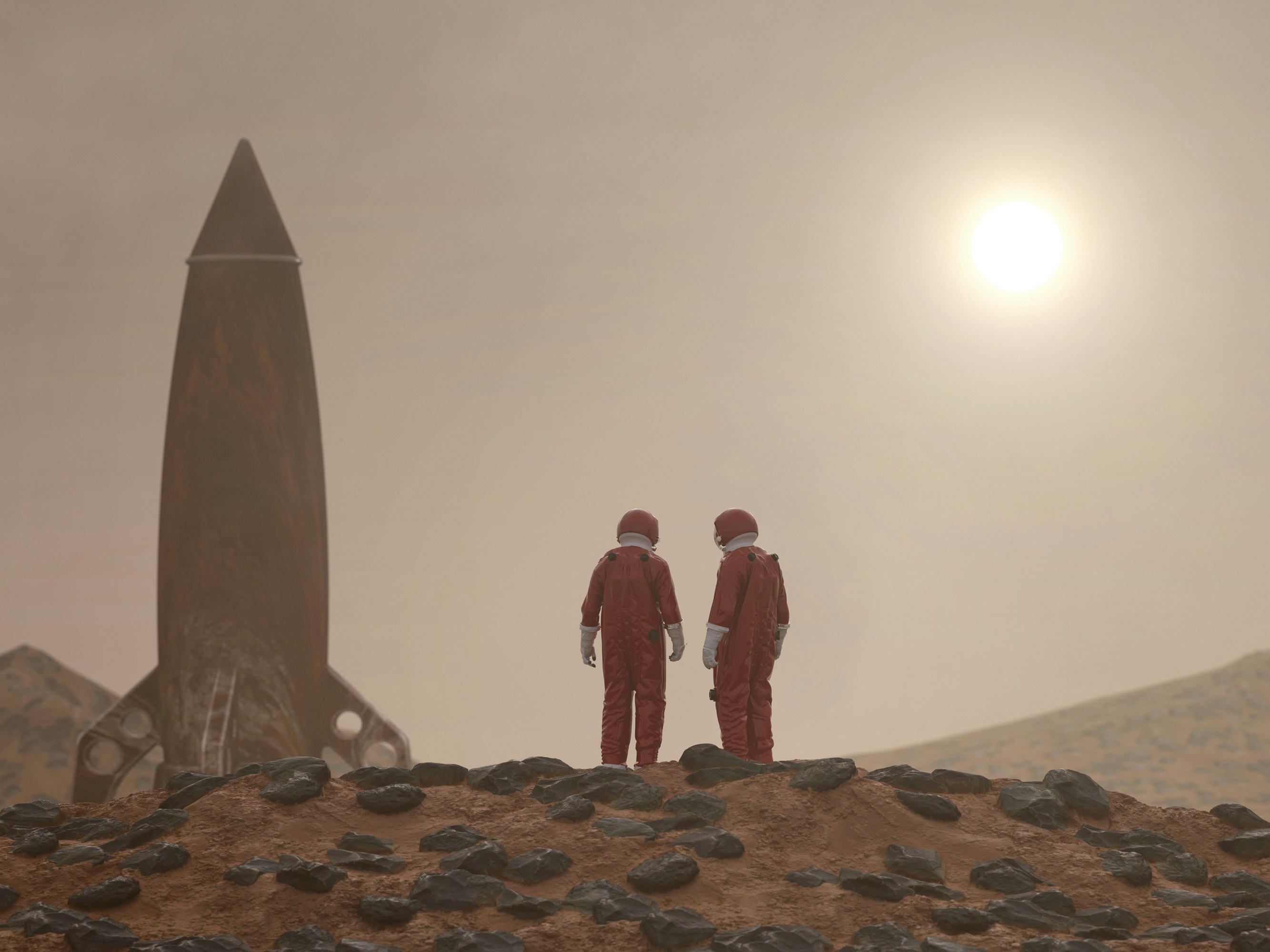
Humans have long explored the natural world can as an act of worship that seeks to glorify God, specifically because the act of exploration seeks to know the heart and mind of the One who created it. If we are okay with exploring land, sea and air, should we not also be okay with exploring space?
Psalm 19 provides a theological basis for exploration to the glory of God:
“The heavens declare the glory of God; the skies proclaim the work of his hands. Day after day they pour forth speech; night after night they reveal knowledge. They have no speech, they use no words; no sound is heard from them. Yet their voice goes out into all the earth, their words to the ends of the world. In the heavens God has pitched a tent for the sun. It is like a bridegroom coming out of his chamber, like a champion rejoicing to run his course. It rises at one end of the heavens and makes its circuit to the other; nothing is deprived of its warmth.”
Obviously, when David was writing this psalm 3000 years ago, he had no idea about radio waves or the possibility that the heavenly bodies actually do make noise, which contemporary scientists have been listening to for decades, made possible, of course, through space exploration. To David while heavenly bodies seemed audibly quiet and distant, those heavenly bodies loudly proclaimed the glory of God.
I love looking at the night sky, and especially the moon, though it freaks me out to think that we can see this giant ball so clearly, yet so far away. It does something to me. It reminds me of my smallness, and God’s unfathomable hugeness. The moon and stars speak to me
The heavens help us have perspective. In Psalm 8, verses 3-4, David writes, “When I consider your heavens, the work of your fingers, the moon and the stars, which you have set in place, what is mankind that you are mindful of them, human beings that you care for them?”
David directs us to think about the moon. Space exploration can be so theologically rich, when we consider that the sun is far larger than the moon. The sun, by comparison, is not a big stars. Or think about the massive expanse of the universe, untold lightyears in every direction. Space is mindboggling, which is why would do well to explore space and worship.
No doubt space exploration since the 1950s has not been done simply to worship God. When we beat the Russians to the moon, how much of our motivation was simply because we wanted to demonstrate superiority over the Russians? Was the race to the moon a massive ego contest? Probably. And it was quite expensive. My guess is that there were plenty of individuals who approach their work for the government or other private space agencies as worship to God. No matter where or how you work, we are called to view our work as worship. Space exploration fits very nicely with this idea of work as worship. How so? Because in exploring new worlds, we are seeking the mind of the creator of those worlds. We want to know more of him and how and why he created.
I think it is of great value for Christians to be people who gaze at the stars and moon and other celestial events. The recent eclipses have been amazing opportunities to worship God. Paul writes in Romans 1:20, “For since the creation of the world God’s invisible qualities—his eternal power and divine nature—have been clearly seen, being understood from what has been made, so that people are without excuse.” We explore space so we can know God! That is, if we are also caring for earth and human flourishing at the same time.
Third, exploration whether over land or under the land, in air, on the ocean, under the ocean, have led to the advancement of humanity and technology that can benefit humanity. Space exploration glorifies God, in other words, because it has advanced human flourishing.
Let me ask you this: why do you like the Olympics? The athletes are amazingly talented. The competition is entertaining. But the Olympics have a depth about them that is so striking. In our broken, divided world, the Olympics peacefully bring humanity together. Space exploration does too!
Even though the space race mimicked the ideological standoff between communism and democracy, things took a dramatic turn since the 1980s. In 1984 Ronald Reagan authorized the beginning stages of creating an international space station. Design and component-building took place from 1984 to 1993 through a collaboration between the US, Canada, Japan, and the European Space Agency. Then in 1993, Russia was invited to participate. Russian had their own tiny space stations in 1970s, and they would go on to build a larger one, Mir, which was in operation from 1986-2000. But the ISS has taken space habitation to a new level. From 1995-1998, 36 space shuttles missions and 6 Russian rockets brought all the initial components to space. It has taken over 250 spacewalks to build and maintain. Since November 2000, the ISS has been continually inhabited by an international array of people from five space agencies and 15 countries. NASA reports that “the microgravity laboratory has hosted nearly 3,000 research investigations from researchers in more than 108 countries.”
Though space exploration started off as a competition, one of the amazing aspects of the International Space Station is that it has been, like the Olympics, a stunning effort for peace.
The ISS has promoted human flourishing many other ways. NASA reports that scientist and astronauts have done experiments and research on the ISS that have led to advances in medical scanning technology such as ultrasound, creating new drugs for disorders like Muscular Dystrophy, lowering heat in cities and tracking water, applying station air filtration technology to fighting COVID and preserving food in grocery stores, creating artificial retinas in space, making cancer treatments simpler for patients, monitoring heat safety on Earth, and more.
So at the conclusion of this series of posts about a theology of space exploration, I believe we Christians can thoroughly support space exploration, as long as we keep one foot planted firmly on the earth, eyes open to spot injustice and suffering, hands and that other foot ready to run to share the love of God in word and deed.
Photo by Photobank Kiev on Unsplash
 Engaging Scripture