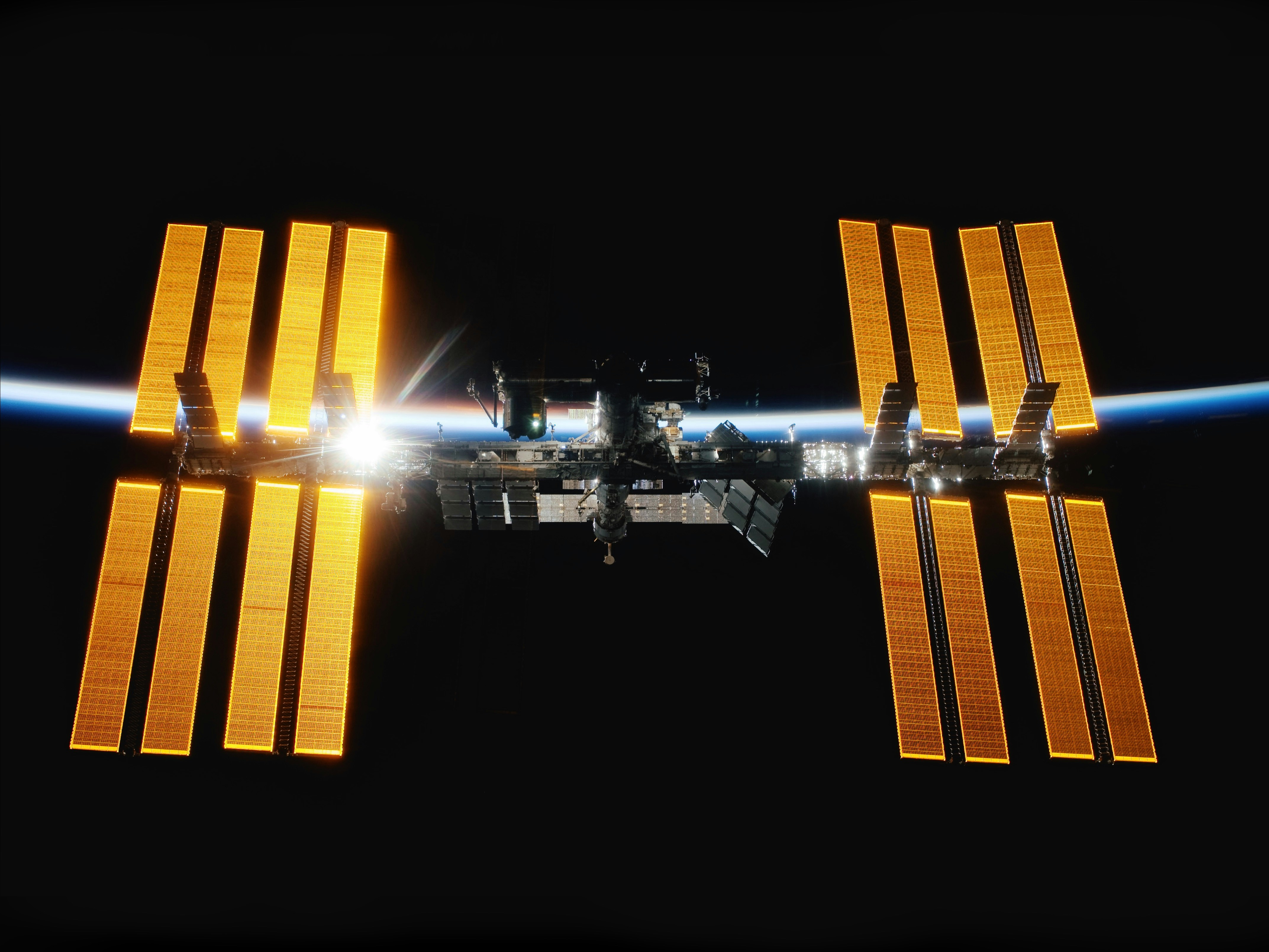
Trivia question for you: Why doesn’t the International Space Station fall to the earth and burn up during reentry in the atmosphere? Did you know the International Space Station is 357 feet long end to end, has a mass of 1 million pounds and would just barely fit inside a football field? It has living space like that of a large six-bedroom house. It’s so big, you can see it flying across the night sky when the sun reflects off it, making it look like a moving star. Track it on this NASA website. Back to my trivia question. If the ISS is that large and heavy, how does atmospheric drag and earth’s gravity not pull it down?
The answer is that earth’s gravity does pull the station downward, always, as gravity does with everything. Furthermore, though the station is about 250 miles above earth, there is still a minute amount of atmospheric drag slowing the station. Those two factors, drag and gravity, always, slowly, pull the ISS closer and closer to earth. The station falls about 1 kilometer every 10 days, easily enough to have brought the ISS down in the 20+ years since it was built (especially consider the fact that the lower it falls, the more atmospheric drags slows it, thus speeding its descent). Given, gravity and drag, why hasn’t the ISS reentered earth’s atmosphere? There is something keeping the station aloft. Do you know what it is? The answer is at the conclusion of this post.
I’m talking about the ISS because this coming week on the blog because we’re taking a break from the Life of David series, and we are going to have a Current Events week about space exploration. For more than two decades, the space station has been a major focus of space exploration. Not the only focus, of course, as the USA, other countries, and private companies have sent probes to the moon, Mars, asteroids, and into deep space. Those same countries and companies have big plans for the near future, not just sending probes and robots, but humans to explore space.
While that might sound exciting to some (like me), others have misgivings about the cost (also me). Consider the price tag of space exploration. Some estimates report that in 2023, total global government spending on space exploration was $117 billion. The US space budget alone was $73 billion in 2023. Now total the massive sums of money spent on space exploration every year since the 1950s. We’re talking trillions of dollars. Is it worth it?
Join me on the blog this coming week, as I seek to apply biblical theology to space exploration. The purpose of current events weeks on the blog is just that, to attempt to think theologically about what is happening in the world around us. I have thoroughly enjoyed studying for the blog posts this week because I love all things space. If NASA invited pastors or theologians to become astronauts, I would seriously consider applying!
But maybe you are not as excited about space as I am. Maybe you are very skeptical about the emphasis on and cost of space exploration. After all, we have so many problems here on earth. That $73 billion the USA spent in 2023 could have done a lot of good toward fixing serious issues such as poverty, disease, energy, hunger, and housing. I agree with that. But I’m torn, because I also love space. I regularly watch rocket launches, and whenever I take my dog outside on a clear night I look for satellites. My family got me a telescope for Christmas last year, and I’ve enjoyed close-up views of the moon. But I also believe that $73 billion could do so much good to help people in need.
So how should Christians think about space exploration? Does the Bible have anything to say about space exploration? It does! Even if you are not a fan of space exploration, I think this coming week’s blog series has the potential to speak to your life. I’m looking forward to talking about it with you starting Monday.
Answer to the Trivia question about what keeps the ISS in orbit: When the ISS dips far enough, the various spacecraft docked at the station which transport supplies or astronauts to the ISS will fire their engines, pushing the ISS back to the proper orbit height. This boosting occurs on average once/month.
 Engaging Scripture
One thought on “A theology of space exploration – Preview”