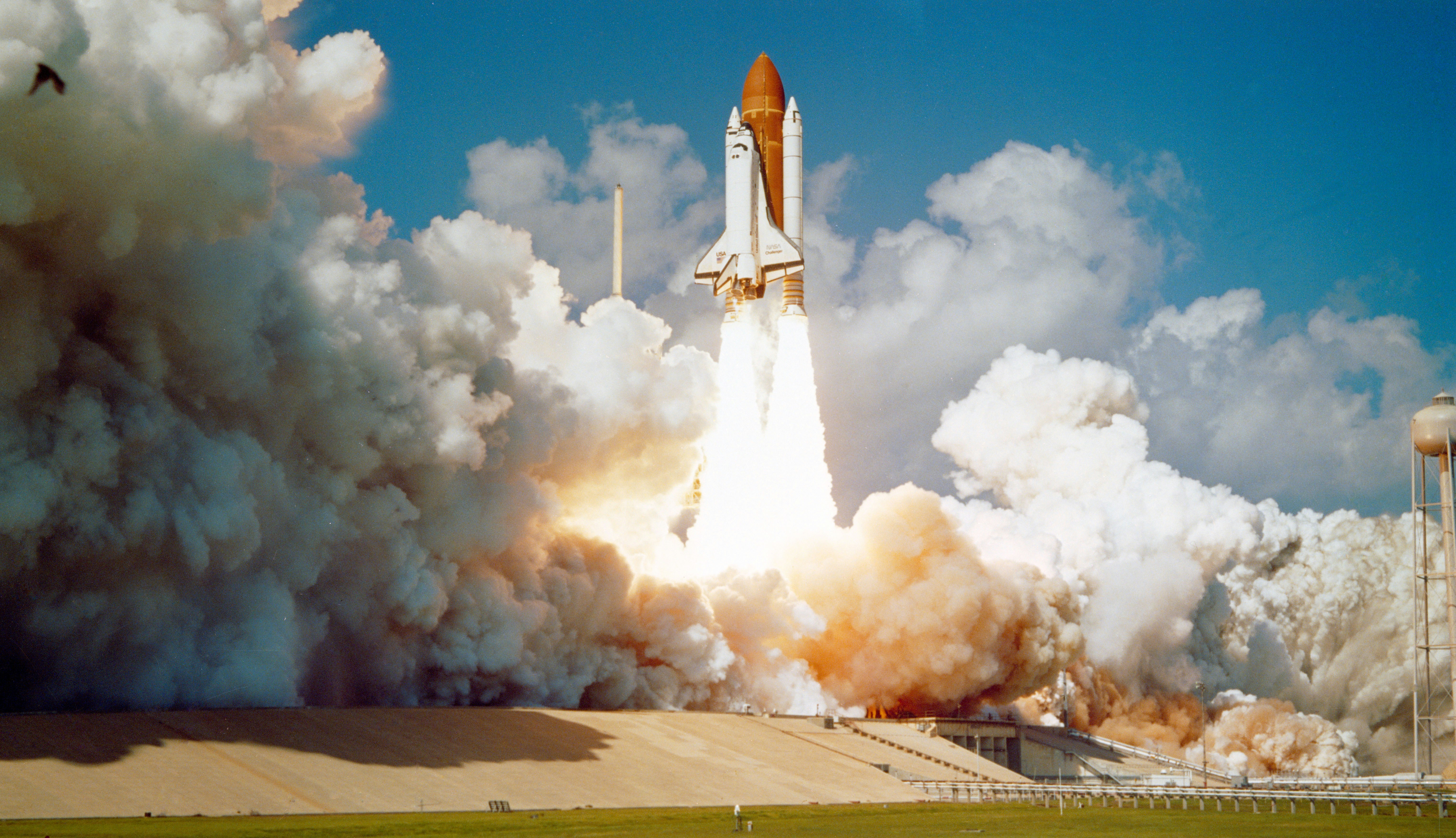
January 28, 1986, was a day I will never forget. What happened that day scarred me. I was in sixth grade, came in from recess, and a student who had been inside for recess drew a picture on the chalkboard of the space shuttle Challenger blowing up. We were shocked, as was our nation. In the days leading up to the launch, students across the country had been so excited because there was a special passenger on that Challenger mission.
Christa McAuliffe, a social studies teacher from New Hampshire, was going to be the first private citizen in space, where she would teach lessons that would be broadcast by satellite to schools across the nation. My school’s satellite link-up was in the school library, and we waited with anticipation for the day when McAuliffe would teach us from space. Then Challenger exploded soon after its launch. I have always had vivid dreams, and that one got me. I had space shuttle nightmares for years.
But I’m getting ahead of myself. This week I’m attempting to bring biblical theology to bear on the topic of space exploration. In the previous post I began a brief history of space exploration. With the retirement of the expensive and nonreusable Apollo Saturn V rockets, NASA envisioned a space transport system that would be reusable, hoping to explore space less expensively and more frequently. We know the space transport system more familiarly as the Space Shuttle. Development began in 1972, and the first shuttle mission blasted off April 12, 1981.
Because of the Challenger tragedy, space shuttle launches were paused for 32 months. But after loads of investigations, redesigns, and testing, on September 29, 1988, Shuttle mission STS-26 relaunched the shuttle program. By that time, I was now in my freshman year in high school, and I remember watching the launch in school, having high anxiety that the shuttle would explode again. I and probably many others breathed a sigh of relief when it was a successful mission.
But fifteen years later, on February 1, 2003, another shuttle, Columbia, broke up during re-entry. Between the two shuttle disasters, 14 astronauts lost their lives. After more investigation and safety correction, shuttles launched again. The final Shuttle mission launched in July 2011, having flown 135 total missions. Over the its 30 years in operation, NASA’s shuttle program built six shuttles, using them for zero-gravity experimentation, deploying satellites, building the International Space Station, and famously launching the Hubble Space Telescope.
Even though shuttles were reusable, they were still extremely expensive, and the loss of life was unfathomable. In 2011 when the final shuttle mission returned to the USA, you’d think that, given the cost of life and resources, it might seem that our human fascination with outer space exploration was fading. Not even close.
Long before that last shuttle mission in 2011, a shift was underway. Private companies began to take an interest in space exploration. Elon Musk started Space X in 2002. Ten years later in 2012, Space X flew its first astronauts to the International Space Station. Since that time, Space X’s growth has been extraordinary.
Space X is famous for its rockets that land upright on the ground or on boats in the water. These advancements have allowed Space X to fly to space far more inexpensively than any government or company before. As of this writing, Space X has launched 375 times, 340 of which have landed rockets safely so they are able to be launched again, and in fact 309 of Space X’s launches are on rockets that have been flown before. Visit Space X’s website for updated numbers. Last week one of Space X’s Falcon 9 rockets broke the record for the most launches by the same rocket, 22 launches. Maybe you’re wondering, what are they doing launching so many rockets? In 2023, they launched 100 times. By far, most of their rocket payloads are satellites for a variety of countries and companies, or supply and transport missions to the International Space Station.
Space X also has its own network of satellites, called Starlink, through which it provides internet service across the globe. When a series of Starlink satellites launch, they are often visible in the night sky, forming what appears to be a “train” of stars flying above in a straight line. These Starlink trains are visible until they reach their desired orbit and spread out.
Space X has set its sights well beyond launching satellites or ferrying astronauts to the International Space Station. Over the last few years it has built the biggest reusable rocket in history, the Super Heavy, as well as a new reusable space transport vehicle called Starship. Starship is larger than space shuttle, designed to carry payloads and humans to the moon and Mars. Whereas the Shuttle launched on the back of a rocket and landed like a jet with wheels, Starship sits on top of a Super Heavy rocket, and then Starship will land upright like Space X’s other rockets. Also, the Super Heavy Booster will be caught by a giant structure called Mechazilla with robot arms. Space X has launched Starship multiple times, unmanned, still in the testing phase.
Speaking of Mars, since NASA got out of the space shuttle business, it has still been involved in all sorts of missions. NASA sends exploratory probes and vehicles around the solar system. Maybe you’ve seen the probes’ close-up photos of Saturn, Jupiter, and the other planets, moons and asteroids. Or perhaps you’ve watched video of robot rovers on Mars, including most recently a robot helicopter on Mars.
In recent years, NASA is looking again toward landing humans on the moon, and eventually Mars. To do this, NASA created its own massive rocket, the Space Launch System, which in Nov/Dec 2022 sent an unmanned mission of the new Orion spacecraft to orbit the moon. These new moon missions have a new name, Artemis. Artemis mission 2 is slated to be a manned mission to fly around the moon, possibly as early as September 2025. Artemis 3 will attempt to land astronauts on the moon, later this decade. Artemis 3’s Orion spacecraft will meet up with a Space X Starship in orbit around the moon, and the astronauts will use Starship to land on the moon.
There is so much more happening in space exploration that some have declared that we are in a new space race. Countries and private companies across the globe are working on all sorts of rocket and spaceship technology and vehicles. Trying to find water on the moon. Trying to find minerals on asteroids. Recently scientists have found evidence of a massive ocean under the red, dusty surface of Mars?
In this new space race, numerous governments around the world sent unmanned missions to the moon in the last year or so. The USA on Christmas Day 2021 launched the James Webb Space Telescope, and we sent it into orbit not around the earth or around the moon, but around the sun! Webb has given us clearer images and data from deeper into space than ever before.
Then came the billionaries. The founder of Amazon, billionaire Jeff Bezos, started a space tourism company called Blue Origin. Blue Origin’s spaceship called New Shephard travels just past the Karman Line (62 miles above earth where space begins). That’s no big deal, considering that the first astronauts broke that boundary in 1961. What is new is that anyone can pay for a ticket on the New Shephard. That is, anyone who has $1.25 million for a seat. Or you can fly on Richard Branson’s bargain spaceflight company Virgin Galactic and their space plane for only $450,000 per ticket. Apparently, waiting lists are long, so you better get on that.
Another private company has recently been struggling to get in the space race. In the next post we’ll learn about their story, which will set us up nicely to talk about the intersection of theology and space exploration.
 Engaging Scripture
One thought on “Space Shuttle, Space X, Artemis and the billionaires – A Theology of Space Exploration, Part 2”