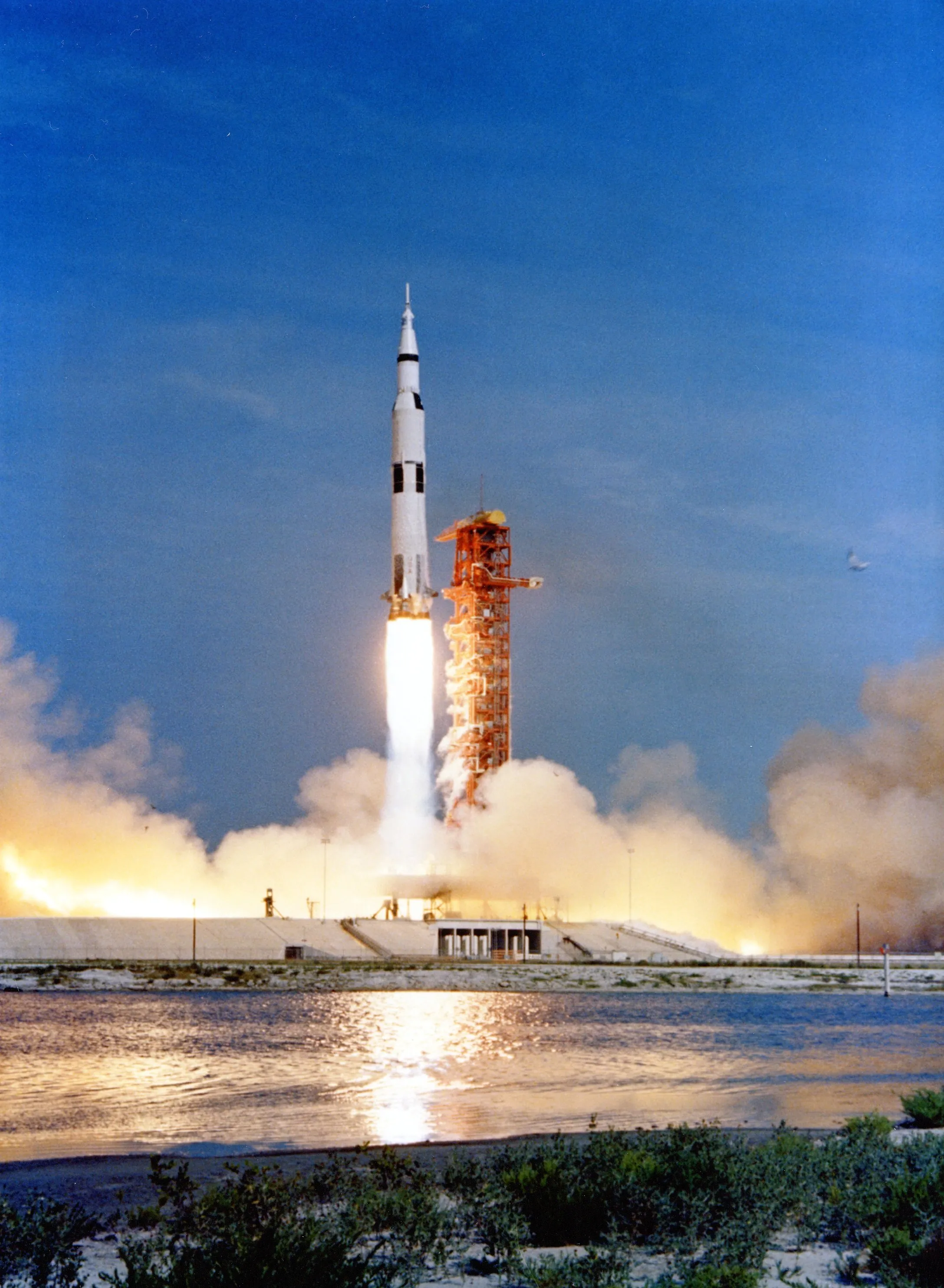
Trivia question: What major lunar event happened on December 14, 1972? On December 14, 1972, US astronaut Eugene Cernan stepped off the surface moon, climbed up the ladder back into the lunar module Challenger, closed the hatched, blasted off, returned to earth, and humans have never again set foot on the moon. That was 52 years ago.
Though humans haven’t gone back to the moon, we have been exploring outer space nonstop ever since. Nations and companies have spent massive amounts of money and energy in our exploration. Is it worth it? And what would God have to say? This week on the blog we’re going to look at what the Bible says about space exploration. Before we can examine what the Bible has to say about space exploration, we need to know, “What is space exploration?”
Even before that, we have to answer “What is space?” Where does space begin? 62 miles above the earth, a distance known as the Karman line, is the boundary between earth’s atmosphere and where space begins. Therefore, space exploration started in the middle of World War 2, when Nazi Germany launched a V-2 rocket October 3, 1942, the first man-made object to travel past the Karman line.
The foremost Nazi rocket scientist Wernher von Braun surrendered to American troops near the end of the war, and began helping the US military with rocket development. He would be instrumental in helping create the US space program. But it was not the Americans who would lead the way in the early years of space exploration.
On October 4, 1957, the Soviet Union launched the first satellite into orbit around the earth, Sputnik. It looked like an chrome silver over-sized beachball with four antennae. A month later, the Soviets sent the first living creature to space, a monkey.
This was the era of the Cold War, the epic battle between democracy and communism. It was the USA and our allies versus the Soviet Union and their allies. With Sputnik and the monkey, the Soviets had scored the first points in the contest to explore space. Not to be outdone, the USA launched our first satellite, Explorer 1, on January 31, 1958. Six months later, July 28, 1958, the National Aeronautics and Space Administration, known more familiarly by its acronym, NASA, was founded as the US government agency which would lead our nation’s space exploration efforts. With that the Space Race between the USA and the USSR was on!
Over the next few years, it seemed that the Soviet Union was beating the USA at every turn. First to launch a satellite. First human to orbit earth, April 12, 1961, Cosmonaut Yuri Gagarin. The US was chasing. A month later, on May 5, the first American in space was Alan Shephard. Shephard made it to space, but he didn’t orbit the earth, so we didn’t match the Soviet achievement. An American wouldn’t orbit earth until Feb 20, 1962, John Glenn.
Then on September 12, 1962, US President John F. Kennedy made his famous declaration, “We choose to go to the moon,” launching a national mandate to land humans on the moon and return them safely by 1970. But the Soviets were thinking the same thing, so the space race became a race to the moon.
Over the next three years, the Soviets continued to notch firsts. First woman in space in 1963, first multi-human space flight in 1964, and first space walk in 1965. The US would hit all those milestones in 1965, except for one, the first US woman in space. We wouldn’t send a woman to space until 20 years after the Soviets, Sally Ride, 1983. Back in 1966, the Soviets hit another major first, when they safely landed an unmanned spacecraft on the surface of the moon. As if coming in second place wasn’t bad enough, in 1967 NASA suffered a terrible loss when the rocket which later came to be known as Apollo 1 caught fire on the launchpad, killing three US astronauts.
Prior to the disaster of Apollo 1, the US space exploration program, though trailing the Soviets, was still making progress, including some firsts of its own. Multiple US Gemini missions were the first to perform orbital docking procedures. But after the Apollo 1 disaster, the effort to beat the Soviets to the moon was paused for 18 months. In September 1968, the USSR scored another major victory, sending an unmanned spaceship to orbit the moon and return safely to earth. With the US space program grounded, and with the Soviets making numerous advances to the moon, it seemed just a matter of time until a cosmonaut would be the first person to walk on the moon.
NASA, however, had been hard at work behind the scenes, testing, fixing, and launching unmanned Apollo rockets. In what is known as Moonshot, NASA made a gutsy push to beat the Soviets. On Oct 11, 1968, the first manned Apollo mission was successful. On December 24, 1968, NASA scored points in the space race, beaten the Soviets in sending the first manned Apollo mission to orbit the moon and return to earth successfully. Just as our American Moonshot was succeeding, the Soviet space program experienced struggles. In early July 1969 their unmanned moon rocket exploded just after launch.
After years of playing catch-up, NASA was suddenly ahead. On July 16, 1969 we struck the final blow, landing humans on the moon. The USA would go on to launch six more Apollo missions over the next few years, landing humans five more times on the moon. The exception was the famous Apollo 13 mission that had complications, never landing on the moon, but instead used the gravitational force of the moon to slingshot the impaired Apollo craft back to earth. During those years, the Soviet space program had no response.
By December 14, 1972, when US astronaut Cernan left the moon on Apollo 17, the USA had clearly defeated the Soviets in the space race. The race to the moon was over, but the space race was not. The USSR diverted its attention to space stations, building a variety of small stations for military reconnaissance and science. From the perspective of the USA, the Apollo moon missions were exceedingly expensive, and with no more race to the moon justifying that kind of expenditure (did it, in the first place?), the USA decided to race the Soviets in building space stations. In 1973 NASA launched the Apollo Saturn V rockets for the last time, sending pieces of a space station into orbit, where they were combined to make Skylab. The purpose of the Skylab station was to do science in space. It was larger than the USSR’s early space stations, lasted longer, and was occupied longer. Skylab went out of service in 1979.
With the retirement of the expensive and nonreusable Apollo Saturn V rockets, NASA envisioned a space transport system that would be reusable, hoping to explore space less expensively and more frequently.
We’ll learn about that space transport system in the next post.
Photo credit NASA.gov
 Engaging Scripture
2 thoughts on “Space Race, Moonshot and SkyLab – A Theology of Space Exploration, Part 1”